Economy
10 Economic Indicators Investors Should Watch Before the Next Fed Move
From inflation gauges to labor-market signals, the metrics shaping Fed policy and market expectations
Markets rarely move without warning. The signals are often visible in economic data — but only if investors know where to look.
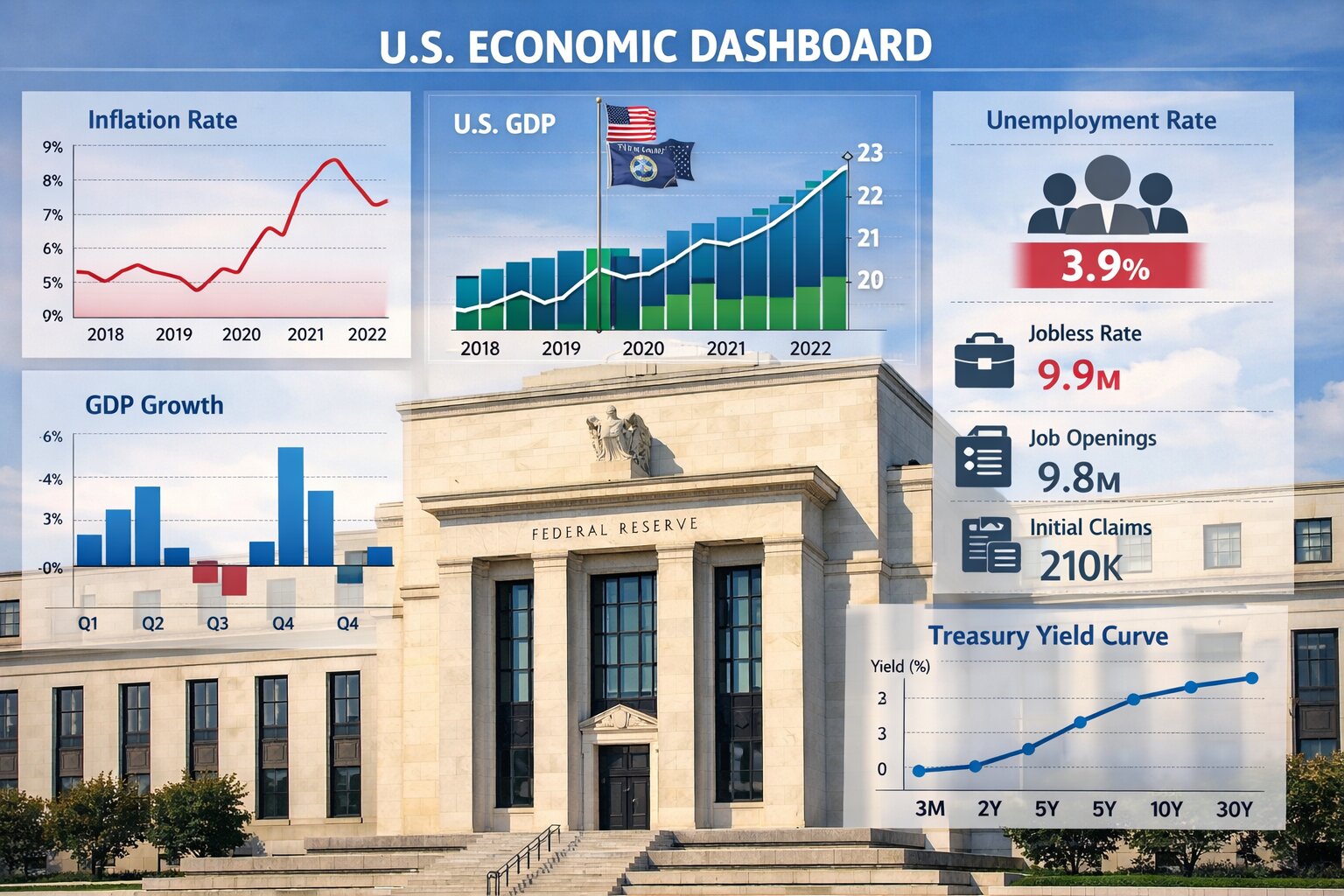
The latest macro snapshot illustrates the balance policymakers and markets are watching. Inflation remains close to the Federal Reserve’s target, with consumer prices rising 2.4% year over year in February 2026, while core inflation excluding food and energy was 2.5%. The labor market remains resilient, with the unemployment rate at 4.4% in February 2026. At the same time, growth has slowed: real GDP expanded at a 0.7% annualized pace in the fourth quarter of 2025, according to the second estimate released on 03/13/2026.
Meanwhile, financial markets are signaling cautious optimism. As of 03/12/2026, the Treasury yield curve was positively sloped, with the 10-year yield at 4.27% and the 2-year at 3.76%, suggesting investors expect moderate growth rather than an imminent recession.
Taken together, these data points illustrate why investors monitor a broad set of indicators. Some metrics reveal where the economy has been, others show where it is now, and a few hint at where it may be heading.
Below are the ten economic indicators that matter most for investors in 2026.
Student Loan Refinancing for doctors and dentists
---
The Four Core Signals Anchoring the 2026 Outlook
CPI: The Market’s Daily Inflation Compass
The Consumer Price Index (CPI) remains the most closely watched measure of inflation in financial markets.
For investors, CPI answers a simple but critical question: Are prices rising faster or slower than expected?
The February 2026 CPI report released on 03/11/2026 showed inflation stabilizing at 2.4% year over year, while core CPI rose 2.5%. That level sits only slightly above the Federal Reserve’s long-term inflation objective.
Markets react strongly to CPI surprises because inflation directly affects:
- Federal Reserve interest-rate policy
- Bond yields
- Equity valuations
- Currency strength
When inflation cools, markets often price in lower future interest rates, supporting equities and longer-duration bonds.
---
GDP: The Broadest Measure of Economic Growth
If CPI measures price pressure, Gross Domestic Product (GDP) measures overall economic activity.
GDP aggregates consumption, investment, government spending, and trade into a single number that reflects the pace of economic expansion or contraction.
The second estimate for Q4 2025 GDP released on 03/13/2026 showed real growth slowing to a 0.7% annualized rate. While still positive, the pace suggests the economy entered 2026 with limited momentum.
For investors, GDP growth influences:
- Corporate earnings expectations
- Equity market performance
- Credit risk in bond markets
- Global capital flows
Slow but positive growth typically supports equities while keeping recession fears contained.
---
Unemployment Rate: A Key Labor Market Signal
Labor market conditions are one of the most reliable indicators of economic health.
The unemployment rate stood at 4.4% in February 2026, according to the latest labor report released 03/07/2026. That level remains historically low despite slowing economic growth.
For markets, employment data influence:
- Consumer spending expectations
- Wage growth and inflation pressure
- Federal Reserve policy decisions
Because layoffs tend to rise late in economic downturns, unemployment is often considered a lagging indicator. Still, sudden increases can signal that economic conditions are deteriorating faster than expected.
---
Treasury Yield Curve: The Market’s Forward-Looking Signal
Among financial indicators, few receive as much attention as the Treasury yield curve.
The curve plots interest rates across different maturities. When short-term yields exceed long-term yields, the curve inverts — historically a warning sign for recession.
As of 03/12/2026, the curve had returned to a normal upward slope, with:
- 10-year Treasury yield: 4.27%
- 2-year Treasury yield: 3.76%
A positive curve typically reflects expectations of stable growth and moderate inflation.
Because it reflects investor expectations rather than backward-looking data, the yield curve is often considered a leading indicator.
---
Six Additional Indicators Investors Should Watch
Nonfarm Payrolls
The monthly payroll report measures the number of jobs added or lost across the economy.
Strong payroll growth supports consumer spending and corporate revenues. Weak job creation, by contrast, often signals slowing demand.
Equity markets often react sharply to payroll surprises because they shape expectations for both growth and monetary policy.
---
Core PCE Inflation
While markets watch CPI closely, the Federal Reserve prefers the Personal Consumption Expenditures (PCE) price index, particularly the core measure excluding food and energy.
Core PCE captures broader consumer spending patterns and tends to be less volatile. For investors, it offers insight into how policymakers are likely to interpret inflation trends.
---
Retail Sales
Retail sales measure consumer spending across goods categories, from automobiles to online purchases.
Because consumption accounts for roughly two-thirds of U.S. economic activity, retail sales provide a near-real-time look at economic momentum.
Strong retail spending supports corporate earnings and equity markets.
---
ISM Manufacturing and Services PMIs
The Purchasing Managers’ Index (PMI) surveys business leaders about new orders, production, and employment.
Readings above 50 indicate expansion, while levels below 50 signal contraction.
Because these surveys capture business sentiment and order activity, they are widely viewed as leading indicators of economic cycles.
---
Housing Market Activity
Housing indicators such as housing starts and existing home sales reveal the health of one of the economy’s most interest-rate-sensitive sectors.
Housing often slows early when borrowing costs rise and rebounds when financial conditions ease.
Because construction and real estate drive employment and spending across multiple industries, housing trends can signal broader economic shifts.
---
Consumer Confidence
Consumer sentiment surveys measure household expectations about income, employment, and the economy.
Confidence levels influence spending behavior. When consumers feel optimistic, they tend to spend more freely. When sentiment deteriorates, households often cut discretionary purchases.
For investors, declining confidence can be an early warning sign of slowing demand.
---
How Investors Combine These Indicators
No single statistic tells the entire economic story. Instead, investors analyze indicators together to understand four key questions.
Is inflation rising or falling?
CPI and core PCE provide the clearest answer.
Is economic growth accelerating or slowing?
GDP, retail sales, and PMI data help reveal the trajectory.
How strong is the labor market?
Payrolls and unemployment rates provide insight into income and spending power.
What does the bond market expect?
The yield curve summarizes expectations for growth, inflation, and monetary policy.
When these indicators align, market trends become clearer. When they conflict, volatility tends to increase.
---
What Investors Should Watch Next in 2026
The economic landscape in 2026 appears balanced but uncertain.
Inflation has cooled near target levels, yet economic growth has slowed noticeably. The labor market remains resilient, and the yield curve suggests markets expect expansion to continue.
For investors, the key question is whether the economy can maintain moderate growth without reigniting inflation.
Future CPI releases, labor reports, and PMI surveys will likely shape expectations for Federal Reserve policy — and, by extension, the direction of equities, bonds, and currencies.
In uncertain macro environments, the most effective strategy remains the same: watch the data, not the headlines.
Student Loan Refinancing for doctors and dentists
---
FAQ
Which economic indicator matters most for investors?
There is no single most important indicator. Inflation metrics such as CPI and growth measures such as GDP are central, but investors typically analyze multiple indicators together.
What does the yield curve tell investors?
The yield curve reflects market expectations for future growth and interest rates. An inverted curve has historically preceded recessions, while a normal upward slope suggests expansion.
Why does the Federal Reserve prefer PCE inflation over CPI?
Core PCE reflects a broader range of consumer expenditures and adjusts for changes in consumer behavior, making it a preferred gauge for monetary policy.
Are unemployment numbers a leading indicator?
Not usually. The unemployment rate is typically considered a lagging indicator because job losses often occur after economic conditions have already weakened.
---
Sources and Further Reading
- Consumer Price Index News Release — U.S. Bureau of Labor Statistics — 03/11/2026 — https://www.bls.gov/news.release/archives/cpi_03112026.htm
- Employment Situation Summary — U.S. Bureau of Labor Statistics — 03/07/2026 — https://www.bls.gov/news.release/empsit_03072026.htm
- Gross Domestic Product, Second Estimate Q4 2025 — Bureau of Economic Analysis — 03/13/2026 — https://www.bea.gov/news/2026/gross-domestic-product-fourth-quarter-2025-second-estimate
- Daily Treasury Yield Curve Rates — U.S. Department of the Treasury — 03/12/2026 — https://home.treasury.gov/resource-center/data-chart-center/interest-rates
- ISM Manufacturing Report on Business — Institute for Supply Management — 03/03/2026 — https://www.ismworld.org
- Consumer Confidence Index — The Conference Board — 02/25/2026 — https://www.conference-board.org
- Existing Home Sales Report — National Association of Realtors — 01/24/2026 — https://www.nar.realtor
- Retail Sales Advance Report — U.S. Census Bureau — 02/14/2026 — https://www.census.gov/retail
---
Editorial Note: This content is strictly educational and does not constitute investment advice.
---