Business
How AI Productivity Is Changing Business Strategy Faster Than Expected
From pilots to workflows — the real story of generative AI at work and its implications
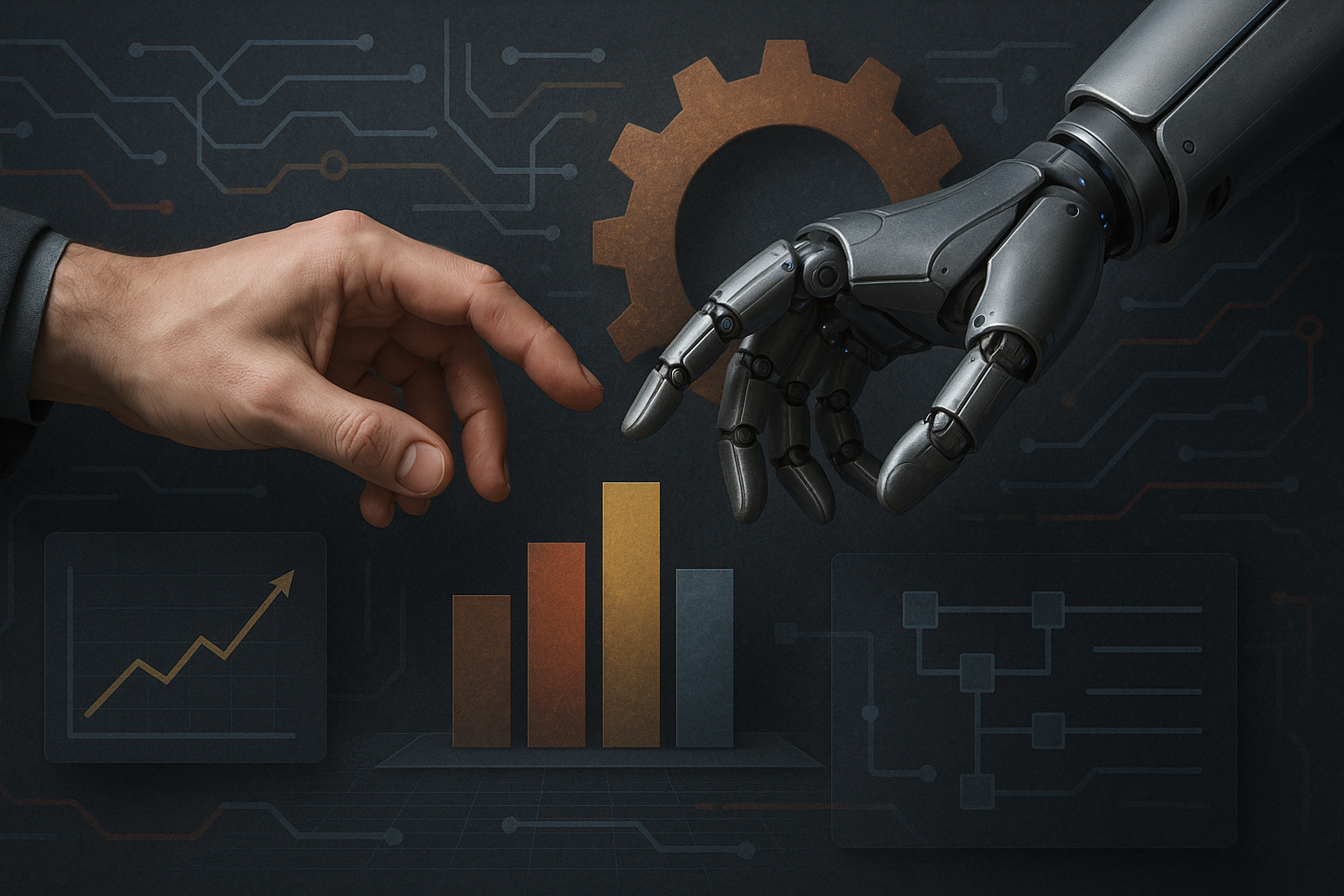
The generative AI (GenAI) wave promises to redefine how knowledge work gets done. Yet beyond the familiar hype — “AI will supercharge productivity” — lies a more nuanced reality. Many U.S. companies are experimenting, few are scaling, and the road to measurable gains is lined with organizational friction, data challenges, and cultural inertia.
This article offers a grounded productivity playbook: how firms are deploying GenAI today, where real productivity is emerging (and where it isn’t), and what the implications are for jobs, skills, and corporate performance in the decade ahead.
---
produto:The Art of X: Build a Business That Makes You $100/Day
The State of GenAI Adoption in U.S. Firms
- ### Broad Usage vs. Deep Deployment
As of late 2024, 95% of U.S. companies report using generative AI in some capacity, according to Bain. The number of production use cases has roughly doubled year over year. But widespread experimentation does not mean deep integration — many of these “uses” remain ad hoc or exploratory.
A February 2024 working paper by Kathryn Bonney and colleagues found that only 5.4% of firms had implemented company-wide GenAI adoption at that time. The gulf between “using” and “adopted” suggests most organizations remain stuck in pilot mode or informal experimentation.
- ### Investment Trajectories and Use-Case Expansion
U.S. private AI investment reached $109.1 billion in 2024, with generative AI commanding a significant share of the capital flow. Bain’s data shows that the number of GenAI use cases in production is doubling annually, particularly within IT functions. Moreover, roughly 60% of AI-related investment is now coming from standard departmental budgets rather than isolated innovation funds — a sign of early normalization.
---
How Companies Are Embedding GenAI for Productivity Gains
- ### Frontline and Individual Use Cases
One of the clearest productivity wins comes from customer support. In a large-scale study of 5,172 agents by Erik Brynjolfsson, Danielle Li, and Lindsey Raymond, access to a conversational AI assistant increased issues resolved per hour by 15% on average. The uplift was strongest among newer or less experienced agents, who benefited from real-time suggestions and contextual retrieval.
In software engineering, GenAI is becoming an embedded co-pilot. By December 2024, roughly 30% of Python functions written by U.S. developers were AI-assisted — a sharp increase from prior baselines. Researchers estimate this translates into an annual $9.6–14.4 billion in incremental productivity for the software sector. Their analysis further suggests that increasing AI-assisted coding from 0% to 30% correlates with a 2.4% rise in quarterly output.
Across these examples, GenAI consistently amplifies human throughput in knowledge-intensive, repetitive, or context-rich tasks — not by replacing workers, but by compressing the time between intent and execution.
- ### From Pilot to Production: The Scaling Gap
Despite enthusiasm, most firms remain trapped in pilot purgatory. The GenAI Divide report finds that while over 80% of organizations are exploring or piloting GenAI, only about 5% of custom enterprise tools reach production scale and demonstrate sustained P&L impact. Projects often stall due to technical brittleness, misaligned workflows, or governance bottlenecks.
Some firms, however, are breaking through. Goldman Sachs recently deployed a firmwide generative AI assistant to roughly 10,000 employees, supporting document summarization, data analysis, and content drafting. Moves like this suggest rising confidence in enterprise-scale AI assistants — but they remain exceptions.
The toughest challenges persist: integrating GenAI into legacy systems, maintaining context memory, ensuring data security, and aligning leadership around coherent use cases.
---
Productivity Gains vs. The Productivity Paradox
- ### Short-Term Drag, Long-Term Lift
Economists have long noted that technological revolutions often bring an initial productivity dip before the payoff. New AI deployments can cause short-run disruption as firms retrain staff, refine data pipelines, and realign workflows. This “productivity paradox” underscores that transformation involves friction before acceleration.
- ### Surveys vs. Measurable Returns
Executive optimism often outpaces empirical results. A 2024 Harvard Business Review report found that 95% of organizations had yet to see measurable ROI from their GenAI initiatives. Many firms have adopted tools but lack the metrics, scale, or process redesign to realize bottom-line impact.
Employee sentiment tells a more complex story. In a May 2025 Perficient survey, 76% of workers said GenAI improved their productivity in quality or quantity, yet 42% reported no formal communication from management about AI policy, and fewer than 35% received role-specific training. The result is a patchwork of enthusiasm and uncertainty — innovation from below without strategic coordination from above.
---
Economic and Labor-Market Implications
- ### Macro Productivity Outlook
Forecast models are cautiously optimistic. The Penn Wharton Budget Model (September 2025) projects that GenAI could boost U.S. GDP by 1.5% by 2035, 3% by 2055, and 3.7% by 2075. The model expects a peak annual growth bump of roughly 0.2 percentage points in the early 2030s before stabilizing at a modest but persistent uplift.
Still, the analysts warn that these figures rely on limited early data and assume broad diffusion of AI tools into genuine production workflows — a process that has historically taken decades for general-purpose technologies.
- ### Skills, Jobs, and Disruption
In the labor market, GenAI is shifting skill demand rather than triggering mass displacement. A 2025 working paper by Gulati and co-authors found that GenAI-related job postings show 36.7% higher cognitive-skill requirements and a 5.2% increase in social-skill emphasis post–ChatGPT. Firms increasingly value employees who can guide, audit, and contextualize AI outputs.
So far, fears of sudden job loss have not materialized. A 2025 Yale–Brookings study found no statistically significant evidence of large-scale AI-driven displacement since 2022. The researchers concluded that job churn remains consistent with historical patterns of automation and technological adjustment.
Still, longer-term risks remain: standardized or lower-wage work may be more exposed, and inequality could widen without strong reskilling policies.
---
What Separates the Winners in the GenAI Productivity Race
- ### Crossing the GenAI Divide
Top-performing firms tend to follow a consistent playbook, according to the GenAI Divide analysis:
- Start with narrow, high-value processes, not grand transformation promises.
- Focus on deep workflow integration, not superficial chatbot interfaces.
- Build learning-capable systems that retain context and improve through feedback.
- Prioritize domain fluency — tuning models to the organization’s language and data.
- Invest in feedback loops, human oversight, and continuous iteration.
These principles help organizations move from experimentation to enduring productivity impact.
- ### Organizational Enablers and Culture
McKinsey’s 2025 survey revealed a counterintuitive insight: employees are more ready to adopt AI than many leaders assume. Much of the experimentation already happens informally — “shadow AI” — without executive sponsorship. Leadership must therefore catch up, setting clear vision, communication, and guardrails.
The most successful companies share key enablers: robust data infrastructure, mature governance frameworks, visible executive champions, and ongoing training and change management. Without these, GenAI remains a novelty rather than a productivity engine.
---
produto:The Art of X: Build a Business That Makes You $100/Day
Conclusion and Forward Look
Generative AI is steadily moving from novelty to necessity. But the transition from pilot project to systemic productivity uplift remains slow and uneven. As of late 2025, only a minority of U.S. firms are realizing measurable financial impact.
Still, the evidence is encouraging. Real gains in customer support, coding, document workflows, and financial analysis point to tangible progress. Macro models projecting 1–3% long-term GDP gains provide a reason for cautious optimism.
Over the next two to five years, key watchpoints include:
- Which firms successfully cross the GenAI Divide
- The emergence of autonomous, memory-based AI agents
- Shifts in skill requirements, compensation, and organizational design
- The balance between productivity gains and social risks — inequality, displacement, and reskilling
- Hard data confirming real, not just perceived, productivity improvement
At AlphaPulse, we’ll continue to track how GenAI evolves from promising experiment to genuine productivity engine — and what that means for companies, workers, and the broader U.S. economy.
---
FAQ
Q: How many U.S. companies are truly using generative AI at scale?
A: Surveys like Bain’s (late 2024) show roughly 95% of firms experimenting with GenAI, but only about 5% have fully integrated, enterprise-scale systems.
Q: What magnitude of productivity uplift is supported by evidence?
A: In customer support, AI assistants raised throughput by around 15%. In coding, partial AI assistance has been linked to billions in added value. Macro forecasts suggest up to 1.5% cumulative GDP lift by 2035.
Q: Will GenAI cause mass job losses?
A: So far, no. The Yale–Brookings 2025 study found no significant displacement since 2022. Instead, demand is shifting toward cognitive and social skills.
Q: What distinguishes companies that turn GenAI into real productivity gains?
A: Winners embed AI deeply into workflows, start with specific use cases, align tools with domain expertise, and invest heavily in governance, training, and leadership support.
---
Sources and Further Reading
- Bain & Company. Generative AI in U.S. Enterprises (2024).
- Bonney, K. et al. Working Paper on GenAI Adoption (Feb 2024).
- Brynjolfsson, E., Li, D., & Raymond, L. Generative AI at Work: Evidence from Customer Support (2023).
- Penn Wharton Budget Model. Macroeconomic Implications of Generative AI (Sept 2025).
- Gulati, A. et al. Labor Market Effects of Generative AI Skills (2025).
- Yale–Brookings. AI and Labor Market Transitions (2025).
- McKinsey & Company. State of AI 2025: Adoption and Organizational Readiness.
- Perficient. Employee Perceptions of Generative AI (May 2025).
- Harvard Business Review. Why Generative AI ROI Is Hard to Measure (2024).
- The GenAI Divide Report (2025).
- Goldman Sachs. Internal AI Assistant Deployment Announcement (2025).
---