Business
AI Is Reshaping the Global Economy: Which Industries Will Win?
From semiconductors to healthcare, artificial intelligence is triggering a new industrial cycle—and redefining where economic value will concentrate.
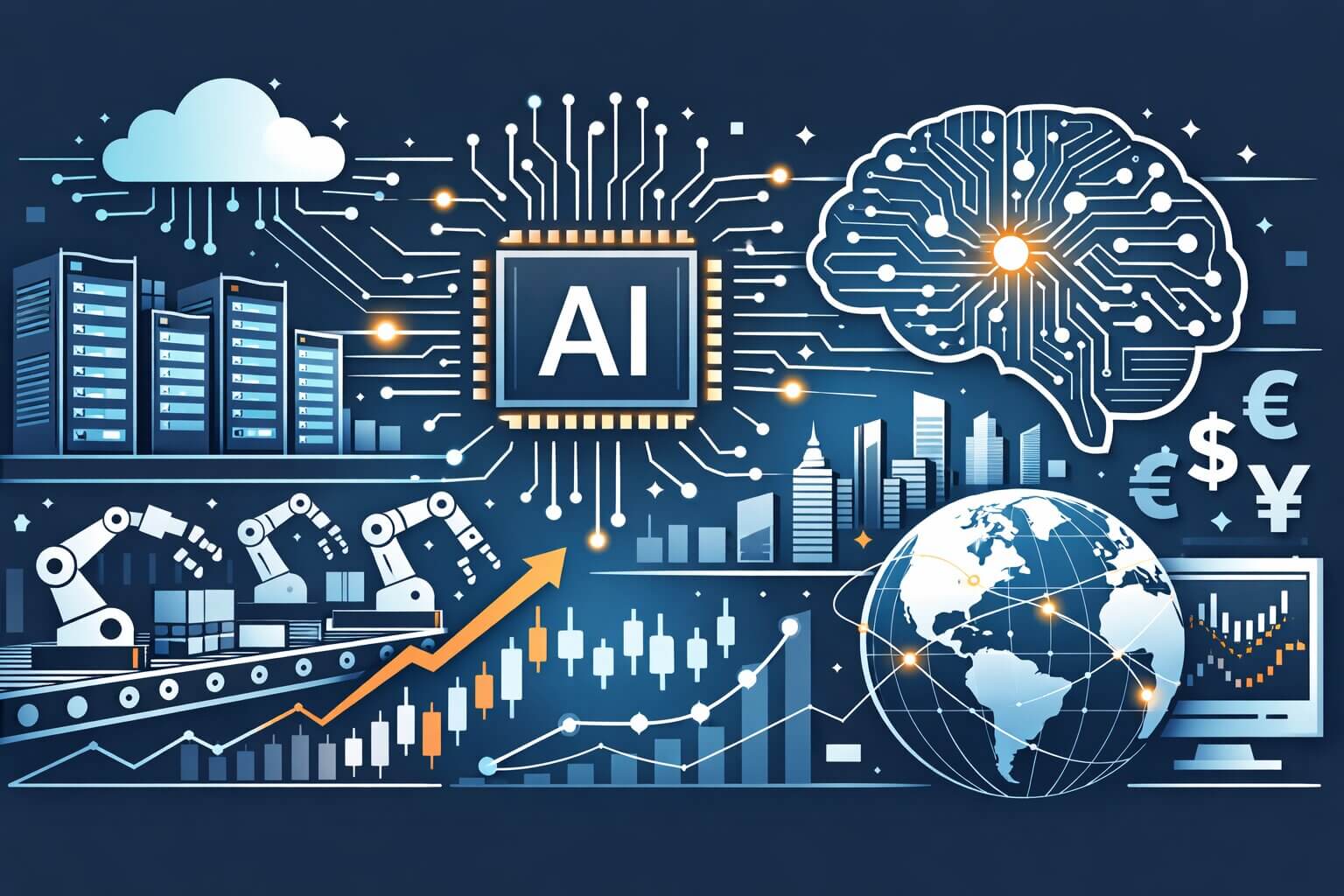
Artificial intelligence is no longer a speculative technology. By early 2026, it has become a structural driver of the global economy, reshaping productivity, capital investment, and competitive dynamics across industries.
A wave of spending on AI chips, cloud infrastructure, and data centers—led by companies such as Nvidia, Microsoft, Alphabet, and OpenAI—has triggered what many economists now describe as the beginning of a new technological capital cycle.
For investors, the key question is increasingly clear: Which industries will capture the economic value created by AI—and which will face disruption?
---
The AI Infrastructure Boom
Data Centers, Chips, and the New Capital Cycle
The foundation of the AI economy is infrastructure.
In 2025 and early 2026, global technology companies accelerated spending on high-performance computing, advanced GPUs, and hyperscale data centers designed specifically for AI workloads.
Nvidia’s data center business—driven largely by demand for AI chips—has emerged as one of the fastest-growing segments in the technology sector. Meanwhile, Microsoft, Alphabet, and Amazon are investing billions of dollars in cloud infrastructure to support AI models and enterprise deployments.
This surge in capital expenditure resembles earlier industrial technology cycles. Just as railroads powered the 19th-century economy and the internet reshaped commerce in the 1990s, AI infrastructure is becoming a foundational layer of modern economic activity.
The implications extend far beyond Silicon Valley.
---
The Industries Poised to Benefit the Most
Semiconductors and AI Hardware
Semiconductors sit at the center of the AI boom.
Advanced GPUs, specialized AI accelerators, and high-bandwidth memory are essential for training and running large language models. Demand for these chips has surged as companies race to deploy AI systems at scale.
Nvidia has become the dominant supplier of AI training chips, while competitors such as AMD and Intel are expanding their AI hardware offerings. The result is a new semiconductor investment cycle focused not just on consumer electronics but on AI computing capacity.
For investors, this suggests that AI hardware remains one of the most direct beneficiaries of the technology wave.
---
Cloud Computing and Hyperscalers
AI’s rapid expansion is also transforming cloud computing.
Training and deploying advanced AI models requires enormous computational power, which is typically delivered through cloud platforms. As a result, hyperscale providers such as Microsoft Azure, Google Cloud, and Amazon Web Services are positioning themselves as the infrastructure backbone of the AI economy.
Cloud platforms are increasingly integrating AI tools directly into enterprise software—turning AI capabilities into subscription-based services.
The model is powerful: rather than companies building their own AI infrastructure, they can access it through cloud providers, creating a recurring revenue stream for hyperscalers.
---
Finance and Algorithmic Productivity
Financial institutions are rapidly adopting AI to improve productivity and decision-making.
Applications include:
- Algorithmic trading models
- Fraud detection
- Risk analysis
- Regulatory compliance
- Automated research and reporting
Large banks and asset managers are also experimenting with AI assistants that can summarize financial data, generate reports, and analyze market trends.
While AI will not replace human decision-makers in finance, it is likely to significantly increase the efficiency of knowledge work across the industry.
---
Healthcare and Drug Discovery
Healthcare may become one of the most transformative use cases for artificial intelligence.
AI systems are increasingly used to analyze medical images, detect diseases earlier, and accelerate pharmaceutical research. In drug discovery, machine learning models can analyze massive datasets of molecular interactions—dramatically shortening research timelines.
For pharmaceutical companies, this could reduce the cost and duration of developing new drugs. For healthcare providers, AI-assisted diagnostics may improve accuracy and patient outcomes.
As a result, AI adoption in healthcare could become one of the most economically significant technology trends of the decade.
---
Logistics and Manufacturing Automation
AI is also reshaping physical industries.
Manufacturing companies are integrating AI systems into robotics, predictive maintenance, and production planning. Smart factories can analyze sensor data in real time to optimize operations and reduce downtime.
In logistics, AI algorithms are improving route optimization, warehouse automation, and supply chain forecasting.
These technologies allow companies to operate with greater efficiency while reducing operational costs—an advantage that could reshape global supply chains over the coming decade.
---
Sectors Facing Disruption
The Automation of Knowledge Work
If AI creates winners, it will also create disruption.
Generative AI models are capable of performing many routine cognitive tasks that were previously handled by white-collar workers. These include drafting reports, summarizing documents, coding basic software functions, and conducting research.
Industries that rely heavily on routine information processing—such as customer service, marketing operations, and administrative roles—may face significant automation pressure.
This does not necessarily mean widespread job elimination. Instead, the structure of work may change as AI handles repetitive tasks while humans focus on strategic and creative functions.
---
The Productivity Shock to Services
Professional services—including legal, consulting, and media industries—may also experience productivity shocks.
AI tools can dramatically accelerate tasks such as document analysis, contract review, and data synthesis. For firms, this could lower operating costs and improve margins. But it may also reduce the demand for certain junior-level roles that traditionally handled these tasks.
The result could be a reshaping of career paths in knowledge-intensive industries.
---
The Labor Market Transformation
Jobs at Risk
Multiple economic studies suggest that a significant portion of global jobs could be affected by AI automation in the coming decade.
Routine administrative roles, entry-level analytical positions, and certain customer support jobs appear particularly exposed.
However, historical technological transitions suggest that while automation eliminates some tasks, it also creates new categories of work.
---
The Rise of AI-Augmented Workers
At the same time, demand for highly skilled technical workers is rising rapidly.
Companies are competing for:
- AI engineers
- machine learning specialists
- data scientists
- AI infrastructure architects
Rather than replacing workers entirely, many companies are adopting a model of AI-augmented employees—where workers use AI tools to enhance productivity and decision-making.
This shift may ultimately increase output per worker while transforming how knowledge work is performed.
---
What Investors Should Watch
As artificial intelligence moves from experimentation to economic infrastructure, investors should focus on several key indicators:
- Capital spending on AI infrastructure
- Adoption of AI tools by enterprises
- Semiconductor demand tied to AI workloads
- Productivity gains across industries
If AI follows the trajectory of past transformative technologies, economic value will concentrate around the companies that control the infrastructure, platforms, and data powering the ecosystem.
In that sense, the current AI boom may represent not just a technological shift—but the early stages of a new economic architecture.
For markets and investors alike, the race to define that architecture is only beginning.
---
FAQ
Which industries benefit most from artificial intelligence?
Semiconductors, cloud computing, healthcare, finance, logistics, and manufacturing are among the sectors expected to benefit the most from AI adoption.
Will AI replace white-collar jobs?
AI is likely to automate certain routine knowledge tasks, but it will also create new technical roles and increase productivity for many professionals.
Why are tech companies investing so heavily in AI infrastructure?
Training and deploying advanced AI models requires enormous computing power, leading to large investments in chips, data centers, and cloud platforms.
How should investors evaluate AI opportunities?
Investors should watch companies involved in AI infrastructure, cloud computing, semiconductors, and enterprise software that integrates AI capabilities.
---
Sources and Further Reading
- Generative AI Could Add $2.6T–$4.4T Annually to Global Economy — McKinsey Global Institute — 06/14/2023 — https://www.mckinsey.com/mgi
- Nvidia Data Center Revenue Surges Amid AI Demand — Reuters — 02/21/2024 — https://www.reuters.com
- Big Tech’s AI Spending Race Intensifies — Bloomberg — 11/2025 — https://www.bloomberg.com
- The Economic Potential of Generative AI — Goldman Sachs Global Investment Research — 03/26/2023 — https://www.goldmansachs.com
- The Future of Jobs Report 2025 — World Economic Forum — 01/2025 — https://www.weforum.org
- AI Infrastructure Boom Reshaping Data Centers — Financial Times — 02/2026 — https://www.ft.com
- Artificial Intelligence in Healthcare Market Outlook — Deloitte Insights — 2025 — https://www2.deloitte.com
- AI and Productivity Growth — Brookings Institution — 2024 — https://www.brookings.edu
---
Editorial Note: This content is strictly educational and does not constitute investment advice.
---