Crypto
Bitcoin ETFs Explained: Fees, Flows, and U.S. Tax Treatment
A deep dive into costs, capital movements, and tax rules facing U.S. investors in Bitcoin ETFs
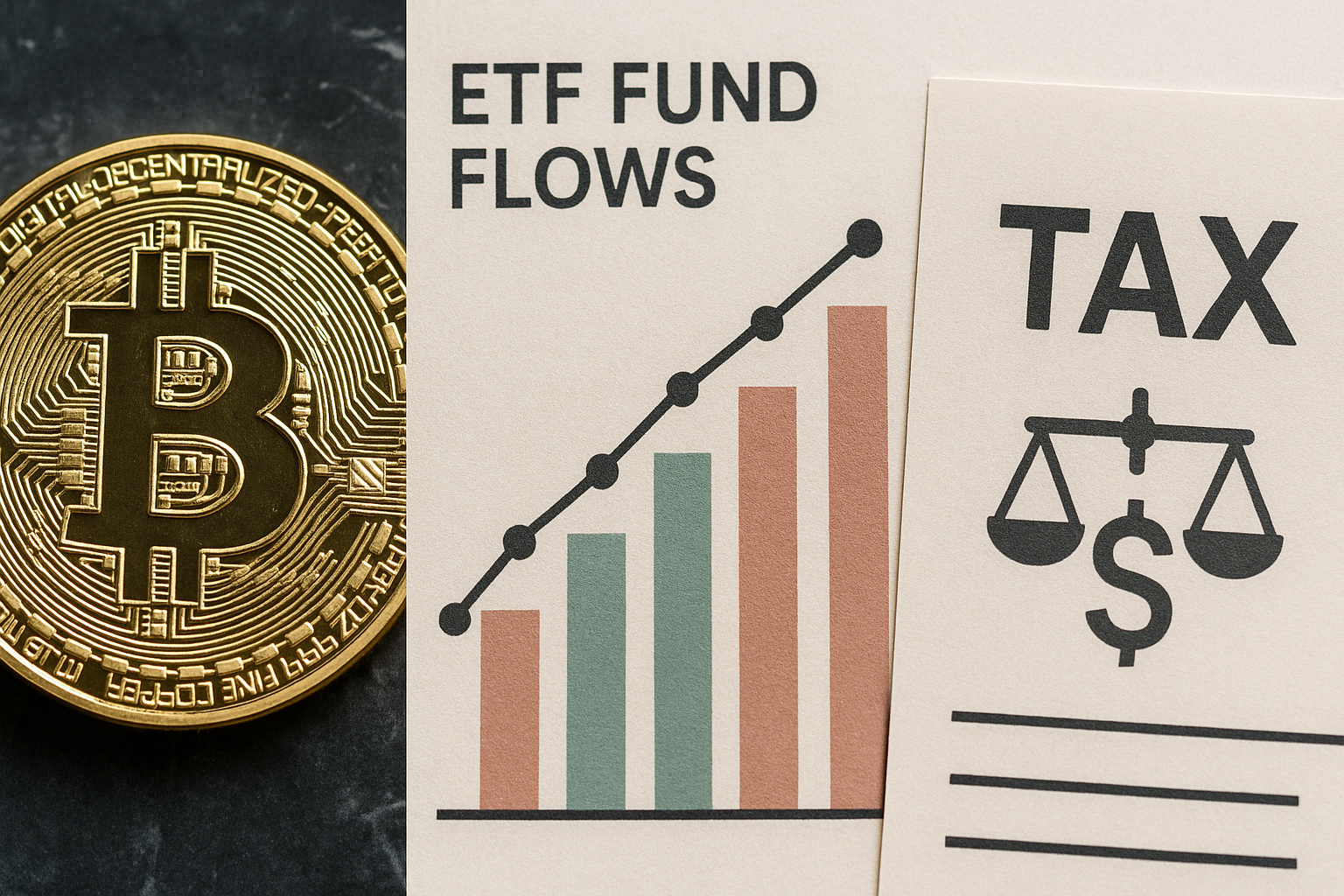
The approval of spot Bitcoin ETFs in the United States in January 2024 marked a watershed in the institutionalization of crypto. For the first time, investors could gain direct Bitcoin exposure through a regulated vehicle—without the hassles of digital wallets or self-custody.
But as of 10/07/2025, the key questions have shifted: what are investors actually paying, where is the capital flowing, and how does the IRS treat those gains?
This article examines the structure, fees, capital flows, and tax implications of Bitcoin ETFs—through both retail and institutional lenses.
---
produto:The Art of X: Build a Business That Makes You $100/Day
How Bitcoin ETFs Work: Structure and Types
- ### Spot Bitcoin ETFs (Grantor-Trust Model)
Most U.S. spot Bitcoin ETFs operate under a grantor trust structure. The trust directly holds Bitcoin in custody, and each share represents a proportional ownership interest. The trust itself pays no corporate tax; instead, income and expenses pass through to shareholders.
When a fund sells or redeems Bitcoin to cover management fees, investors may incur a taxable event, even if they haven’t sold any shares—because the trust’s activities flow through to holders.
- ### Futures or Derivatives-Based Bitcoin ETFs
Futures-based Bitcoin ETFs—such as those investing in CME Bitcoin futures—don’t own Bitcoin itself. Instead, they derive performance from derivative contracts. These vehicles fall under Section 1256 of the tax code, which treats 60% of gains as long-term and 40% as short-term, regardless of the actual holding period. A mark-to-market rule applies at year-end, taxing unrealized gains annually.
That means even a one-day position in a futures-based ETF triggers blended long- and short-term tax treatment.
- ### Creation and Redemption: Cash-Only vs. In-Kind
Initially, most crypto ETFs were limited to cash-only creation and redemption. Authorized participants (APs) had to deliver or receive U.S. dollars, while the trust itself executed Bitcoin trades—introducing slippage and added costs.
That changed on 07/29/2025, when the SEC approved in-kind creation and redemption for crypto exchange-traded products (ETPs). Now, APs can exchange Bitcoin directly for ETF shares and vice versa, reducing trading friction and potential tax drag.
Not all funds have transitioned to this structure yet; additional exchange-level or operational approvals may still be required.
---
Fees and Cost Layers
- ### Expense Ratios
Leading spot Bitcoin ETFs, such as BlackRock’s IBIT, have introduced competitive expense ratios compared with older crypto trusts. Early entrants in the space charged as much as 1.5% annually—a cost that prompted significant investor migration toward lower-fee funds.
These fees are deducted from assets before net asset value (NAV) calculation, directly reducing returns.
- ### Hidden Costs: Slippage, Spreads, and Market Impact
Beyond headline expense ratios, several less visible costs affect investors:
- Bid-ask spreads when trading ETF shares
- Premiums or discounts relative to NAV
- Execution slippage during large inflows or redemptions
- Custody and security costs at the Bitcoin storage level
Cash-only redemption structures magnify these costs, since the fund must transact Bitcoin in the open market. In-kind redemptions mitigate that impact by enabling direct Bitcoin transfers between APs and the trust.
- ### ETF vs. Direct Bitcoin Custody
For long-term holders or active traders, self-custodying Bitcoin can avoid ETF management fees—but introduces security risks, operational burdens, and tax-reporting complexity. ETFs package these functions within a regulated framework, offering ease and compliance at a cost.
Because Bitcoin ETFs structured as trusts are pass-through vehicles, investors typically avoid annual taxation unless the fund itself sells Bitcoin to cover expenses—potentially reducing tax drag relative to mutual-fund structures.
---
Flows and Market Impact
- ### Assets Under Management and Inflows
By 07/15/2025, global Bitcoin ETF assets under management had surpassed $179.5 billion, led by U.S.-listed funds. Since their January 2024 debut, U.S. spot Bitcoin ETFs have accumulated roughly $46.9 billion in cumulative net inflows.
- ### Recent Momentum
On a single trading day in mid-2025, Bitcoin ETFs drew $332.7 million in new capital—$132.7 million into Fidelity’s FBTC and $72.8 million into BlackRock’s IBIT. Between 09/08 and 09/12/2025, spot Bitcoin ETFs attracted $2.32 billion, marking one of the strongest weekly flows on record.
Such inflows amplify Bitcoin’s price dynamics: rising prices attract more flows, which further lift prices—a feedback loop increasingly driven by institutional sentiment and macroeconomic conditions.
- ### Institutional vs. Retail Dynamics
Institutions favor ETFs for compliance, custody simplicity, and audited reporting. Retail investors appreciate convenient exposure without needing crypto infrastructure. Collectively, these flows have tethered Bitcoin more closely to traditional financial markets, increasing its correlation with equities and broader risk assets.
---
U.S. Tax Treatment for Investors
- ### Spot Bitcoin ETF Shares
When you sell a spot Bitcoin ETF share, your gain or loss is treated like a stock sale:
- Short-term (one year or less): taxed at ordinary income rates (10%–37%)
- Long-term (more than one year): taxed at 0%, 15%, or 20%, depending on income
Investors receive Form 1099-B and report gains using Form 8949 and Schedule D. Because Bitcoin ETFs rarely pay dividends or interest, they typically do not generate annual taxable distributions.
Futures-Based Bitcoin ETFs
Futures-based ETFs are governed by Section 1256:
- 60% of gains taxed at long-term rates
- 40% at short-term rates
- Mark-to-market at year-end means unrealized gains are taxable annually
Investors may owe taxes on gains not yet realized in cash—a crucial planning consideration.
- ### IRS 2025 Reporting Changes and Wash-Sale Rules
Beginning 01/01/2025, brokers must issue Form 1099-DA for digital asset transactions, reporting gross proceeds. Cost-basis reporting is postponed until 2026.
For crypto ETFs—classified as securities—wash-sale rules apply. Selling at a loss and repurchasing within 30 days can disallow the loss. Direct Bitcoin holdings, treated as property, remain exempt for now.
Additionally, if an ETF redeems Bitcoin to cover expenses, that transaction may trigger a taxable event, requiring cost-basis adjustments even if you didn’t sell your shares.
- ### Practical Reporting Steps
- Receive Form 1099-B from your brokerage
- Separate spot-ETF vs. futures-ETF activity
- Report spot-ETF gains/losses on Form 8949 + Schedule D
- Report futures-ETF gains on Form 6781 (Part I)
- Settle tax obligations with your annual return
Given the complexity—especially around redemptions and wash sales—many investors consult crypto-savvy tax professionals.
---
produto:The Art of X: Build a Business That Makes You $100/Day
Key Investor Risks
- Tax surprises from internal redemptions or annual mark-to-market
- Wash-sale disallowances for ETF losses repurchased within 30 days
- Liquidity and volatility due to large institutional flows
- Regulatory uncertainty in SEC and IRS treatment of crypto assets
- Correlation risk as Bitcoin’s behavior aligns with broader financial markets
- Direct vs. ETF exposure tradeoff: cost efficiency vs. custody burden
---
What to Watch Next
- Adoption pace of in-kind creation/redemption among major issuers
- Flow trends from pensions, endowments, and corporates
- Potential Congressional or IRS reforms to digital-asset taxation
- Expansion into altcoin or multi-asset ETF strategies
- The evolving relationship between ETF flows, interest rates, and equity markets
---
Conclusion
Bitcoin ETFs have become a critical bridge between traditional finance and digital assets—offering regulated access, operational simplicity, and tax efficiency. Yet investors must weigh those advantages against management fees, taxable internal events, and evolving IRS rules.
For long-term, tax-aware investors, the choice between ETFs and direct holdings depends on comfort with custody, compliance, and cost. As of 2025, Bitcoin ETFs stand as the cornerstone of crypto’s institutional adoption—reflecting both its progress and its compromises.
---
FAQ
Q: Are gains from spot Bitcoin ETFs taxed differently than direct Bitcoin?
A: No. Gains are treated as capital gains—short- or long-term—just like direct Bitcoin holdings. ETFs may simplify reporting but can trigger internal taxable events.
Q: Why are futures-based Bitcoin ETFs taxed with a 60/40 split?
A: Under Section 1256, 60% of gains are taxed as long-term and 40% as short-term, regardless of holding period, with annual mark-to-market treatment.
Q: What does the SEC’s July 2025 approval of in-kind redemptions mean?
A: Authorized participants can now exchange Bitcoin directly for ETF shares, reducing trading friction and tax drag, though adoption varies by fund.
Q: Do wash-sale rules apply to crypto ETFs?
A: Yes. Because ETFs are securities, losses may be disallowed if shares are repurchased within 30 days. Direct Bitcoin holdings remain exempt.
---
Sources and Further Reading
- SEC Press Release, “Approval of In-Kind Creation/Redemption for Crypto ETPs,” 07/29/2025
- IRS Publication 550, “Investment Income and Expenses”
- IRS Draft Instructions for Form 1099-DA (2025)
- CME Group, “Bitcoin Futures Contract Specifications”
- ETF issuer filings and fact sheets (BlackRock, Fidelity, Ark 21Shares, Grayscale)
- Bloomberg Intelligence and CoinShares data on Bitcoin ETF flows (2024–2025)
---