Markets
How the Bond Market Controls the Global Economy
Why U.S. Treasury yields remain the world’s most powerful financial signal in 2026
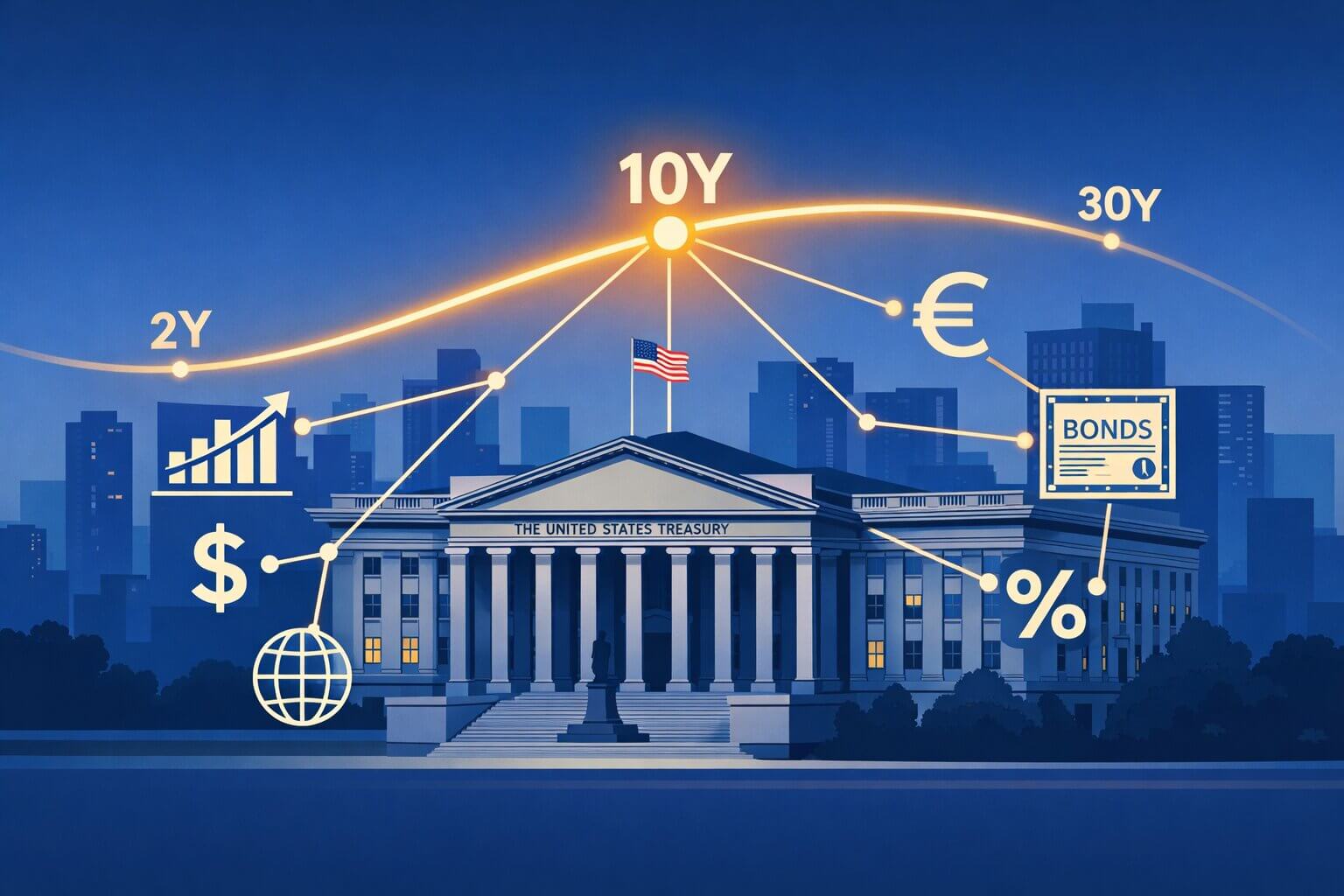
In global finance, few numbers carry as much influence as the yield on U.S. Treasury bonds.
From mortgage rates in America to corporate borrowing in Europe and currency movements in emerging markets, the U.S. Treasury yield curve acts as the central pricing mechanism for the global financial system. When yields move, they ripple across virtually every asset class.
That dynamic has become especially visible in early 2026. With investors reassessing inflation risks, mounting fiscal deficits, and the outlook for economic growth, Treasury yields have returned to the center of market attention. The bond market is not just reflecting economic expectations—it is actively shaping them.
Understanding why requires examining how Treasuries function as the foundation of global finance.
---
Student Loan Refinancing for doctors and dentists
---
Why the Bond Market Still Rules Global Finance
The U.S. Treasury market is the largest and most liquid government bond market in the world. As of February 2026, outstanding U.S. Treasury securities totaled roughly 30.6 trillion dollars, with daily trading volumes approaching $1.2 trillion.
Treasuries occupy a unique role in financial markets: they are widely treated as the global risk-free benchmark. Governments, banks, pension funds, hedge funds, and central banks all use Treasury yields as the baseline against which other assets are priced.
In practice, that means almost every financial asset carries a yield expressed as a spread over Treasuries.
A corporate bond might yield the 10-year Treasury plus 150 basis points. A mortgage rate might be priced at a spread above intermediate-term Treasury securities. Even equity valuations often reference Treasury yields through discounted cash flow models.
When the Treasury yield rises, the cost of capital rises across the entire financial system.
---
The Yield That Prices Everything
The 10-Year Treasury as the Global Reference Rate
Among the many maturities on the Treasury curve, the 10-year yield has become the world’s most important financial benchmark.
In early March 2026, the 10-year Treasury yield traded roughly in the 4.1% to 4.3% range, reflecting persistent inflation concerns and heavy government borrowing. Strategists surveyed in early March expect yields to remain near those levels through the year, with many forecasting a range around 4%–4.35% by the end of 2026.
Because the 10-year bond reflects long-term growth and inflation expectations, it plays a central role in determining borrowing costs across the economy. Mortgage rates, corporate bonds, and infrastructure financing are all heavily linked to this benchmark.
Even small shifts can have outsized consequences. A move of 50 basis points in the 10-year yield can meaningfully alter housing affordability, corporate financing costs, and equity valuations.
The Discount Rate for Global Assets
Treasury yields also serve as the discount rate used to value future cash flows in financial markets.
When yields rise, the present value of future earnings declines. That dynamic often pressures equity markets, particularly high-growth sectors where expected profits are concentrated far in the future.
The relationship also extends internationally. Because the U.S. dollar remains the dominant global reserve currency, higher Treasury yields often pull capital toward U.S. assets, strengthening the dollar and tightening financial conditions abroad.
In this way, the U.S. bond market transmits financial conditions across the world.
---
Fiscal Deficits and the Supply Shock in Treasuries
Heavy Government Borrowing
One of the major forces shaping the bond market in 2026 is the sheer volume of government borrowing.
According to projections published in February 2026, the U.S. federal deficit is expected to reach roughly $1.9 trillion in fiscal year 2026. Financing that gap requires issuing vast quantities of Treasury securities.
At the same time, the Treasury must refinance large amounts of maturing debt. In recent years, trillions of dollars of existing bonds have rolled over annually, adding to issuance pressure.
When supply increases faster than demand, yields tend to rise to attract buyers.
Market Absorption and Term Premium
Large issuance also influences what economists call the term premium—the additional yield investors demand for holding long-term bonds rather than short-term securities.
In periods of fiscal expansion and policy uncertainty, investors often demand a higher premium to compensate for inflation risk and the possibility of future monetary tightening.
That process can push long-term yields higher even if central banks are not actively raising policy rates.
---
Student Loan Refinancing for doctors and dentists
---
Liquidity Stress and Market Fragility
Treasury Market Liquidity
Despite its size, the Treasury market has shown signs of fragility in recent years.
Liquidity indicators deteriorated in parts of 2025, with order-book depth—an important measure of how easily securities can be traded—falling to its lowest levels since early 2023 before recovering later in the year.
Several structural factors contribute to this vulnerability. Dealer balance sheets have become more constrained due to post-financial-crisis regulations, while hedge funds and algorithmic trading strategies now play a larger role in day-to-day market activity.
These changes can amplify volatility during periods of stress.
When Treasuries Shake, Everything Moves
Because Treasuries sit at the core of the financial system, disruptions in this market can cascade outward.
Sharp rises in Treasury yields can trigger global bond selloffs, pressure equity markets, and increase borrowing costs for governments and corporations worldwide. Emerging markets are particularly sensitive, as higher U.S. yields can draw capital away from riskier economies.
In extreme cases, central banks may intervene to stabilize markets, as occurred during the pandemic-era liquidity crisis in 2020.
---
Why This Matters More in 2026
Several forces are converging to make the bond market especially influential this year.
First, inflation remains uncertain. Energy shocks, geopolitical tensions, and shifting supply chains continue to complicate the outlook for price stability.
Second, fiscal policy remains expansive. Persistent government deficits require sustained Treasury issuance, increasing the market’s sensitivity to investor demand.
Third, global investors are reassessing the balance between safety and yield. While Treasuries remain the cornerstone of the financial system, rising yields have prompted debate about the long-term sustainability of U.S. debt dynamics.
Together, these factors have revived a long-dormant force in markets: the so-called bond vigilantes—investors who push yields higher when they believe fiscal or monetary policy is becoming unsustainable.
---
What Investors Should Watch Next
For investors, several signals will reveal how the bond market evolves in the coming months.
Treasury auctions will provide clues about global demand for U.S. government debt. Weak demand could push yields higher and tighten financial conditions.
The shape of the yield curve will also be critical. A steepening curve could indicate rising inflation expectations or concerns about fiscal sustainability.
Finally, Federal Reserve policy remains a key variable. Even small changes in rate expectations can quickly ripple through Treasury markets and, by extension, global asset prices.
In a financial system built on the foundation of risk-free rates, the bond market does far more than reflect economic reality—it helps determine it.
---
Student Loan Refinancing for doctors and dentists
---
FAQ
Why are U.S. Treasury yields important for global markets?
Treasury yields serve as the global benchmark risk-free rate. Many financial assets, including corporate bonds, mortgages, and equities, are priced relative to these yields.
Why does the 10-year Treasury matter so much?
The 10-year yield reflects long-term expectations for growth and inflation and is widely used as a reference rate for mortgages, corporate borrowing, and asset valuation models.
How do higher Treasury yields affect stocks?
Higher yields increase the discount rate used to value future corporate earnings, which can reduce equity valuations—especially for growth companies.
Why are investors focused on the bond market in 2026?
Large fiscal deficits, heavy Treasury issuance, inflation uncertainty, and shifting global capital flows have made Treasury yields a central driver of financial markets.
---
Sources and Further Reading
- U.S. Treasury Securities Statistics — SIFMA — 03/06/2026 — https://www.sifma.org/research/statistics/us-treasury-securities-statistics
- The Budget and Economic Outlook: 2026 to 2036 — Congressional Budget Office — 02/11/2026 — https://www.cbo.gov/publication/62105
- U.S. 10-Year Treasury Yield Forecast to Drift Up — Reuters — 03/11/2026 — https://www.reuters.com/world/us-10-year-treasury-yield-forecast-only-gently-drift-up-following-war-surge-2026-03-11
- How Has Treasury Market Liquidity Fared in 2025? — Federal Reserve Bank of New York — 11/12/2025 — https://libertystreeteconomics.newyorkfed.org/2025/11/how-has-treasury-market-liquidity-fared-in-2025/
- What’s Going on in the U.S. Treasury Market and Why It Matters — Brookings Institution — 04/14/2025 — https://www.brookings.edu/articles/whats-going-on-in-the-us-treasury-market-and-why-does-it-matter/
- US Bonds Shined in 2025 but Returns Could Lose Altitude — Reuters — 12/30/2025 — https://www.reuters.com/business/us-bonds-shined-2025-returns-could-lose-altitude-next-year-2025-12-30
---
Student Loan Refinancing for doctors and dentists
---