Economy
How Corporate Debt Is Becoming the Next Big Market Risk
A looming refinancing wave and higher interest rates are testing corporate balance sheets across the global economy
The next major financial risk may not come from a sudden crisis or a single failing sector. Instead, it is emerging quietly from corporate balance sheets built during an era of ultra-cheap money.
As of early 2026, global non-financial corporate debt is approaching $100 trillion, according to data released in February 2026. At the same time, developed markets face more than 16 trillion dollars in corporate refinancing needs in 2026 alone, a figure that underscores the scale of the challenge ahead.
What makes this moment uniquely important is not the existence of debt itself — corporations have always relied on borrowing — but the shift in the financial environment surrounding that debt. Interest rates remain significantly higher than they were during the pandemic-era borrowing boom of 2020 and 2021, and refinancing conditions are becoming more selective.
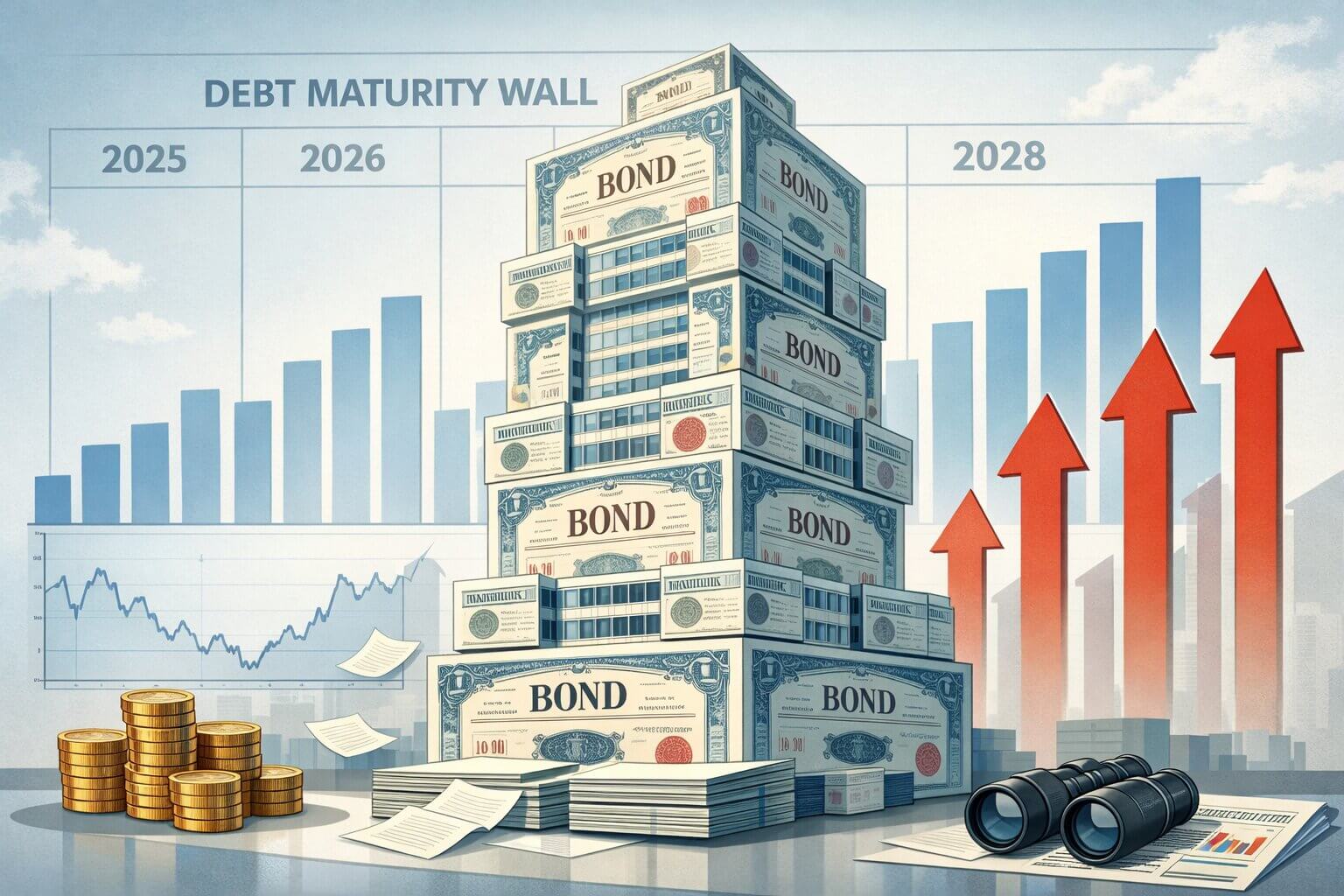
The result is a structural vulnerability that investors and policymakers are increasingly watching: a potential maturity wall, where large volumes of debt come due at once, forcing companies to refinance at higher costs or reduce spending to preserve cash.
For markets, the question is no longer whether corporate debt levels are high. It is whether the transition to a higher-rate world will expose weaknesses that were previously hidden by easy credit.
---
A Decade of Cheap Credit Meets a Higher-Rate Reality
The Legacy of the 2020–2021 Borrowing Boom
During the pandemic, corporations took advantage of historically low interest rates to issue record amounts of debt. In 2020 and 2021, global companies collectively borrowed trillions of dollars to shore up liquidity, refinance existing obligations, and fund expansion.
At the time, the strategy made financial sense. Central banks had slashed policy rates to near zero, and bond investors were eager to buy corporate debt.
But the environment changed rapidly beginning in March 2022, when the Federal Reserve launched its most aggressive tightening cycle in decades to combat inflation. By July 2023, the federal funds rate had reached a range of 5.25% to 5.50%, where it remained through much of 2025.
Higher interest rates did not immediately trigger widespread defaults because many companies had locked in long-term financing at low rates. However, that protection was temporary. As debt matures, companies must refinance at prevailing market rates — and those rates are now significantly higher.
Why Interest Rates Are Staying Higher for Longer
Even as inflation has moderated, central banks have been reluctant to cut rates aggressively. Policymakers remain concerned about persistent wage growth, fiscal deficits, and the risk of renewed price pressures.
This “higher-for-longer” rate environment is reshaping corporate finance decisions. Companies that previously borrowed at rates below 3% are now facing refinancing costs closer to 6% or higher, depending on credit quality.
For highly leveraged firms, the difference is not incremental — it is structural. A doubling of borrowing costs can significantly reduce profitability, limit investment, and weaken balance sheets over time.
---
The 2025–2028 Maturity Wall Comes Into Focus
The Scale of Upcoming Refinancing Needs
The most immediate source of concern is the volume of corporate debt scheduled to mature over the next several years. Analysts refer to this period as the maturity wall, a cluster of large debt obligations that must be refinanced within a relatively short timeframe.
Between 2025 and 2028, trillions of dollars in corporate bonds and loans are set to come due across global markets. In the United States alone, a substantial share of speculative-grade debt issued during the low-rate era will need to be refinanced during this window.
The concentration of maturities matters because it increases competition for capital. If many companies attempt to refinance simultaneously, lenders can demand higher yields and stricter terms.
Rising Debt Service Costs and Interest Coverage Pressure
One of the clearest indicators of stress is the interest coverage ratio, a measure of how easily a company can meet its debt obligations using operating income.
As borrowing costs rise, interest coverage ratios decline — particularly for companies with high leverage.
Credit rating agencies have reported a steady increase in the share of firms with weak coverage metrics since 2024, even as default rates have remained relatively contained. This divergence suggests that financial pressure is building beneath the surface.
In other words, the risk is accumulating gradually rather than appearing suddenly.
---
Why This Risk Is Different From Past Credit Cycles
A System-Wide Structural Vulnerability
Unlike the housing crisis of 2008 or the banking stress of 2023, the current risk is not concentrated in a single industry. Instead, it is spread across corporate balance sheets throughout the economy.
This broad distribution makes the risk more difficult to identify — and potentially more persistent.
For more than a decade, low interest rates allowed companies to refinance debt repeatedly without reducing leverage. That dynamic created what economists sometimes describe as “refinancing dependence,” where firms rely on favorable credit conditions to sustain operations.
The shift to higher rates is now testing that model.
The Global Dimension of Corporate Leverage
Corporate debt levels have risen not only in the United States but across advanced and emerging economies.
Global leverage has increased steadily since the financial crisis, driven by low borrowing costs, investor demand for yield, and expanding private credit markets.
As of early 2026, corporate debt as a share of global GDP remains near historic highs. That level of leverage increases the sensitivity of the financial system to changes in interest rates and economic growth.
In a slowing economy, even modest increases in borrowing costs can have outsized effects on corporate finances.
---
Potential Economic and Market Consequences
Slower Investment and Hiring
The first impact of rising debt costs is often a reduction in discretionary spending.
When companies devote more cash to interest payments, they have less available for capital investment, hiring, and research and development.
This shift can gradually slow economic growth, particularly if it occurs across many industries simultaneously.
Tighter Credit Conditions and Financial Stability Risks
Financial institutions are already responding to the changing environment. Surveys conducted in early 2026 show that banks have tightened lending standards for commercial and industrial loans, reflecting increased caution about borrower risk.
Tighter credit conditions can create a feedback loop:
- Higher borrowing costs reduce corporate profitability
- Lower profitability increases default risk
- Rising default risk leads lenders to restrict credit
Over time, this cycle can amplify economic downturns.
Sector-Specific Stress: CRE, Private Equity, and High-Yield Issuers
While the risk is broad, certain sectors are more exposed than others.
Commercial real estate remains a focal point due to declining property values and large refinancing needs. Private equity-backed companies also face elevated risk because their business models often rely on significant leverage.
Speculative-grade issuers — commonly known as high-yield borrowers — are particularly sensitive to interest rate changes.
Even a modest increase in default rates among these borrowers could ripple through credit markets and affect investor sentiment.
---
What Investors Should Watch in 2026 and Beyond
Key Early Warning Indicators
Investors and policymakers are monitoring several metrics that can signal rising stress in corporate credit markets:
Interest coverage ratios
Corporate default rates
Credit spreads
Bank lending standards
Corporate earnings growth
These indicators often deteriorate before broader economic weakness becomes visible.
Scenarios for the Next Credit Cycle
There are three plausible scenarios for corporate debt over the next several years:
Base case:
Companies refinance gradually, default rates rise modestly, and economic growth slows but remains positive.
Stress case:
Interest rates remain elevated and economic growth weakens, leading to a significant increase in defaults and tighter credit conditions.
Severe case:
A combination of high rates and recession triggers concentrated defaults in leveraged sectors, causing broader financial instability.
At present, most analysts view the base case as the most likely outcome. However, the probability of more adverse scenarios has increased compared with previous years.
---
The Bottom Line — A Structural Risk, Not an Immediate Crisis
Corporate debt is unlikely to trigger an abrupt financial shock in 2026. Default rates remain relatively low, and many companies retain access to capital markets.
Yet the underlying trend is clear: the era of effortless refinancing has ended.
The transition to a higher-rate environment is exposing vulnerabilities that accumulated during years of cheap credit. These vulnerabilities are not catastrophic on their own, but they can amplify economic stress if growth slows or financial conditions tighten further.
For investors, the key takeaway is strategic rather than tactical. Corporate debt is evolving from a background variable into a central driver of market risk — one that will shape credit conditions, equity valuations, and monetary policy decisions throughout the next economic cycle.
In that sense, the story of corporate debt in 2026 is not about crisis. It is about adjustment — and the long-term consequences of a financial system learning to operate without the cushion of ultra-low interest rates.
---
FAQ
Why is corporate debt becoming a concern in 2026?
Corporate debt is drawing attention because large volumes of borrowing from the low-rate period of 2020–2021 are now maturing. Companies must refinance at higher interest rates, increasing financial pressure and potential default risk.
What is a maturity wall?
A maturity wall refers to a period when large amounts of debt come due simultaneously. Between 2025 and 2028, trillions of dollars in corporate debt are scheduled to mature, requiring refinancing or repayment.
Could corporate debt trigger a financial crisis?
While corporate debt poses a significant risk, most analysts do not expect an immediate crisis. However, elevated debt levels can amplify economic downturns and increase market volatility if growth slows.
What indicators should investors monitor?
Key indicators include corporate default rates, interest coverage ratios, credit spreads, and bank lending standards. These metrics often signal financial stress before broader economic problems emerge.
---
Sources and Further Reading
- Global Debt Monitor — Institute of International Finance — 02/15/2026 — https://www.iif.com
- Financial Stability Report — Federal Reserve — 11/21/2025 — https://www.federalreserve.gov
- Global Financial Stability Report — International Monetary Fund — 10/15/2025 — https://www.imf.org
- Corporate Debt Maturity Wall Analysis — S&P Global Ratings — 01/10/2026 — https://www.spglobal.com
- Leveraged Finance Outlook — Moody’s Investors Service — 12/05/2025 — https://www.moodys.com
- Global Credit Outlook — Fitch Ratings — 01/08/2026 — https://www.fitchratings.com
- Senior Loan Officer Opinion Survey on Bank Lending Practices — Federal Reserve — 01/27/2026 — https://www.federalreserve.gov
- Corporate Default and Recovery Report — Moody’s Investors Service — 02/18/2026 — https://www.moodys.com
---