Economy
Why the Fed’s Latest Decision Could Still Move Markets in 2026
Interest rates, oil shocks, and shifting expectations reshape equity markets ahead of the March FOMC decision
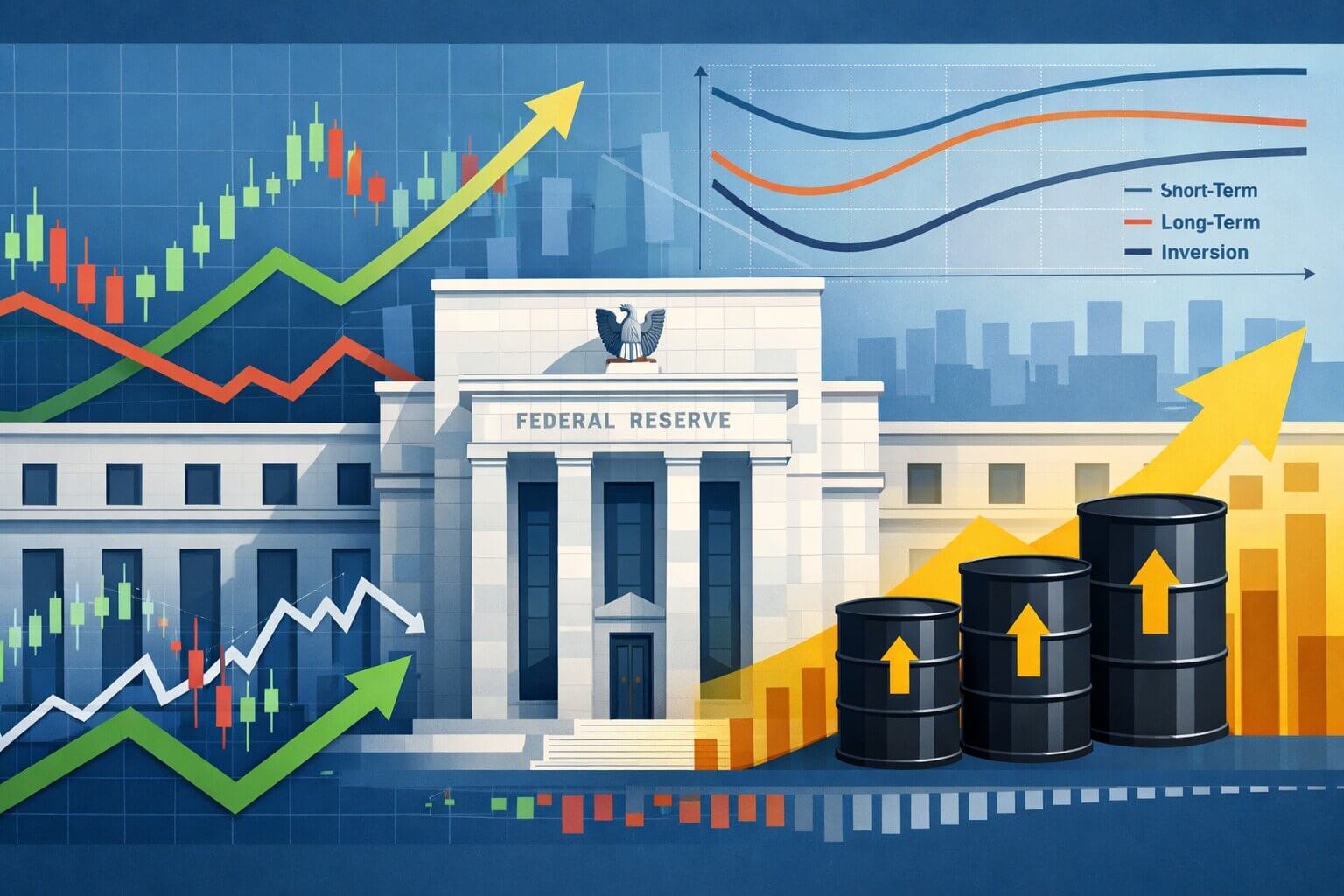
Markets at a Crossroads Ahead of the March Fed Meeting
Markets may have moved on from the Federal Reserve’s latest decision, but the consequences are still unfolding. From bond yields to equity valuations, investors are reassessing risk in ways that could shape the rest of 2026.
Equities have shown heightened volatility throughout the first quarter. Major indices have oscillated as investors reassess the likelihood and timing of rate cuts. At the same time, oil prices have surged above $90 per barrel (as of 03/10/2026, ET), driven by escalating tensions in the Middle East—adding a new inflationary layer to an already uncertain macro backdrop.
What emerges is a market increasingly sensitive not just to Fed decisions, but to the narrative surrounding them.
---
Interest Rates and Equity Valuations
The Discount Rate Effect
At its core, Federal Reserve policy influences the stock market through interest rates. The federal funds rate—currently held in the 5.25%–5.50% range as of 03/17/2026 (ET)—serves as the benchmark for borrowing costs across the economy.
Higher rates increase the discount rate applied to future corporate earnings, compressing equity valuations. This effect is particularly pronounced in growth stocks, where a larger share of value is tied to long-term cash flows.
Rate Cut Expectations vs. Reality
Entering 2026, markets anticipated a series of rate cuts. However, persistent inflation and renewed energy price pressures have forced a recalibration.
As of 03/15/2026 (ET), futures markets imply fewer and later rate cuts than previously expected. This shift has pushed Treasury yields higher, with the 10-year yield hovering near 4.30% and the 2-year yield above 4.60% (03/14/2026, ET).
The result? A repricing of risk assets and increased equity market volatility.
---
Liquidity Conditions and Market Behavior
Balance Sheet Policy and Quantitative Tightening
Beyond interest rates, the Fed continues to reduce its balance sheet through quantitative tightening (QT). As of 03/13/2026 (ET), the Fed’s balance sheet has declined to approximately $6.8 trillion, down significantly from pandemic-era highs.
QT effectively withdraws liquidity from the financial system, reducing the pool of capital available for risk assets like equities.
Financial Conditions Tighten
As liquidity tightens, broader financial conditions have become more restrictive. Credit spreads have widened modestly, and equity risk premiums have adjusted upward.
This tightening acts as an additional brake on market enthusiasm, reinforcing the Fed’s broader effort to contain inflation.
---
Inflation Expectations and the Oil Shock Factor
Oil Prices Reshape the Inflation Narrative
The recent surge in oil prices—driven by geopolitical instability in key producing regions—has complicated the inflation outlook.
Energy costs feed directly into headline inflation and indirectly into core components through transportation and production costs. This dynamic threatens to delay the disinflationary progress seen in late 2025.
Market-Based Inflation Expectations
Market-based measures, such as 5-year breakeven inflation rates, have edged higher in March 2026. Meanwhile, the latest Consumer Price Index report released on 02/13/2026 (ET) showed inflation still above the Fed’s 2% target.
These developments have reinforced the “higher-for-longer” narrative, further pressuring equities.
---
Sector Rotation in a Higher-for-Longer Environment
Growth vs. Value Divergence
Rising yields have triggered a rotation away from high-growth technology stocks toward more value-oriented sectors. Technology and communication services have faced renewed pressure, reflecting their sensitivity to interest rate changes.
Energy and Defensive Sectors Lead
In contrast, energy stocks have benefited from rising oil prices, while defensive sectors such as utilities and consumer staples have attracted capital as investors seek stability.
This sectoral divergence underscores how Fed policy does not affect all equities equally—it reshapes the entire market structure.
---
Forward Guidance and Market Psychology
The Power of Communication
Federal Reserve communication—often referred to as forward guidance—has become a critical driver of market behavior. Even subtle shifts in tone can trigger significant asset price movements.
In early 2026, Fed officials have emphasized caution, signaling that premature easing could reignite inflationary pressures.
Volatility Fueled by Uncertainty
This cautious stance has amplified uncertainty. The CBOE Volatility Index (VIX) has remained elevated relative to late 2025 levels, reflecting investor unease.
Markets are no longer reacting solely to policy actions—they are reacting to the range of possible futures implied by Fed messaging.
---
What to Watch After March 2026
Looking ahead, several key variables will determine market direction:
- Inflation trajectory: Will energy-driven pressures persist?
- Labor market strength: Can the Fed justify holding rates higher for longer?
- Geopolitical developments: Will oil prices stabilize or continue rising?
- Policy clarity: Will the Fed signal a definitive timeline for easing?
The answers to these questions will shape not only the Fed’s next move but also the trajectory of U.S. equities in 2026.
---
FAQ
How does the Federal Reserve influence stock prices?
The Fed affects stock prices primarily through interest rates, liquidity conditions, and forward guidance. Higher rates reduce valuations, while liquidity tightening limits capital available for equities.
Why are rising oil prices important for the stock market?
Higher oil prices increase inflation expectations, which can delay rate cuts and push bond yields higher—both negative for equities.
What sectors benefit from higher interest rates?
Financials and energy sectors often benefit, while growth sectors like technology tend to underperform due to higher discount rates.
What should investors watch after the March 2026 Fed meeting?
Key indicators include inflation data, Treasury yields, Fed communication, and geopolitical developments affecting energy markets.
---
Sources and Further Reading
- FOMC Statement — Federal Reserve — 01/31/2026 — https://www.federalreserve.gov
- Consumer Price Index Summary — U.S. Bureau of Labor Statistics — 02/13/2026 — https://www.bls.gov
- Treasury Yield Curve Rates — U.S. Treasury — 03/14/2026 — https://home.treasury.gov
- FedWatch Tool Data — CME Group — 03/15/2026 — https://www.cmegroup.com
- Oil Prices Rise on Middle East Tensions — Reuters — 03/10/2026 — https://www.reuters.com
- Stocks Volatile Ahead of Fed Decision — Bloomberg — 03/14/2026 — https://www.bloomberg.com
- Factors Affecting Reserve Balances (H.4.1) — Federal Reserve — 03/13/2026 — https://www.federalreserve.gov
---