Economy
Global Debt Is Surging Again—And This Time It’s Costlier
Higher interest rates are turning record borrowing into a growing economic risk
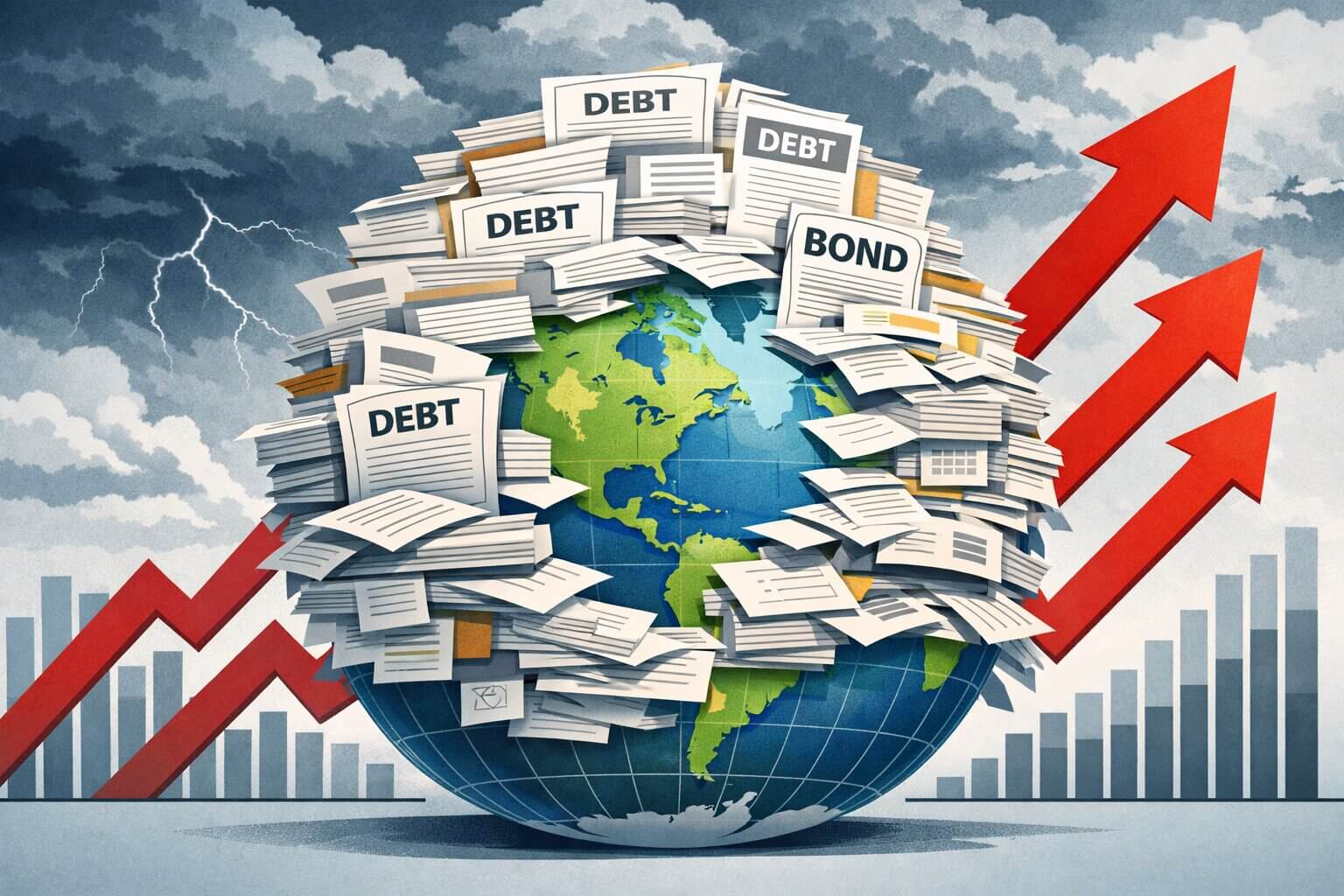
The $315 Trillion Problem
The world is sitting on a debt pile that’s never been bigger—and suddenly, it’s getting much more expensive to carry.
Global debt topped $315 trillion in early 2026, a staggering figure that once seemed manageable in a low-rate world. But that world is gone. What changed isn’t just the size of the debt—it’s the price of it.
For years, governments borrowed freely under near-zero interest rates. Now, that same debt is colliding with a new reality: higher yields, tighter policy, and less room for error.
When Cheap Money Disappears
The turning point is simple but powerful. Interest rates are no longer close to zero.
As of 01/29/2026 (ET), the Federal Reserve kept rates in the 5.25%–5.50% range. Meanwhile, the U.S. 10-year Treasury yield hovered around 4.2% on 03/14/2026 (ET), a level that significantly raises borrowing costs across the system.
This matters because debt doesn’t just sit still—it matures. Governments and companies now face a wave of refinancing, rolling over old obligations at much higher rates.
The result? Interest payments are climbing fast, even without new spending. In the U.S., federal debt surpassed $34 trillion as of 02/2026 (ET), with interest costs becoming one of the fastest-growing budget items.
Why This Matters Now
This isn’t just a government problem—it’s a market story.
As borrowing costs rise, capital gets tighter. Governments issuing more debt can crowd out private investment, slowing growth just as economies try to stabilize. At the same time, higher yields are exposing vulnerabilities in bond markets, which have already shown signs of volatility.
Layer in geopolitical tension and persistent deficits, and the picture becomes more fragile. The IMF warned in its 01/2026 outlook that elevated debt levels could amplify future shocks, especially if growth weakens.
The risk isn’t an immediate crisis—it’s a slow squeeze. Less flexibility, higher costs, and fewer easy options.
For investors, that shift may be the real story of 2026.
---
FAQ
Why is global debt a concern in 2026?
Because record debt levels are now paired with high interest rates, making it more expensive to refinance and sustain.
What role do interest rates play?
Higher rates increase borrowing costs and push up debt servicing expenses across governments and companies.
Is this a financial crisis?
Not yet, but rising debt and yields are creating structural pressure that could amplify future risks.
What should investors watch?
Interest rate trends, sovereign bond yields, and government deficit trajectories.
---
Sources and Further Reading
- Global Debt Monitor — Institute of International Finance — 01/15/2026 — https://www.iif.com
- World Economic Outlook Update — IMF — 01/30/2026 — https://www.imf.org
- Fiscal Monitor Report — IMF — 10/2025 — https://www.imf.org
- U.S. Treasury Monthly Statement — U.S. Treasury — 02/2026 — https://fiscaldata.treasury.gov
- Federal Reserve Rate Decision — Federal Reserve — 01/29/2026 — https://www.federalreserve.gov
- U.S. 10-Year Treasury Yield Data — FRED — 03/14/2026 — https://fred.stlouisfed.org
---