Economy
Why Global Interest Rates Could Shift Faster Than Markets Expect
Policy makers hold steady as inflation risks and slowing growth complicate the path to rate cuts.
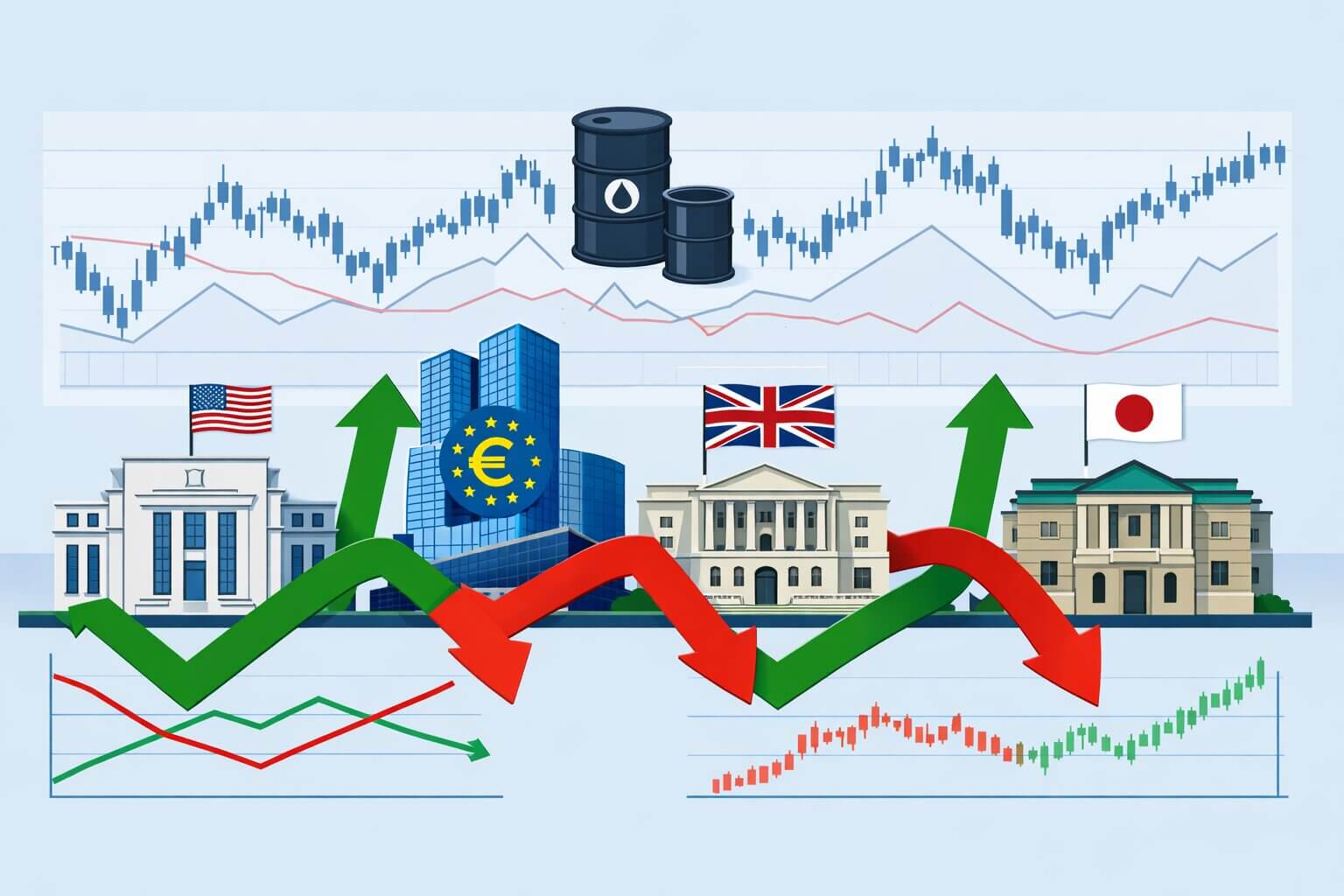
In early 2026, the global interest-rate cycle appears to be entering a delicate transition phase. After two years defined by aggressive monetary tightening and the gradual stabilization that followed, the world’s major central banks are now confronting a new dilemma: inflation pressures have not fully disappeared, even as economic growth begins to soften.
Recent decisions illustrate the moment of hesitation. On 01/28/2026, the Federal Reserve left its policy rate unchanged at 3.50%–3.75%, citing heightened uncertainty about the inflation outlook. One week later, on 02/05/2026, the European Central Bank kept its deposit facility rate at 2.00%, while the Bank of England voted narrowly—5–4—to maintain its 3.75% Bank Rate. Meanwhile, the Bank of Japan, long the outlier in global monetary policy, raised rates to 0.75% in December 2025 and is now debating whether further normalization is warranted.
Taken together, these decisions suggest the global rate cycle may have reached an inflection point. Markets had anticipated a broad easing phase in 2026. Instead, central banks are signaling patience, wary that a new wave of inflation—partly driven by energy markets—could derail progress.
The result is a world economy caught between two competing forces: moderating growth and persistent price pressures.
Student Loan Refinancing for doctors and dentists
---
A Pause in the Global Policy Cycle
Through much of 2024 and 2025, financial markets largely assumed that the next major move in global monetary policy would be downward. Inflation had cooled from the post-pandemic surge, and central banks appeared ready to gradually normalize policy.
But the first months of 2026 have complicated that narrative.
When the Federal Reserve announced its January policy decision, officials emphasized that inflation progress had become uneven. Energy prices, particularly crude oil, rose sharply during late 2025 and early 2026, feeding through to transportation and consumer costs. At the same time, wage growth in the U.S. labor market remained resilient.
The ECB faces similar challenges. While euro-area inflation has slowed significantly since the peak years of 2022–2023, services inflation and energy costs continue to pose risks to price stability. As a result, policymakers have resisted pressure to begin rate cuts prematurely.
The situation in the United Kingdom appears even more finely balanced. The Bank of England’s February 5 vote revealed deep divisions among policymakers. Four members favored an immediate rate cut, citing weakening growth indicators and declining household consumption. The narrow majority, however, argued that inflation persistence still justified caution.
Across advanced economies, the same question now dominates monetary policy debates: has inflation truly been defeated, or merely subdued temporarily?
---
The Bank of Japan’s Unique Position
While Western central banks hesitate over when to ease, the Bank of Japan remains on a different trajectory.
After decades of ultra-low rates, the BOJ has been cautiously dismantling its unconventional policies. The increase to 0.75% in December 2025 marked the strongest signal yet that Japan is exiting its long era of negative or near-zero interest rates.
Japan’s policy shift reflects structural changes in its economy. Wage growth accelerated during the 2025 spring wage negotiations, and inflation has remained consistently above the BOJ’s longstanding target.
This divergence creates an unusual global dynamic. For years, Japan was the anchor of global liquidity, with ultra-low rates encouraging investors to borrow yen and invest abroad. As Japanese yields rise, those capital flows may gradually reverse.
That shift could have significant implications for currency markets and global bond demand.
---
Inflation’s Stubborn Second Phase
The hesitation among policymakers stems from a broader pattern economists often describe as the “second phase” of inflation.
The first phase—driven by supply-chain disruptions and pandemic-era stimulus—has largely subsided. The second phase is proving more difficult: inflation embedded in wages, services, and energy costs.
Oil prices have become a central concern. Supply constraints and geopolitical tensions pushed crude prices higher in late 2025, feeding directly into transportation, manufacturing, and consumer prices. Even modest increases in energy costs can ripple through the global economy.
For central banks, the risk is clear. Cutting rates too early could reignite inflation expectations, forcing policymakers to reverse course later.
That scenario would be far more damaging for credibility—and financial stability—than delaying easing by a few months.
---
The Market Implications
For investors, the shifting interest-rate outlook carries wide-ranging consequences across asset classes.
Borrowing Costs and Consumer Demand
Higher-for-longer interest rates mean borrowing costs for households and businesses are likely to remain elevated through much of 2026. Mortgage rates, corporate lending rates, and consumer credit costs typically move in tandem with policy expectations.
As a result, consumer demand in interest-sensitive sectors—housing, autos, and durable goods—may remain subdued.
Equity Valuations
Equity markets are particularly sensitive to interest-rate expectations. When rates fall, valuations often rise because future corporate earnings are discounted at a lower rate.
If the easing cycle is delayed, equity valuations could face renewed pressure—especially in sectors that benefited from low borrowing costs during the previous decade.
Bond Yields and Fixed Income
Government bond markets are already reflecting the policy pause. Yields across major developed economies remain elevated relative to early-2025 levels, as investors adjust expectations for fewer near-term rate cuts.
For fixed-income investors, this environment creates both risk and opportunity. While bond prices remain sensitive to inflation surprises, higher yields offer improved income compared with much of the past decade.
Currency Markets and Capital Flows
Interest-rate differentials also influence global currency movements.
If the United States maintains relatively high rates while Europe begins easing earlier, the U.S. dollar could remain supported. Conversely, rising Japanese yields could strengthen the yen and reshape global capital flows as domestic investors bring funds home.
Such shifts have historically played a major role in international investment patterns.
Student Loan Refinancing for doctors and dentists
---
What to Watch Next
Several indicators will determine whether the current policy pause evolves into a delayed easing cycle—or something more complicated.
Inflation data remains the most important variable. Central banks are watching closely for signs that energy-driven price pressures are feeding into broader consumer inflation.
Labor markets also matter. Strong wage growth could reinforce inflation persistence, while weakening employment would increase pressure for rate cuts.
Finally, global growth trends will shape policy decisions. If economic activity slows more sharply than expected, central banks may find themselves balancing inflation risks against recession concerns.
For now, the world’s major monetary authorities appear united in one conclusion: the path to lower interest rates will not be as smooth—or as immediate—as markets once assumed.
---
FAQ
Why are central banks delaying interest rate cuts in 2026?
Central banks remain cautious because inflation has not fully returned to target levels. Energy prices and services inflation are still creating upward pressure, raising concerns that cutting rates too soon could reignite inflation.
What does the Federal Reserve’s January 2026 decision signal?
By keeping rates at 3.50%–3.75% on 01/28/2026, the Federal Reserve signaled that policy makers want additional evidence that inflation is sustainably declining before beginning an easing cycle.
Why is the Bank of Japan moving in the opposite direction?
Japan is gradually exiting decades of ultra-low interest rates. Stronger wage growth and persistent inflation have allowed the Bank of Japan to raise rates to 0.75% in December 2025, with further normalization under discussion.
How could delayed rate cuts affect markets?
A prolonged period of higher interest rates could keep borrowing costs elevated, pressure equity valuations, support government bond yields, and reshape global currency movements and capital flows.
---
Sources and Further Reading
- Federal Reserve FOMC Statement — Federal Reserve — 01/28/2026 — https://www.federalreserve.gov
- Monetary Policy Decision — European Central Bank — 02/05/2026 — https://www.ecb.europa.eu
- Monetary Policy Summary and Vote — Bank of England — 02/05/2026 — https://www.bankofengland.co.uk
- Monetary Policy Meeting Statement — Bank of Japan — 12/19/2025 — https://www.boj.or.jp
- Global Economic Outlook Update — International Monetary Fund — 01/2026 — https://www.imf.org
- Global Markets Analysis on Monetary Policy Outlook — Reuters — 02/2026 — https://www.reuters.com
Editorial Note: This content is strictly educational and does not constitute investment advice.
---