Markets
Why Hedge Funds Are Increasing Commodity Bets Again
Oil shocks, gold’s surge, and strategic metals scarcity are pulling institutional capital back into the commodity complex.
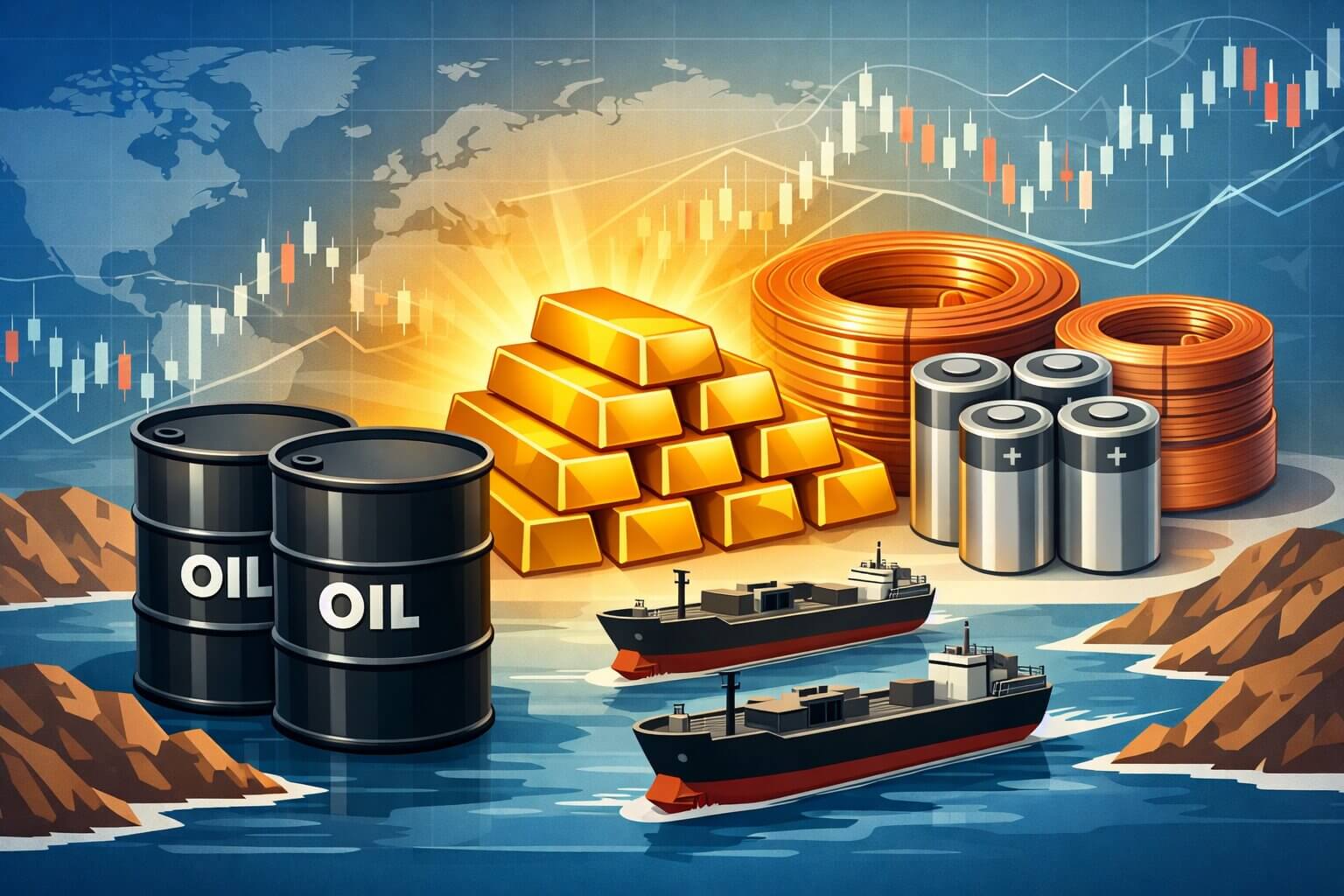
Institutional investors are shifting capital back into commodities, and that move is sending signals about inflation, growth, and global demand.
But the renewed interest in commodities runs deeper than a single oil spike. Behind the rotation lies a broader convergence of forces — geopolitical risk, inflation hedging, and tightening long-term supply for critical minerals.
Together, these dynamics are drawing institutional capital back into a market many investors had sidelined for much of the previous decade.
---
A Sudden Catalyst: The March 2026 Oil Shock
The immediate trigger for the commodity rebound came in March.
On 03/13/2026, Brent crude surged above $100 per barrel after escalating tensions in the Middle East raised concerns about potential disruptions to shipping routes through the Strait of Hormuz — one of the world’s most critical energy chokepoints.
The market reaction was swift. Global equities experienced their largest weekly outflows since December, while energy markets saw heavy speculative inflows as traders priced in supply risk.
For macro hedge funds, the move revived a familiar scenario: the possibility of stagflation — a combination of rising energy prices, persistent inflation, and slowing economic growth.
Oil has historically been one of the most direct ways to express that macro thesis. Unlike equities or bonds, crude prices react immediately to geopolitical supply shocks.
That sensitivity has once again made energy futures an attractive hedge against both inflation and geopolitical disruption.
---
Gold’s Surge and the Return of the Inflation Hedge
If oil represents the cyclical side of the commodity story, gold represents the defensive one.
By 03/16/2026, gold prices were approaching $5,000 per ounce, fueled by a combination of geopolitical uncertainty, inflation concerns, and shifting interest-rate expectations.
Safe-haven demand surged as investors sought protection against both financial instability and rising energy costs.
Historically, gold rallies during periods when markets fear that inflation will remain elevated while real interest rates fall or remain uncertain. The current environment echoes several past episodes where geopolitical crises triggered significant inflows into precious metals.
Hedge funds have been rebuilding exposure accordingly. Commodity-focused funds and global macro strategies have increased long positions in gold futures, viewing the metal as both an inflation hedge and a geopolitical risk buffer.
The trade also benefits from broader portfolio dynamics. After several years dominated by equities and technology stocks, many institutional investors now see commodities as an effective diversification tool in an environment where traditional assets are increasingly correlated.
---
The Strategic Commodities Trade Is Back
Beyond oil and gold, the most important shift may be occurring in industrial and strategic metals.
Copper, lithium, cobalt, and nickel — all critical for electrification, energy infrastructure, and advanced technology — have become central to a new structural investment narrative.
Copper prices reached record highs above $13,000 per metric ton on 01/05/2026, reflecting intensifying concerns about future supply constraints.
The metal sits at the heart of multiple long-term demand drivers: renewable energy systems, electric vehicles, grid expansion, and data-center infrastructure supporting artificial intelligence.
At the same time, supply growth has struggled to keep pace. New mines take years to develop, and political risk in key producing regions has complicated investment.
The geopolitical dimension is equally significant. Governments are increasingly treating critical minerals as strategic assets.
In early March 2026, efforts by the United States to secure access to mineral supplies from the Democratic Republic of Congo highlighted the geopolitical competition unfolding around copper, cobalt, and lithium.
Private industry is moving just as aggressively. On 03/16/2026, a U.S. recycling and refining company announced a $1.1 billion offtake agreement with a major global commodities trader to secure lithium and nickel supplies for the coming decade.
Meanwhile, supply constraints in cobalt have intensified as export restrictions and logistical challenges tighten availability.
For hedge funds, these developments represent a different kind of commodity opportunity: not a short-term macro trade, but a long-duration scarcity thesis tied to industrial transformation.
---
How Hedge Funds Are Positioning
Positioning data provides a clearer picture of how investors are responding.
The latest Commitments of Traders report from the U.S. derivatives regulator, dated 03/10/2026, shows rising speculative long exposure across several commodity markets, particularly crude oil, gold, and copper.
This does not mean every hedge fund is bullish on commodities. Strategies remain diverse, and some funds continue to favor relative-value trades rather than outright directional bets.
However, the overall pattern suggests a meaningful rotation toward real assets.
Part of that shift reflects macro uncertainty. After years of relatively stable inflation and predictable monetary policy, the current environment is more volatile.
Commodity markets offer a way to hedge against multiple risks simultaneously — inflation surprises, geopolitical disruptions, and supply shocks.
Importantly, investors are distinguishing between cyclical trades and structural ones.
Oil and gold positions often reflect short-term macro views about inflation or geopolitical tension.
Strategic metals, by contrast, are increasingly viewed as multi-year investment themes tied to industrial policy, energy security, and the electrification of the global economy.
---
What This Means for Markets
For portfolio managers, the renewed interest in commodities highlights a broader shift in asset allocation.
For much of the 2010s, commodities struggled to compete with equities and technology stocks. Low inflation and abundant supply kept prices relatively subdued.
Today’s environment looks very different.
Energy markets remain vulnerable to geopolitical shocks. Inflation risks persist. And the supply of many strategic minerals appears increasingly constrained.
That combination is bringing commodities back into institutional portfolios.
Still, the trade carries risks. A sharp economic slowdown could weaken industrial demand. Central banks could maintain tighter monetary policy longer than expected. And geopolitical tensions could ease, reducing the risk premium embedded in energy prices.
For now, however, hedge funds appear to see commodities as one of the few asset classes offering both macro protection and structural upside.
As 2026 unfolds, the key question is whether this renewed commodity focus marks a temporary rotation — or the beginning of a longer structural shift in global markets.
From the AlphaPulse perspective, the answer may depend less on speculative enthusiasm and more on something far more tangible: the real-world scarcity of energy and materials powering the next industrial era.
---
FAQ
Why are hedge funds investing in commodities in 2026?
Hedge funds are returning to commodities primarily due to rising geopolitical risk, renewed inflation concerns, and tightening supply in strategic metals needed for electrification and technology infrastructure.
Why did oil prices surge in March 2026?
Oil prices jumped above $100 per barrel on 03/13/2026 amid fears that conflict in the Middle East could disrupt shipping through the Strait of Hormuz, a key global energy corridor.
Why is gold rising toward $5,000?
Gold is benefiting from safe-haven demand driven by geopolitical instability, inflation fears linked to rising energy prices, and uncertainty around future interest-rate policy.
Why are copper and lithium attracting investors?
Copper, lithium, cobalt, and nickel are critical for electric vehicles, renewable energy systems, and AI infrastructure. Supply constraints and geopolitical competition for these minerals have strengthened long-term investment demand.
---
Sources and Further Reading
- Global equity funds see highest outflows since December on oil shock fears — Reuters — 03/13/2026 — https://www.reuters.com/world/china/global-markets-flows-graphic-2026-03-13/
- Gold eases as conflict-driven inflation fears counter dollar softness — Reuters — 03/16/2026 — https://www.reuters.com/world/india/gold-edges-lower-higher-energy-prices-dim-ratecut-hopes-2026-03-16/
- Record copper price signals accelerating race for supplies — Reuters — 01/05/2026 — https://www.reuters.com/world/americas/record-copper-price-signals-accelerating-race-supplies-2026-01-05/
- Copper is pricing scarcity at a time of plenty — Reuters — 02/13/2026 — https://www.reuters.com/markets/commodities/copper-is-pricing-scarcity-time-plenty-2026-02-13/
- US struggling to de-risk Congo's war-zone minerals — Reuters — 03/02/2026 — https://www.reuters.com/world/africa/us-struggling-de-risk-congos-war-zone-minerals-even-after-pact-sources-say-2026-03-02/
- Nth Cycle signs $1.1 billion lithium offtake deal with Trafigura — Reuters — 03/16/2026 — https://www.reuters.com/business/energy/nth-cycle-signs-11-billion-lithium-offtake-deal-with-trafigura-2026-03-16/
- Glencore turns to China exchange stocks to meet cobalt commitments — Reuters — 03/16/2026 — https://www.reuters.com/world/china/glencore-turns-china-exchange-stocks-meet-cobalt-commitments-sources-say-2026-03-16/
- Commitments of Traders Long Report — CFTC — 03/10/2026 — https://www.cftc.gov/dea/futures/other_lf.htm
---