Economy
How High Interest Rates Are Reshaping the Global Economy
From cheap money to tight conditions, the Fed’s prolonged stance is rewriting growth, credit, and capital flows worldwide
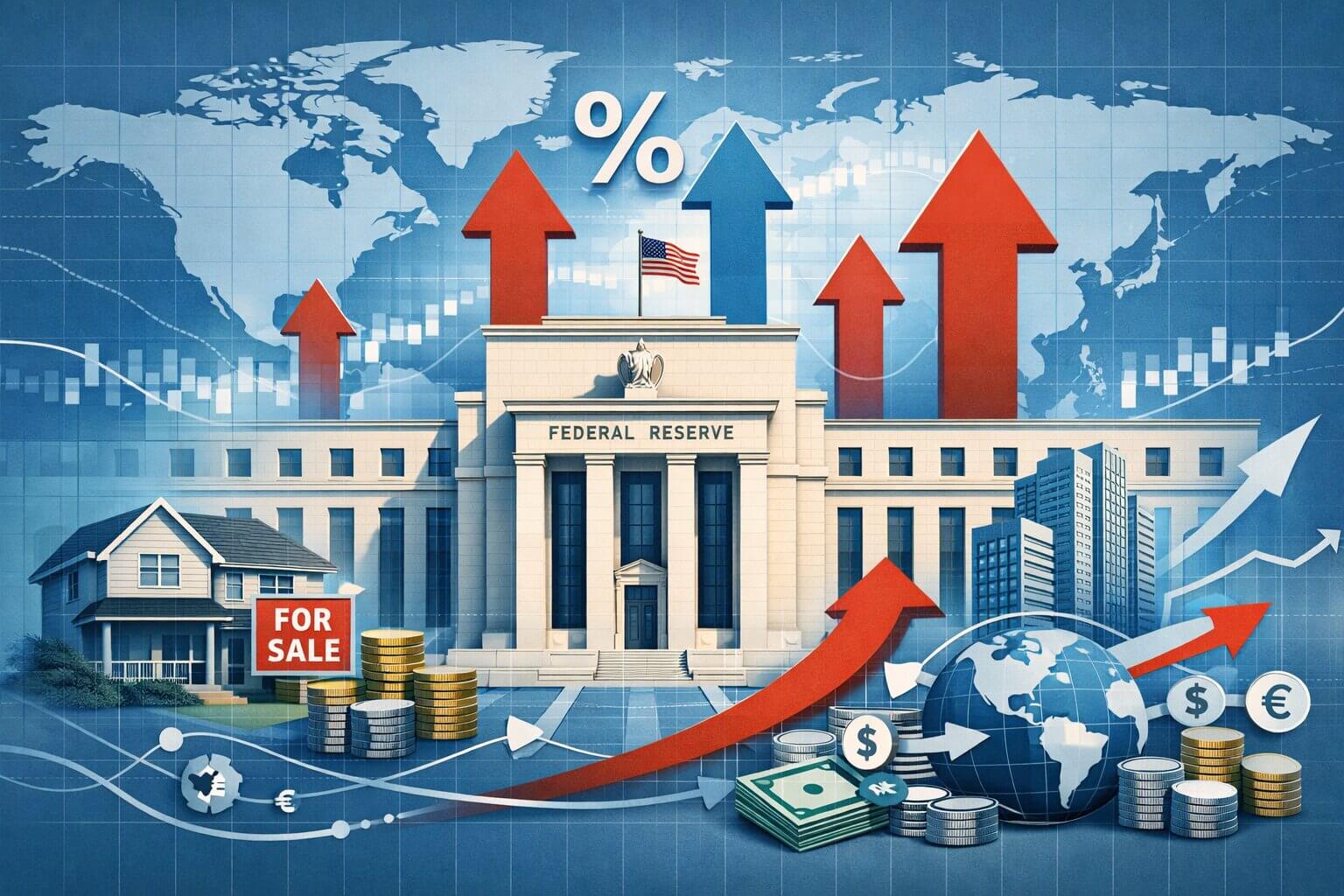
The End of Easy Money—and Why It Matters
For more than a decade following the 2008 financial crisis, the global economy operated under an extraordinary monetary regime: ultra-low interest rates and abundant liquidity. That era ended decisively when the Federal Reserve began tightening policy in March 2022 to combat the highest inflation in four decades.
By 07/26/2023 (ET), the Fed had raised its benchmark federal funds rate to a target range of 5.25%–5.50%, the highest level since 2001. As of 03/19/2026 (ET), rates remain elevated, reflecting the central bank’s cautious approach to ensuring inflation returns sustainably to its 2% target.
This prolonged period of restrictive policy is not just a domestic story—it is reshaping the global economy in profound and lasting ways. What happens when the cost of money is no longer near zero? The answer is unfolding across growth trajectories, corporate balance sheets, housing markets, and cross-border capital flows.
---
Slower Growth in a High-Cost World
The Global Growth Trade-Off
Higher interest rates are designed to slow economic activity. That mechanism is now clearly visible.
Global GDP growth has moderated since 2022, with advanced economies experiencing slower expansion as borrowing costs weigh on consumption and investment. The U.S. economy has shown resilience, but even there, growth has cooled compared to the post-pandemic rebound.
Emerging markets face an even more complex challenge. Many rely on external financing, often denominated in U.S. dollars. As rates rise in the U.S., global financial conditions tighten, making capital more expensive and less accessible.
Investment Hesitation and Capital Discipline
Corporate investment has become more selective. Projects that once appeared viable under near-zero rates are now being reassessed under higher discount rates.
This shift has introduced a new discipline into capital allocation:
- Fewer speculative investments
- Greater focus on profitability and cash flow
- Delayed expansion plans
In short, the cost of capital has reasserted itself as a central constraint on growth.
---
Corporate America: Debt Gets Expensive
Refinancing Risk and Balance Sheet Pressure
During the low-rate era, corporations accumulated record levels of debt, often locking in favorable terms. But as those debts mature, refinancing becomes significantly more expensive.
Investment-grade and high-yield borrowers alike are now facing:
- Higher interest expenses
- Tighter lending standards
- Reduced access to capital markets
This dynamic is particularly acute for highly leveraged sectors such as commercial real estate and private equity-backed firms.
The Rise of “Higher for Longer” Strategy
Markets have adjusted to a “higher for longer” narrative. Rather than anticipating rapid rate cuts, investors now expect a gradual easing path, if any.
As a result:
- Credit spreads remain sensitive to macro signals
- Default risks are rising in certain sectors
- Lenders are prioritizing quality over yield
The era of easy refinancing has ended—and with it, a key pillar of corporate expansion.
---
Consumers Under Pressure
Borrowing Costs and Spending Behavior
High interest rates directly affect consumers through mortgages, credit cards, and auto loans. As borrowing costs rise, discretionary spending tends to decline.
By late 2025, average credit card interest rates in the U.S. exceeded 20%, a historic high. Meanwhile, auto loan rates and personal lending costs have also climbed sharply.
This has led to:
- Increased household debt servicing burdens
- A shift toward savings and essential spending
- Greater sensitivity to labor market conditions
Resilience Meets Constraint
Despite these pressures, U.S. consumers have shown surprising resilience, supported by a strong labor market and accumulated savings from the pandemic period.
However, that cushion is gradually eroding. As excess savings decline and borrowing costs remain high, consumption growth is expected to moderate further into 2026.
---
Housing Markets: A Structural Reset
Mortgage Rates and Affordability
The housing market has been one of the most visibly affected sectors. Mortgage rates surged alongside Treasury yields, reaching levels not seen in over two decades.
As of late 2025, 30-year fixed mortgage rates hovered near 7%, significantly reducing affordability for new buyers.
This has created a dual effect:
- Reduced home sales and transaction volumes
- Limited housing supply, as existing homeowners are reluctant to sell and lose lower-rate mortgages
A Frozen Market Dynamic
The result is a “locked-in” housing market, where both buyers and sellers face constraints.
Home prices have shown mixed behavior:
- Stabilizing or declining in some regions
- Remaining elevated in supply-constrained markets
This structural reset may persist as long as interest rates remain elevated.
---
Global Capital Flows and the Dollar Effect
Strong Dollar, Weaker Emerging Markets
High U.S. interest rates tend to strengthen the dollar by attracting global capital seeking higher returns. This has significant implications for emerging markets.
A stronger dollar increases the burden of dollar-denominated debt, making it more expensive for countries and corporations to service obligations.
Consequences include:
- Currency depreciation in emerging markets
- Capital outflows
- Increased risk of financial instability
Policy Divergence Across Central Banks
Not all central banks are moving in lockstep with the Federal Reserve. Some have begun easing policy, while others remain constrained by inflation or currency pressures.
This divergence creates:
- Volatility in exchange rates
- Uneven global financial conditions
- Challenges for coordinated economic policy
---
Investment Strategies in a High-Rate Era
From Growth to Value—and Income
The investment landscape has shifted dramatically. In a world of near-zero rates, investors favored growth stocks and long-duration assets.
Today, higher yields have changed the calculus:
- Fixed income offers attractive returns again
- Value-oriented equities are gaining favor
- Cash and short-term instruments are no longer negligible
Repricing Risk Across Asset Classes
Higher rates have forced a broad repricing of risk:
- Equity valuations are more sensitive to earnings
- Real estate faces pressure from higher financing costs
- Private markets are adjusting to new discount rates
Investors are increasingly focused on fundamentals rather than liquidity-driven momentum.
---
What Comes Next?
The Path of Monetary Policy
The Federal Reserve’s next moves remain data-dependent. Inflation has moderated since its peak in 2022, but progress toward the 2% target has been uneven.
Key indicators to watch include:
- Core inflation trends
- Labor market conditions
- Financial stability risks
Markets are currently pricing a gradual normalization of rates, but uncertainty remains high.
A More Resilient—or Fragile—System?
The transition from cheap money to tight conditions is testing the resilience of the global economy.
On one hand, higher rates:
- Reinforce financial discipline
- Reduce speculative excess
- Strengthen long-term stability
On the other hand, they also:
- Increase debt burdens
- Expose vulnerabilities
- Slow economic momentum
The balance between these forces will define the next phase of global economic evolution.
---
FAQ
Why are interest rates still high in 2026?
Interest rates remain elevated because the Federal Reserve is ensuring inflation returns sustainably to its 2% target. Policymakers are cautious about cutting rates too early and reigniting price pressures.
How do high interest rates affect global markets?
They tighten financial conditions worldwide, strengthen the U.S. dollar, increase borrowing costs, and influence capital flows—particularly impacting emerging markets.
Which sectors are most affected by high rates?
Housing, commercial real estate, and highly leveraged corporate sectors are among the most sensitive to higher borrowing costs.
Are high interest rates good or bad for investors?
They present both risks and opportunities. While they pressure valuations, they also offer attractive yields in fixed income and promote more disciplined investment strategies.
---
Sources and Further Reading
- Federal Reserve FOMC Statement — Federal Reserve — 07/26/2023 — https://www.federalreserve.gov
- World Economic Outlook Update — International Monetary Fund — 01/30/2026 — https://www.imf.org
- Global Financial Stability Report — International Monetary Fund — 10/2025 — https://www.imf.org
- U.S. Consumer Credit Report — Federal Reserve — 12/2025 — https://www.federalreserve.gov
- Mortgage Market Survey — Freddie Mac — 11/2025 — https://www.freddiemac.com
- Global Economic Prospects — World Bank — 01/2026 — https://www.worldbank.org
---