Economy
How the Fed Sets Interest Rates: FOMC, Dot Plot, and the Data That Matters
A deep dive into how the U.S. Federal Reserve decides rates — and what it means for markets, borrowers, and savers
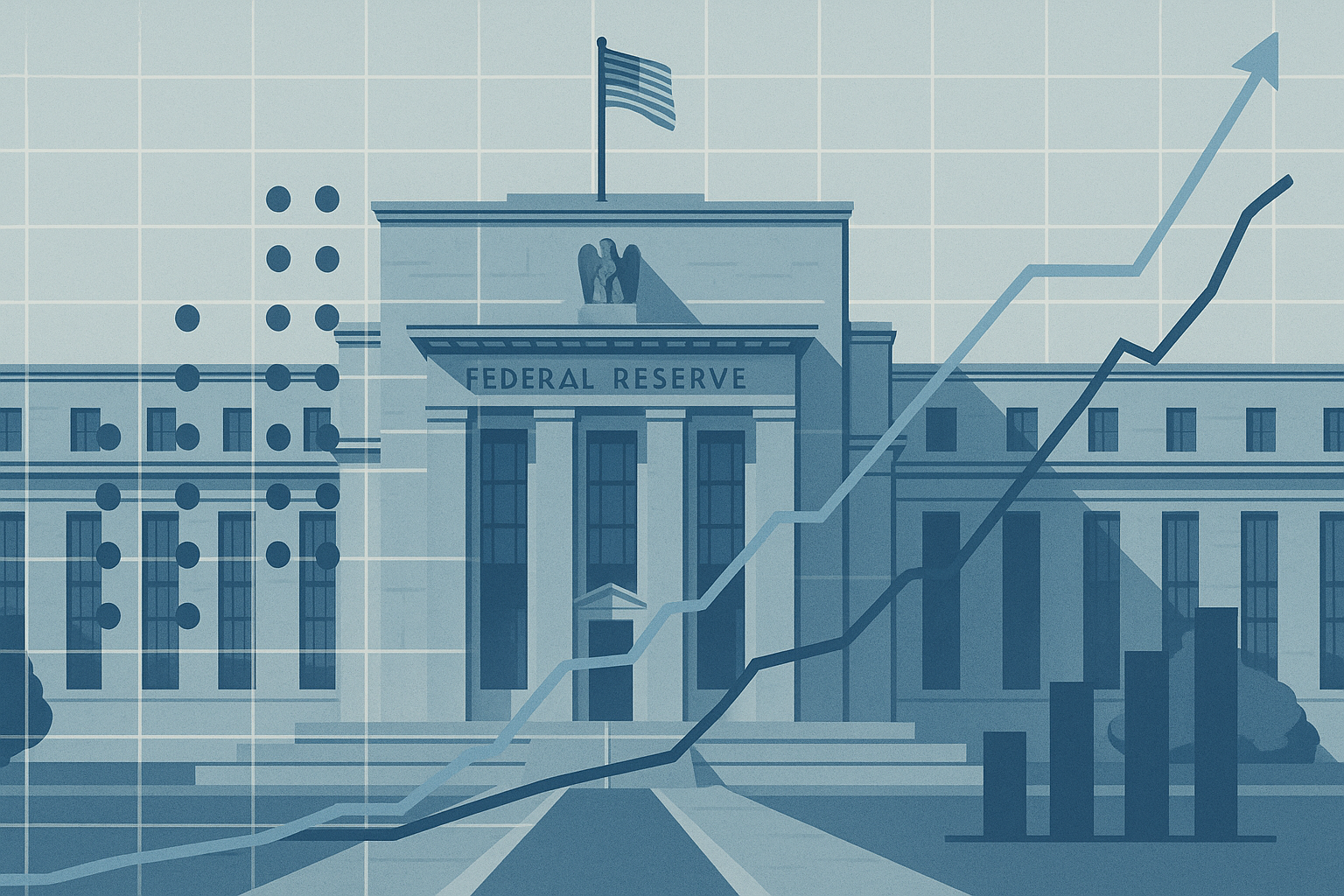
When the U.S. Federal Reserve moves interest rates, the ripple effects reach nearly every corner of the economy—from Wall Street to Main Street. Behind each of these moves is a data-intensive process centered on the Federal Open Market Committee (FOMC), internal projections (the “dot plot”), and an ongoing interpretation of economic indicators.
This article explains how the Fed determines rate policy, why markets place so much emphasis on the dot plot (and its limits), and which data points truly influence the outcome.
---
The Structure of U.S. Monetary Policy and the FOMC
- ### What Is the FOMC and How Often Does It Meet?
The Federal Open Market Committee (FOMC) is the Fed’s policymaking body responsible for setting the target range for the federal funds rate and directing open market operations. It includes the seven members of the Board of Governors, the president of the New York Fed, and four rotating regional Fed presidents.
The FOMC meets eight times a year—roughly every six weeks—to assess economic conditions and adjust policy as needed. Four of these meetings (March, June, September, and December) include the release of updated projections, known as the Summary of Economic Projections (SEP), which features the dot plot.
- ### The Dual Mandate: Inflation and Employment
The Fed operates under a “dual mandate”: to promote maximum employment and maintain price stability. Rate decisions therefore balance the risks of inflation running too hot against the dangers of slowing growth or rising unemployment.
In the September 17, 2025, FOMC statement, the committee noted:
“Job gains have slowed, and the unemployment rate has edged up but remains low. Inflation has moved up and remains somewhat elevated.” — Federal Reserve, 09/17/2025
- ### Tools at the Fed’s Disposal
To guide the federal funds rate, the Fed employs several tools:
- Open Market Operations (OMOs): Buying or selling Treasury securities to add or drain reserves from the banking system.
- Interest on Reserves / Overnight Reverse Repos: Adjusting rates paid on reserves or repo operations to influence short-term rates.
- Forward Guidance: Communicating policy intentions to shape market expectations.
- Balance Sheet Policy: Adjusting asset holdings (quantitative easing or tightening).
Together, these tools allow the Fed to influence liquidity and short-term rates while maintaining flexibility across market conditions.
---
The Federal Funds Rate — What It Means in Practice
- ### Definition and Mechanism
The federal funds rate is the overnight rate at which banks lend reserve balances to one another. The FOMC doesn’t fix this rate directly but sets a target range (for example, 4.00%–4.25%) and uses operations to guide market conditions toward that range.
- ### Transmission to Broader Rates
The federal funds rate serves as the foundation for most other borrowing costs:
- Short-term funding markets (commercial paper, interbank loans)
- Longer-term Treasury yields (via yield-curve adjustments)
- Credit spreads for mortgages, corporate bonds, and consumer loans
- Asset valuations, through changes in discount rates
When the Fed raises rates, borrowing becomes more expensive and risk assets typically face downward pressure. Lower rates generally ease financial conditions.
- ### Constraints and Limits
- The zero (or effective lower) bound on rates
- The size and composition of the Fed’s balance sheet
- Market credibility and communication clarity
Given these constraints, the Fed emphasizes data dependence—its path can shift as new information emerges.
---
The Dot Plot and the Summary of Economic Projections (SEP)
- ### What Is the Dot Plot?
The dot plot, published quarterly with the SEP, shows each FOMC participant’s projection for the midpoint of the federal funds rate for the current year, the next few years, and the “longer-run” equilibrium rate. Each dot represents one member’s view; the median dot is often cited as the committee’s consensus.
- ### Purpose: Transparency vs. Uncertainty
Introduced after the 2008 financial crisis, the dot plot was designed to enhance transparency and provide markets with insight into policymakers’ thinking. However, the Fed repeatedly warns that the dots are not promises—they are forecasts subject to change.
- ### Limitations
- The projections depend on current assumptions and may shift if economic conditions change.
- The median dot can obscure wide internal disagreement between hawks and doves.
- Market expectations (expressed through futures and forward curves) often diverge from the Fed’s projections.
In short: the dot plot reflects how the Fed thinks today, not what it will necessarily do tomorrow.
---
The Data That Drives Fed Decisions
- ### Inflation Metrics: CPI, PCE, and Core Measures
- CPI (Consumer Price Index): In August 2025, CPI rose 2.9% year over year.
- Core CPI: Excludes volatile food and energy prices, offering a steadier view of inflation trends.
- PCE (Personal Consumption Expenditures): The Fed’s preferred measure, as it covers a broader range of spending and typically reports lower readings than CPI.
What matters most to policymakers is the persistence and breadth of inflation—not just short-term spikes.
- ### Labor Market Indicators
- Nonfarm Payrolls (NFP): Monthly job gains or losses
- Unemployment Rate: 4.3% as of August 2025
- Labor Force Participation and Wage Growth: Indicators of labor market tightness
Sustained labor strength can justify higher rates; signs of weakness often point toward easing.
Growth and Activity Data
- GDP Growth: Real GDP grew about 3.8% (annualized) in Q2 2025.
- Industrial Production, Retail Sales, and Business Investment: Gauges of momentum.
- Leading Indicators (ISM, PMIs): Early signals of turning points.
If growth moderates and inflation pressures ease, the Fed gains room to cut rates.
- ### Financial Conditions and Global Developments
- Yield curve dynamics and credit spreads
- Global central bank policies and commodity prices
- Geopolitical and supply shocks that could impact U.S. inflation or growth
Because of the dollar’s central role, global developments can feed directly into domestic policy choices.
---
2025 FOMC Decisions in Context
- ### March 2025 SEP
At the March 18–19, 2025 meeting, the SEP showed a median projection for the year-end federal funds rate around 3.9%, implying two 25-basis-point cuts through 2025.
- ### June and September Updates
By June 2025, the outlook remained for two rate cuts, but inflation stickiness limited expectations for 2026. In September, the Fed adopted a slightly more dovish tone, signaling 50 basis points of remaining cuts in 2025 and lowering its outlook for 2026–2027.
The FOMC also reduced the target range to 4.00%–4.25% at the September 17 meeting.
- ### Market Reactions
Markets interpreted the September decision as confirmation of a mild easing cycle. Treasury yields declined modestly, and futures markets priced in additional cuts for late 2025. Still, several Fed officials, including Kansas City Fed President Jeff Schmid, cautioned against moving too quickly, warning that inflation persistence could delay further easing.
---
Implications for Investors, Markets, and Consumers
- ### For Investors
Lower rates generally boost bond prices and support equities by lowering discount rates. Yet over-easing can raise inflation risks or compress future returns. Investors must assess whether the Fed’s “pivot” is already priced in.
- ### For Borrowers and Consumers
- Mortgages: Especially adjustable-rate loans, tend to follow long-term Treasury yields.
- Corporate Borrowing: Lower rates reduce financing costs and may spur refinancing.
- Consumer Credit: Slight declines in rates can meaningfully affect credit cards and auto loans.
For highly leveraged borrowers, even small changes can have major cash flow implications.
- ### Risks and Uncertainties
Data lags, global volatility, and shifting expectations all complicate the Fed’s task. Market pricing often diverges from official guidance, creating volatility around key releases. Flexibility—and skepticism—remain essential.
---
What to Watch Next
Key Data Releases Ahead
- September CPI and Core CPI (released 10/15/2025)
- Nonfarm Payrolls and Unemployment (pending government data updates)
- PCE Inflation Reports
- ISM and PMI Surveys, Retail Sales, and Industrial Production
These indicators will shape whether the Fed maintains its easing path or pauses.
Risk Scenarios
- Dovish Pivot: Continued disinflation and labor softness allow multiple 25-basis-point cuts.
- Moderate Path: One or two more cuts, followed by a pause.
- Caution Scenario: Sticky inflation or labor strength leads to a halt or renewed tightening.
Market participants will parse every Fed statement for clues about which path is most likely.
---
Conclusion
The Fed’s decisions rest on a constant balancing act between curbing inflation and sustaining employment.
The FOMC provides the structure, and the dot plot offers a glimpse into policymakers’ thinking—but neither guarantees the future.
As of late 2025, the Fed’s tone has shifted toward modest easing, signaling roughly 50 basis points of expected cuts. For investors, businesses, and consumers alike, the coming months will hinge on incoming data and the Fed’s evolving language.
AlphaPulse will continue monitoring developments and providing timely analysis.
---
FAQ
Q: Does the Fed ever commit to future rate cuts based on the dot plot?
No. The dot plot represents projections under current assumptions, not promises. The Fed retains flexibility as data evolves.
Q: Why does the Fed prefer PCE inflation over CPI?
The PCE index captures a broader range of spending and tends to be less volatile than CPI, offering a more comprehensive measure of household consumption.
Q: How reliable is the dot plot compared to market forward curves?
The dot plot shows policymakers’ internal expectations, while forward curves reflect market pricing. They often diverge, especially when markets anticipate more aggressive moves.
Q: What happens if inflation spikes unexpectedly?
The Fed could pause rate cuts—or even re-tighten—if inflation exceeds its comfort zone, given its dual mandate for price stability and employment.
---
Sources and Further Reading
- Federal Reserve Board — Monetary Policy Statements and SEP
- Bureau of Labor Statistics — CPI and Employment Data
- Bureau of Economic Analysis — GDP and PCE Reports
- Corporate Finance Institute — FOMC and Federal Funds Rate Overview
- Fidelity and Bankrate — Understanding the Dot Plot
- Chatham Financial — Market Expectations and Fed Projections
- Bloomberg, Reuters, Nuveen — FOMC Analysis and Market Reactions
- The Conference Board — Economic Outlook 2025