Markets
IMF & World Bank 2025: Geopolitics, Macro Risk and Market Volatility
How the Washington meetings reflect—and amplify—global economic uncertainty
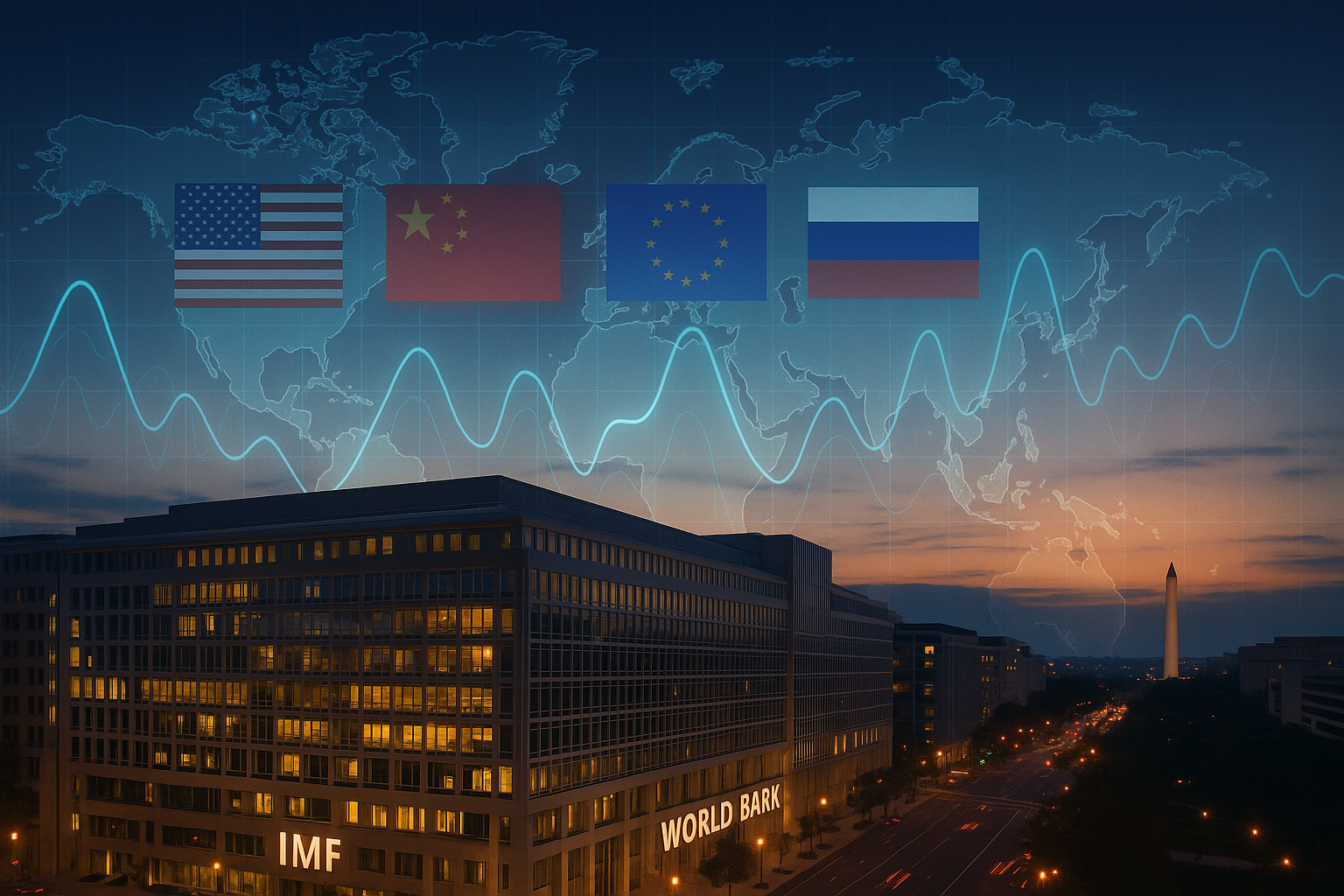
IMF & World Bank Annual Meetings 2025: Geopolitics Meets Macro Uncertainty
As the 2025 Annual Meetings of the IMF and World Bank convene in Washington (October 13–18), the agenda is dominated by a tangle of geopolitical tensions, macroeconomic fragilities, and mounting financial risks. Analysts are watching closely: how will the institutions navigate disputes over trade, debt, and governance—and what might that mean for markets already straining under volatility?
Below, we examine the geopolitical backdrop, the key macro risks on the table, the mechanisms through which shocks can spread, and what investors and policymakers should monitor once the meetings conclude.
produto:The Art of X: Build a Business That Makes You $100/Day
The Geopolitical Backdrop Entering the 2025 Meetings
U.S.–China Tensions, Trade Escalations, and Tariff Brinkmanship
The lead-up to these meetings has been marked by renewed friction between Washington and Beijing. In October 2025, President Trump threatened sweeping tariffs on Chinese imports following Beijing’s export controls on key tech materials. Markets reacted sharply as hopes for a truce wavered. Earlier trade uncertainties and tariff ambiguities could extend further into 2025, inhibiting investment flows and complicating global supply chain planning.
Fragmentation, Supply Chains, and Bloc Competition
The global economy continues to realign. Multilateralism is under strain as protectionism, deglobalization, and bloc-based trade arrangements intensify. The BlackRock Geopolitical Risk Indicator (September 2025) underscores how policy uncertainty and fragmentation have become central drivers of investor attention. National security, strategic technology, and trade reciprocity are no longer peripheral debates—they are shaping the global economic order.
The Rise of AI, Tech Rivalry, and Regulatory Brinkmanship
Beyond trade, competition in AI, semiconductors, and dual-use technologies looms large. At the meetings, IMF Managing Director Kristalina Georgieva warned that overoptimistic valuations around AI could trigger abrupt reversals and destabilize markets—especially in economies with weaker buffers. In this sense, the meetings are not just about capital flows or debt—they are a stage for a broader techno-strategic contest.
---
How the Meetings Reflect and Respond to Macro Volatility
Global Growth Forecasts: Cautious Optimism
Heading into October 2025, the IMF’s July 2025 World Economic Outlook projected global growth at roughly 3.0% for the year. Yet with trade tensions intensifying, many observers view that estimate as a baseline scenario rather than a certainty. In its article “Uncertainty About Uncertainty,” the IMF notes that elevated uncertainty—well above long-term norms—could suppress investment, hiring, and durable consumption, typically with a lag of 6–18 months.
Debt Vulnerabilities, Especially in Emerging Markets
Sovereign debt remains one of the most volatile fault lines. As IMF leadership has emphasized, several countries entered this decade already constrained, and renewed global pressures—higher rates, weaker exports—have heightened rollover risks. The 2025 meetings are expected to highlight proposals for debt restructuring, liquidity support, and reform of official creditor frameworks.
Financial Stability, Valuations, and Capital Flows
The IMF’s Global Financial Stability Report (GFSR, April 2025) warns that global stability risks have risen sharply, citing three core drivers: inflated asset valuations, high leverage in financial institutions, and tightening financial conditions amid trade and geopolitical uncertainty. Chapter 2 of the same report explores how geopolitical shocks can depress equities and widen sovereign risk spreads—especially in countries with limited policy buffers. In short, the foundations are shakier than they appear.
---
Transmission Channels: From Geopolitical Shock to Market Stress
Asset Repricing and Volatility Spikes
When a major geopolitical event unfolds—such as a tariff escalation or diplomatic rupture—markets often reprice swiftly. The GFSR finds that such shocks, particularly when unexpected, produce disproportionate effects on asset prices and volatility. Equity markets may experience abrupt drawdowns, and implied volatility tends to surge. Although some investors hedge against geopolitical risk, realized shocks often exceed expectations.
Sovereign Spreads, Credit Risk, and Banking Stress
Geopolitical disruptions elevate risk premia on sovereign debt, particularly in emerging economies. As spreads widen, debt-servicing costs rise and refinancing becomes more difficult. Banking systems tied to sovereign bonds or exposed to credit defaults may come under stress. The GFSR notes that after major events, bank capital ratios and credit growth can stagnate—especially in weaker economies.
Cross-Border Contagion and Volatility Spillovers
Shocks rarely remain localized. Trade and financial linkages transmit stress across borders. A tariff escalation by a major economy can choke exports for others, while capital flow reversals may cascade into fragile markets. During periods of volatility, developed markets can become net receivers of risk from emerging markets, reversing the typical direction of contagion.
---
Key Debates and Frictions at the 2025 Meetings
Institutional Politics and U.S. Influence
These meetings are as political as they are economic. The United States remains the largest shareholder in both institutions, and debates are expected over agenda control, voting leverage, and reform priorities. Some member states may resist language that appears to infringe on their autonomy or impose conditionalities perceived as politically motivated.
Conditionality, Governance, and Structural Reform
Calls for structural reforms—on climate, governance, and private-sector liberalization—often clash with borrower priorities. The balance between conditionality and fairness will be a recurring flashpoint. Several emerging economies argue that geopolitical fractures should allow greater flexibility in how reforms are sequenced and monitored.
Behind-Closed-Doors Trade-Offs
Observers note that “the communiqué will likely avoid binding statements condemning mercantilist policies,” since the United States and China are unlikely to agree on restrictive language. Much of the real negotiation—and the next phase of tension—will occur in private meetings and staff corridors rather than on stage.
---
Market Implications and What to Watch After the Meetings
Two Scenario Paths
- Hawkish interpretation: Markets perceive the tone as defensive, implying tighter global financial conditions, steeper rate curves, and wider spreads.
- Dovish interpretation (“risk management” mode): Institutions emphasize buffers, capital support, and liquidity backstops—offering some relief to risk assets.
Which path prevails may hinge on the tone of press releases, guidance from IMF and World Bank leadership, and alignment among key economies.
Key Indicators to Monitor
- Sovereign credit spreads (EM and G7)
- Volatility indices (VIX, VSTOXX)
- Corporate bond spreads and CDS curves
- Capital flow data and portfolio allocation trends
- Central bank statements and forward guidance
- Currency stress and capital outflows in fragile markets
Policy Reactions and Coordination Prospects
Central banks may be forced to recalibrate. If geopolitical spillovers intensify, monetary policy could remain hawkish despite domestic headwinds. Fiscal authorities might need to strengthen buffers or introduce countercyclical measures. Any joint statements or coordination among the G20 and IMF could help stabilize confidence—but such alignment is far from guaranteed.
produto:The Art of X: Build a Business That Makes You $100/Day
Conclusion and Outlook
The 2025 IMF and World Bank Annual Meetings arrive at a moment when geopolitics is no longer a backdrop—it is a central determinant of economic outcomes. The tension between rhetorical ambition and realpolitik will be high. Markets are already jittery, and any misstep in communication or coordination could amplify volatility.
Investors, policymakers, and analysts should expect turbulence rather than calm seas. The risks are substantial—but so is the need for strategic clarity.
---
FAQ
Q1: Can geopolitical tension alone trigger a global market crash?
Yes. While rare, large-scale geopolitical shocks—such as wars or trade escalations—have historically triggered abrupt equity corrections and spread widening.
Q2: How much geopolitical risk is already priced in?
To some extent, investors price in risk premia and hedge exposure. But when an event defies expectations—or exceeds consensus severity—volatility tends to spike beyond pre-positioned hedges.
Q3: Will the IMF/World Bank meetings themselves move markets?
Yes. Markets react not only to policies but also to tone, forecasts, and perceived institutional unity. The language of communiqués and press briefings will carry significant weight.
Q4: What should emerging markets watch most closely?
They should monitor sovereign spreads, capital flow reversals, currency pressures, and any shifts in conditionality or liquidity support frameworks.
---
Sources and Further Reading
- IMF, World Economic Outlook: July 2025
- IMF, Global Financial Stability Report: April 2025
- IMF, “Uncertainty About Uncertainty,” Research Department, 2025
- BlackRock, Geopolitical Risk Indicator: September 2025
- IMF, Kristalina Georgieva – Opening Remarks at the 2025 Annual Meetings
- World Bank, Debt Sustainability and Emerging Market Resilience, 2025
- Academic and market analyses on volatility spillovers and geopolitical risk premia (2024–2025)