Economy
Watching the Gauges: Inflation Indicators and the Odds of Fed Rate Cuts in 2026
How upcoming CPI, PPI and regional Fed data may shift market expectations for easing
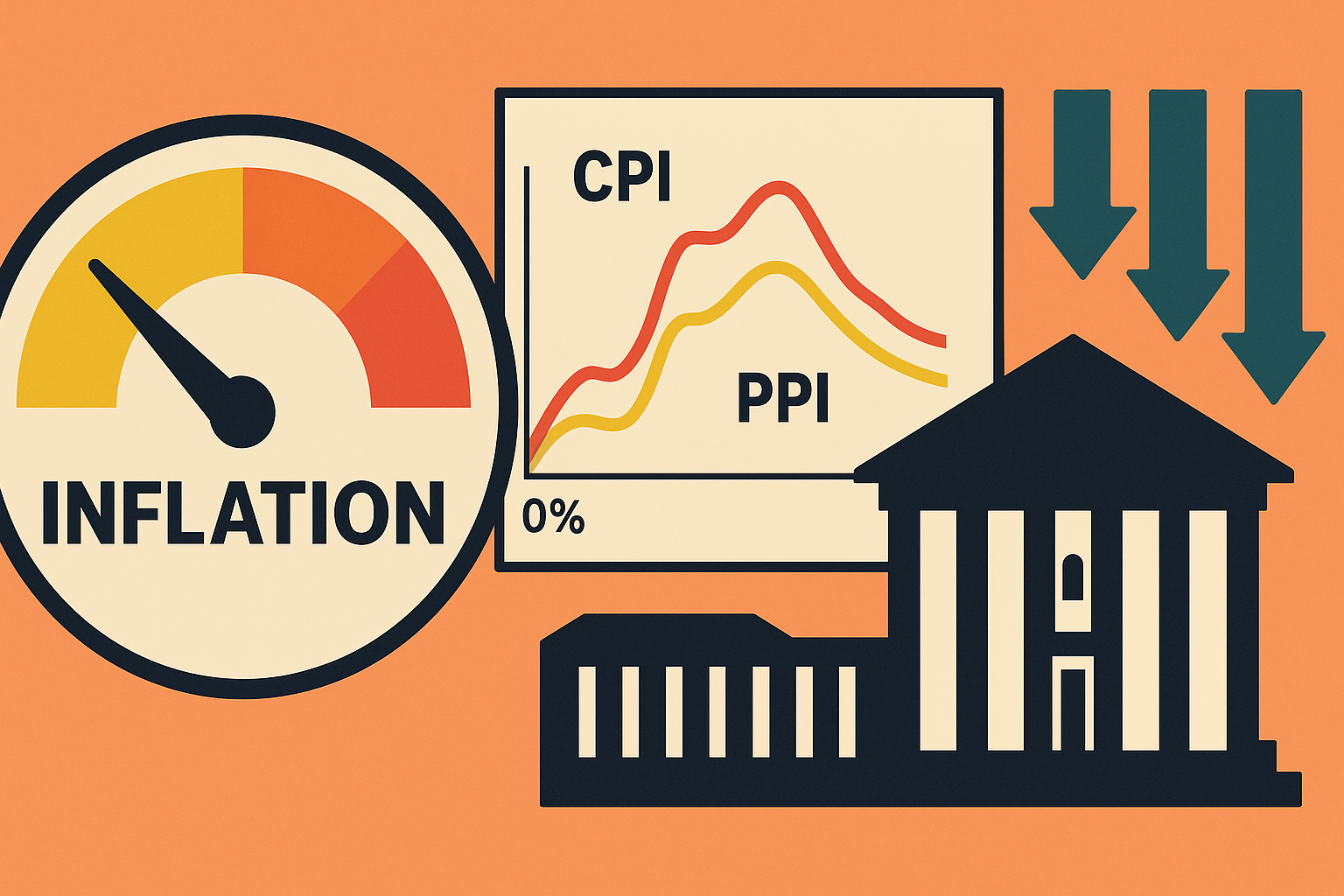
As the Federal Reserve navigates a landscape of sticky inflation and a cooling labor market, attention is turning to how upcoming inflation data and business confidence indicators could shape the path toward rate cuts in 2026. Will the Fed pivot again, and if so, how aggressively? This report examines key inflation releases, complementary indicators, policy messaging, and the potential market impact.
produto:The Art of X: Build a Business That Makes You $100/Day
Recent Context: Inflation, Fed Moves, and Market Sentiment
Throughout 2025, headline inflation has remained slightly above the Fed’s comfort zone. By late summer, year-over-year CPI hovered around 2.9 %, while core inflation held near 3.1 %. Producer prices have also shown renewed strength, reflecting higher service costs and persistent wage pressures.
The Fed has already implemented one rate cut this year, with another possible before year-end. However, policymakers continue to stress caution. Chair Jerome Powell recently reaffirmed that progress on inflation remains “uneven,” emphasizing that policy will stay data-dependent. Other Fed officials, such as Vice Chair Michael Barr and Philadelphia Fed President Anna Paulson, have echoed the need for prudence while acknowledging growing risks to employment and business confidence.
The message is clear: the bar for additional cuts in 2025 remains high, and the trajectory into 2026 hinges on convincing evidence that inflation is sustainably cooling.
---
Forecasts and Key Releases: CPI, Core CPI, and PPI
Schedule and Market Expectations
Both CPI and PPI releases are due mid-month through the Bureau of Labor Statistics. Consensus forecasts point to a modest monthly rise of 0.2 % to 0.3 % in headline CPI and around 0.3 % in core CPI. Producer prices are expected to show a similar moderation, easing from the summer spike toward a more stable range.
Even small deviations from these estimates could sway expectations sharply. Softer inflation prints would reinforce the case for multiple rate cuts in 2026; any upside surprise could delay or reduce the scale of easing.
Nowcasting and Input Signals
The Cleveland Fed’s inflation nowcasting models remain a key reference, capturing near-term movements in prices before official releases. Additionally, food and energy volatility remains an unpredictable driver of headline inflation, with ongoing tariff effects and service-sector costs contributing to uncertainty.
Tariff pass-through and wage growth are likely to determine whether inflation resumes its descent or plateaus near current levels — a factor that could heavily influence the timing of rate adjustments next year.
---
Complementary Indicators: NFIB, Regional Fed Surveys, and Expectations
Beyond headline inflation, a series of high-frequency indicators will guide the Fed’s assessment of underlying pressures.
The NFIB Small Business Survey continues to show elevated price-hike intentions among small firms, suggesting that pricing momentum persists beneath the surface. Meanwhile, regional Fed surveys — particularly from New York, Philadelphia, and Dallas — highlight mixed conditions across industries and regions, with some pockets of softening demand.
Inflation expectation surveys from the New York Fed and the University of Michigan suggest that consumers still expect price growth to moderate gradually, though the dispersion of responses has widened. This split underscores the fragility of confidence in the Fed’s inflation-targeting credibility.
If expectations rise or regional pricing power strengthens, policymakers may turn more defensive, even if headline CPI appears benign.
---
Fed Messaging and Market Expectations for 2026 Cuts
The latest FOMC projections continue to show gradual progress toward the 2 % target by 2027, with the median path implying modest easing through 2026. Yet internal divisions persist: some officials favor preemptive cuts to avoid overtightening, while others prefer to hold rates high until inflation is decisively tamed.
Market-implied probabilities suggest at least two rate cuts in 2026 are priced in. Futures curves currently point to an initial move in the second quarter of 2026, contingent on continued disinflation and a stable labor backdrop.
The delicate interplay between data and communication remains crucial. If inflation moderates as expected, the Fed will likely move gradually; if not, the path could be postponed — a scenario markets have not fully priced.
---
Implications for Fixed Income and Equity Markets
Fixed Income
Bond markets remain hypersensitive to inflation surprises. A series of softer prints would flatten the yield curve further and enhance total returns for intermediate-duration bonds. Conversely, sticky inflation could push short-end yields higher, steepening the curve and eroding performance for long-duration assets.
Investors are increasingly favoring shorter-duration and floating-rate exposures, providing flexibility against potential re-pricing shocks as the Fed’s trajectory evolves.
Equities
Equities continue to trade on a delicate balance between macro weakness and policy relief. A scenario of moderate inflation and gradual easing supports valuation multiples, while persistent inflation would compress them. Growth sectors remain the most rate-sensitive, and any delay in easing could prompt renewed rotation toward cyclicals and value stocks.
Volatility is likely to rise around CPI and PPI release days, as each data point redefines the narrative for policy direction.
---
Risks and Alternative Scenarios
Sticky Inflation Scenario
If inflation remains entrenched due to service costs, tariffs, or wage growth, the Fed could slow or pause its easing cycle. Persistent price pressures would risk re-anchoring inflation expectations at higher levels, testing the Fed’s credibility.
Soft-Growth or Recession Scenario
Conversely, if economic activity weakens materially, the Fed could be forced to cut earlier and more aggressively despite lingering inflation risks. Under such conditions, bond yields would likely fall sharply, while equity markets could face earnings-related volatility.
Policy and Data Risks
Potential data delays, political uncertainty, or fiscal disruptions could cloud the near-term picture, introducing additional volatility to market pricing.
External Shocks
Energy price swings or renewed global supply pressures could alter the inflation outlook unexpectedly, compelling the Fed to reassess its easing path.
produto:The Art of X: Build a Business That Makes You $100/Day
Conclusion
As 2025 draws to a close, the Federal Reserve finds itself at an inflection point. The path toward rate cuts in 2026 will depend not only on CPI and PPI outcomes but also on broader sentiment indicators and the credibility of inflation expectations.
Markets remain poised between competing forces — disinflation that justifies easing, and lingering cost pressures that argue for patience. For investors, vigilance and flexibility will be essential as each data release reshapes the probabilities for policy and performance.
---
FAQ
Q1: Which inflation release will most likely influence the Fed’s 2026 rate-cut expectations?
A: Core CPI tends to drive policy expectations because it filters out volatile components and better captures underlying inflation trends.
Q2: Can weak growth data prompt the Fed to cut even if inflation remains elevated?
A: Yes, but the Fed would proceed cautiously, balancing the risk of recession against the threat of renewed inflation.
Q3: Why do regional Fed surveys matter?
A: They provide early signals about business activity and pricing power between national data releases, often foreshadowing broader inflation trends.
Q4: How should investors prepare for uncertainty around rate cuts?
A: Maintaining diversified exposure, with an emphasis on shorter-duration and flexible fixed-income instruments, can help mitigate volatility as the outlook evolves.
---
Sources and Further Reading
- Bureau of Labor Statistics – CPI and PPI Releases (August–October 2025)
- Federal Reserve Board – Speeches by Powell (Oct 14, 2025) and Barr (Oct 9, 2025)
- Cleveland Fed – Inflation Nowcasting Model
- NFIB – Small Business Economic Trends Survey, September 2025
- New York Fed – National and Regional Economic Outlook (October 2025)
- Philadelphia Fed – Economic Outlook Remarks by Anna Paulson (October 2025)
- IMF – Inflation Expectation and Credibility Commentary (October 2025)
- Reuters, Bloomberg, and FRED data (October 2025)
---