Markets
3 Key Risks Investors Must Watch in 2026
Inflation uncertainty, Fed policy shifts, and geopolitical tensions are reshaping market expectations
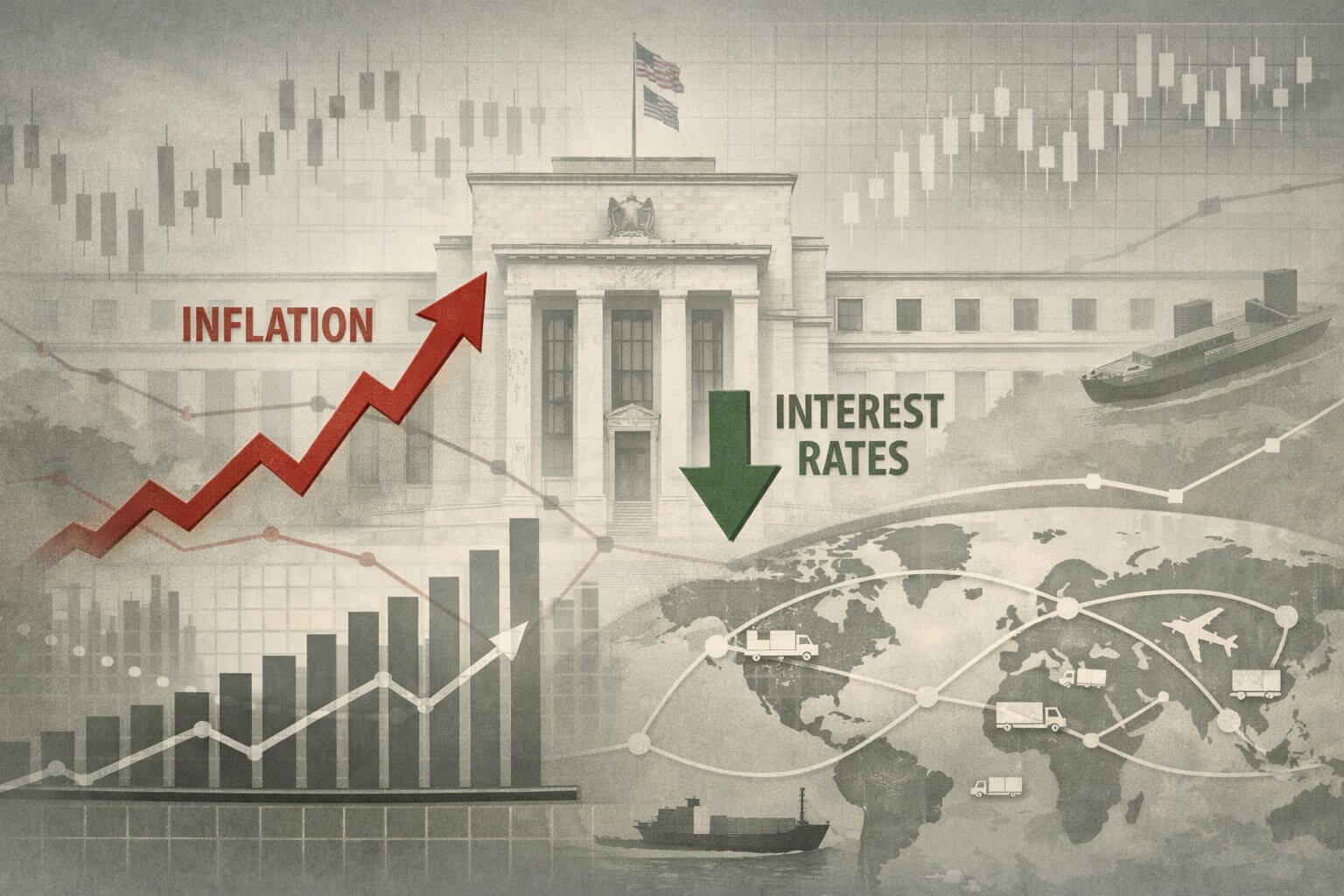
As 2026 unfolds, investors are navigating a market environment defined less by clear trends and more by persistent uncertainty. While recession fears have eased compared to prior years, three macro-financial risks continue to shape investor positioning: inflation volatility, Federal Reserve policy ambiguity, and renewed geopolitical disruptions.
Understanding these forces is critical—not just for risk management, but for identifying where markets may misprice future outcomes.
A Fragile Inflation Path Keeps Markets on Edge
The latest Consumer Price Index data released on 02/12/2026 showed inflation moderating but still above the Federal Reserve’s 2% target. Core inflation remains particularly sticky, driven by services and wage pressures.
Similarly, the Personal Consumption Expenditures index published on 02/28/2026 reinforced this trend, suggesting that while goods disinflation has progressed, underlying price pressures persist.
Why does this matter now? Because markets had largely priced a smooth disinflation path entering 2026. Any deviation—especially from wage-driven inflation—raises the risk of prolonged higher interest rates.
For equities, this creates valuation pressure. For bonds, it introduces uncertainty around real yields. Commodities, meanwhile, remain sensitive to inflation hedging demand.
Federal Reserve Policy Uncertainty Re-enters Focus
The Federal Reserve’s latest decision on 01/29/2026 signaled a cautious stance, maintaining restrictive policy while emphasizing data dependence. However, divergence between market expectations and Fed guidance is widening.
Treasury yields, particularly the 10-year note as of 03/10/2026, reflect this tension. Investors are oscillating between expectations of rate cuts and the possibility of a prolonged higher-rate regime.
This uncertainty has tangible consequences. Equity markets struggle to sustain momentum without clarity on discount rates, while fixed income investors face duration risk amid shifting policy signals.
In short, the Fed is no longer a predictable anchor—it is a source of volatility.
Geopolitical and Supply Chain Risks Resurface
Global risks are once again moving to the forefront. Ongoing geopolitical tensions and fragmented trade dynamics are contributing to renewed supply chain concerns.
Energy markets illustrate this clearly. Oil market data from 02/2026 shows continued volatility, driven by production uncertainty and regional instability.
These disruptions extend beyond commodities. Supply chain inefficiencies can feed back into inflation, complicating central bank policy and amplifying market volatility.
For investors, the implication is clear: geopolitical risk is no longer a tail risk—it is a baseline assumption.
The Bottom Line
Markets in 2026 are not defined by a single dominant narrative but by the interaction of multiple uncertainties. Inflation is easing—but not resolved. The Fed is cautious—but not predictable. Geopolitical risks are persistent—not temporary.
For investors, the challenge is less about forecasting precision and more about scenario preparedness.
AlphaPulse’s view: in a market shaped by overlapping risks, resilience—not conviction—may be the most valuable strategy.
---
FAQ
What is the biggest risk for investors in 2026?
Persistent inflation remains the most immediate risk, as it directly influences interest rates and asset valuations.
Is the Federal Reserve expected to cut rates in 2026?
As of early 2026, the Fed remains data-dependent, with no clear commitment to rate cuts.
How do geopolitical risks impact markets?
They affect energy prices, supply chains, and global trade, often increasing volatility across asset classes.
Are bonds safer in 2026?
Not necessarily—rate uncertainty introduces duration risk, making bond performance less predictable.
---
Sources and Further Reading
- Consumer Price Index Summary — U.S. Bureau of Labor Statistics — 02/12/2026 — https://www.bls.gov
- Personal Consumption Expenditures Price Index — Bureau of Economic Analysis — 02/28/2026 — https://www.bea.gov
- FOMC Statement — Federal Reserve — 01/29/2026 — https://www.federalreserve.gov
- Daily Treasury Yield Curve Rates — U.S. Treasury — 03/10/2026 — https://home.treasury.gov
- World Economic Outlook Update — International Monetary Fund — 01/2026 — https://www.imf.org
- Oil Market Report — International Energy Agency — 02/2026 — https://www.iea.org
- Global Markets Volatility Coverage — Reuters — 03/2026 — https://www.reuters.com
---