Markets
Kharg Island Emerges as a New Oil Market Flashpoint
Why Iran’s export hub is reshaping crude price risk and energy volatility
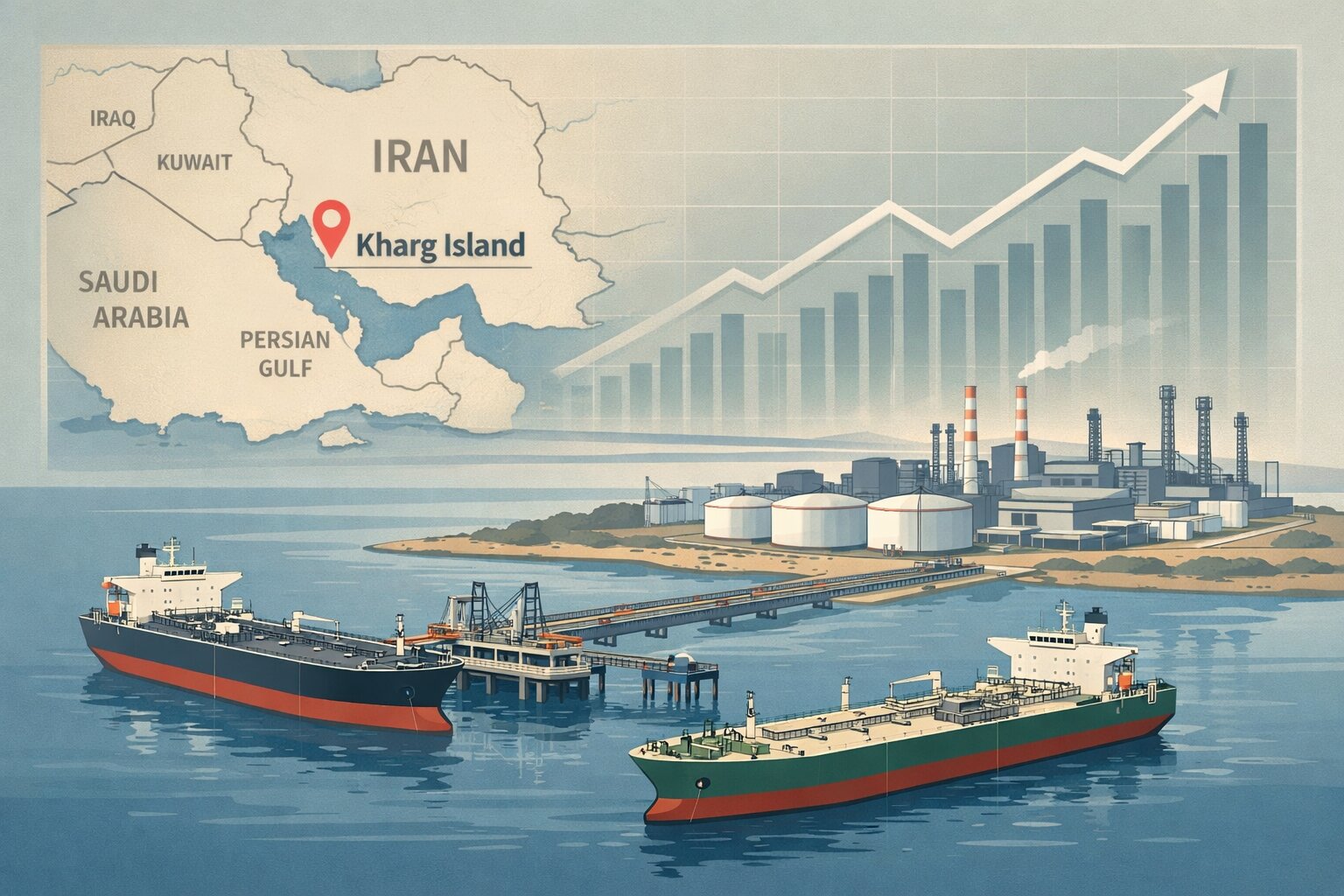
Energy markets rarely react to geography alone. But in early March 2026, a small island in the Persian Gulf suddenly became one of the most closely watched locations in global oil trading.
Kharg Island, Iran’s primary crude-export terminal, is drawing renewed attention following military escalation in the Gulf beginning on February 28, 2026. Analysts now warn that disruptions involving the island could reverberate across global oil supply chains, influence inflation expectations, and introduce new volatility for investors and businesses in the United States.
Why the sudden focus? The answer lies in a simple but powerful statistic: Kharg Island handles roughly 90% of Iran’s crude exports.
In a market already sensitive to geopolitical shocks, that level of concentration represents a major vulnerability.
---
Why Kharg Island Is Back in the Spotlight
Located about 16 miles off Iran’s coast in the northern Persian Gulf, Kharg Island has long served as the centerpiece of the country’s oil export infrastructure. Massive storage tanks, loading terminals, and pipeline connections allow Iranian crude to move from inland fields to tankers bound for global markets.
Energy analysts estimate that the facility supports the vast majority of Iran’s crude export capacity, which has fluctuated in recent years but has often exceeded 1.5 million barrels per day depending on sanctions enforcement and global demand.
This concentration makes the island uniquely important. Unlike some major exporters that rely on multiple terminals, Iran’s system remains highly centralized.
If Kharg Island were disrupted—even temporarily—most Iranian crude exports could stall.
For global markets, that creates a potential supply shock scenario that traders are now actively modeling.
---
The February–March 2026 Escalation Timeline
February 28, 2026: Military Tensions Intensify
The current wave of concern began on February 28, 2026, when renewed military tensions in the Persian Gulf prompted security warnings for shipping routes near Iranian waters.
Oil markets reacted almost immediately. Benchmark crude prices rose as traders priced in the possibility that escalating conflict could threaten regional energy infrastructure or tanker routes.
Although no direct damage to oil facilities was reported, the event reminded markets how quickly geopolitical risk can spill into commodity pricing.
March 9, 2026: Analysts Highlight Kharg Island Risk
Attention shifted sharply on March 9, 2026, when new market analysis emphasized Kharg Island’s central role in Iran’s oil export system.
The report underscored a key vulnerability: because the island processes the vast majority of Iran’s crude exports, even limited disruption could affect global supply balances.
Energy traders began incorporating the facility into their geopolitical risk models, particularly in scenarios involving broader Gulf escalation.
March 11, 2026: Shipping Industry Response
By March 11, 2026, the shipping sector had started reacting.
Tanker operators and maritime security groups reported heightened monitoring across Gulf shipping lanes. Some firms reviewed insurance coverage and routing strategies, reflecting concerns about potential disruptions near Iranian export terminals or transit routes.
Even without a direct attack or blockade, the mere perception of risk can influence tanker traffic, insurance premiums, and freight costs.
Those changes can ripple quickly into global energy pricing.
---
Why Energy Markets Are Sensitive to Kharg Island
To understand why Kharg Island matters to investors, it helps to view the facility in the broader context of global oil logistics.
Iran remains one of the largest oil producers in the Middle East, and its exports play a meaningful role in balancing global supply and demand—particularly for Asian buyers.
But the island’s strategic significance extends beyond Iranian output.
Most tankers loading at Kharg Island must travel through the Strait of Hormuz, one of the world’s most critical oil chokepoints. Roughly one-fifth of globally traded petroleum passes through the strait each day.
That means risks around Kharg Island are effectively layered on top of an already sensitive transit corridor.
In practical terms, markets must consider two overlapping vulnerabilities:
- Disruption at the export terminal itself
- Disruption along tanker routes leaving the Gulf
Either scenario could tighten global oil supply.
---
Market Transmission: Oil Prices, Inflation, and Volatility
For U.S. investors and businesses, geopolitical events around Kharg Island matter primarily through their impact on energy prices.
Oil Price Risk Premium
When markets perceive a higher probability of supply disruption, crude prices typically incorporate a geopolitical risk premium.
That premium reflects uncertainty rather than actual lost production. But historically, even perceived risks in the Persian Gulf have pushed oil prices upward.
If traders believe Iran’s exports could be interrupted, the price response can be swift.
Inflation Expectations
Higher crude prices tend to filter into the broader economy through fuel costs, transportation expenses, and industrial inputs.
For policymakers and investors tracking inflation, energy shocks are particularly important because they can influence consumer expectations and central bank decision-making.
A sustained increase in oil prices would complicate the Federal Reserve’s efforts to manage inflation expectations in 2026.
Market Volatility
Energy-sector equities, oil futures, and shipping stocks often experience heightened volatility during geopolitical crises.
Even without long-term supply losses, markets can swing sharply as investors reassess risk probabilities.
That dynamic explains why Kharg Island—a relatively small location on the map—has become a focal point for global macro traders.
---
What Investors Should Watch Next
Several developments could determine whether Kharg Island remains a background risk or evolves into a full-scale market driver.
First is the trajectory of military tensions in the Persian Gulf. Any direct threat to energy infrastructure would likely produce an immediate oil price reaction.
Second is tanker traffic. If shipping firms begin avoiding certain routes or insurance premiums spike, energy logistics could tighten quickly.
Third is government policy. Strategic petroleum reserve releases or coordinated responses from major oil producers could offset supply shocks if disruptions occur.
For now, the market’s reaction remains largely precautionary.
But the events of early March 2026 serve as a reminder that global energy markets remain deeply exposed to geopolitical chokepoints—and Kharg Island has suddenly reentered that risk map.
---
FAQ
Why is Kharg Island important to global oil markets?
Kharg Island is Iran’s main oil export terminal and handles roughly 90% of the country’s crude shipments. Disruptions there could significantly reduce Iranian exports.
How could events at Kharg Island affect oil prices?
If traders believe exports could be disrupted, crude prices often rise due to a geopolitical risk premium reflecting potential supply shortages.
What role does the Strait of Hormuz play in this situation?
Most tankers leaving Kharg Island must pass through the Strait of Hormuz, a chokepoint through which about 20% of global oil trade flows.
Why should U.S. investors watch developments there?
Changes in oil prices can influence inflation, energy stocks, transportation costs, and overall market volatility.
---
Sources and Further Reading
- Iran Oil Exports and Kharg Island Infrastructure — U.S. Energy Information Administration — 01/2024 — https://www.eia.gov
- World Oil Transit Chokepoints: Strait of Hormuz — U.S. Energy Information Administration — 09/2025 — https://www.eia.gov
- Oil Prices Rise as Middle East Tensions Escalate — Reuters — 02/28/2026 — https://www.reuters.com
- Energy Markets React to Gulf Escalation and Iran Export Risks — Bloomberg — 03/09/2026 — https://www.bloomberg.com
- Shipping Firms Monitor Gulf Risks After Military Activity — Reuters — 03/11/2026 — https://www.reuters.com
- Iran’s Oil Export Infrastructure and Strategic Risks — Center for Strategic and International Studies — 2024 — https://www.csis.org
- Global Oil Market Report — International Energy Agency — 02/2026 — https://www.iea.org
---
Editorial Note: This content is strictly educational and does not constitute investment advice.
---