Business
The Silent Shift: Why Manufacturing Is Leaving China
Tariffs, geopolitics, and cost pressures accelerate the China-plus-one strategy in 2026
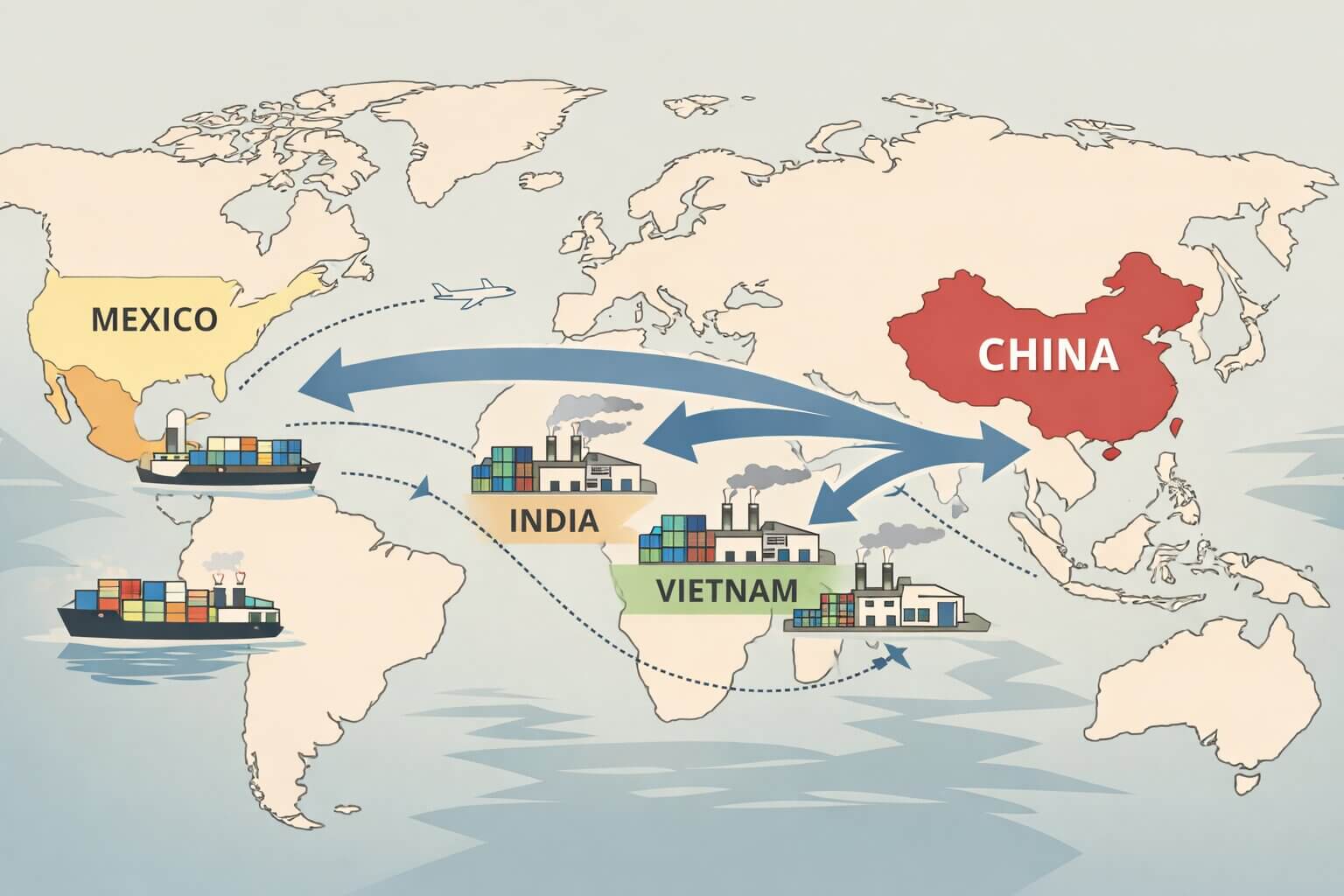
The gradual reconfiguration of global supply chains is entering a new phase in 2026. What began as a cautious diversification strategy—often labeled “China-plus-one”—is now evolving into a more decisive structural shift.
Two developments in March underscore the turning point. On March 11, 2026, U.S. authorities announced new trade investigations targeting Chinese imports, renewing concerns over tariff escalation. Just days earlier, on March 9, 2026, Apple signaled a deeper commitment to India by expanding its production footprint beyond earlier projections.
Taken together, these signals reflect a broader recalibration underway across global manufacturing.
---
A New Inflection Point in 2026
For much of the past decade, multinational corporations sought to balance efficiency with geopolitical risk. China remained central due to its unmatched industrial ecosystem, but firms quietly built secondary capacity elsewhere.
That balancing act is now shifting.
The March 11 trade investigation announcement revived the possibility of additional tariffs or restrictions, reinforcing a persistent reality: policy risk tied to China is no longer episodic—it is structural.
At the same time, corporate decisions are becoming more visible. Apple’s expanded India production plans, reported on March 9, 2026, highlight how even the most entrenched China-dependent supply chains are diversifying at scale.
The question is no longer whether companies will diversify, but how quickly.
---
The Structural Forces Behind the Shift
Tariff Exposure and Policy Risk
Since the initial wave of U.S. tariffs in 2018, companies have operated under a cloud of uncertainty. While some tariffs remained stable, the policy environment has proven fluid, shaped by national security concerns, industrial policy, and electoral cycles.
The March 2026 investigations signal that tariffs remain an active policy lever. For manufacturers, this creates a persistent cost variable—one that is difficult to hedge and increasingly hard to ignore.
Rising Labor Costs in China
China’s economic success has naturally driven wage growth. Manufacturing wages have risen steadily over the past decade, narrowing the cost advantage that once defined the country’s export dominance.
While China still offers productivity and scale, the relative cost gap versus emerging markets such as India and Vietnam has compressed significantly.
Supply Chain Resilience Post-Pandemic
The COVID-19 pandemic exposed vulnerabilities in highly concentrated supply chains. Lockdowns, port congestion, and component shortages revealed how fragile global production networks could be.
Since then, resilience has become a board-level priority. Geographic diversification is no longer optional—it is embedded in corporate risk management frameworks.
---
Where Manufacturing Is Going
India’s Push for Scale
India is emerging as a primary beneficiary of the shift. Government incentives, including production-linked incentive (PLI) schemes, have attracted global manufacturers across electronics, pharmaceuticals, and automotive sectors.
Apple’s expanded production footprint illustrates this trend. Suppliers are scaling operations, and India is positioning itself not just as an alternative, but as a long-term manufacturing hub.
Yet challenges remain. Infrastructure gaps, regulatory complexity, and workforce training continue to shape the pace of expansion.
Vietnam’s Export Boom
Vietnam has quietly become a manufacturing powerhouse, particularly in electronics and apparel. Its integration into global trade agreements and proximity to China make it an attractive “plus-one” destination.
Exports have grown rapidly, supported by foreign direct investment and a stable policy environment. For many companies, Vietnam offers a balance between cost efficiency and operational continuity.
Mexico and the Rise of Nearshoring
For U.S. companies, Mexico presents a different proposition: proximity.
Nearshoring has accelerated as firms seek shorter supply chains and reduced transportation risk. U.S.-Mexico trade has reached record levels, supported by the USMCA framework.
Industrial investment in northern Mexico has surged, particularly in sectors such as automotive, electronics, and industrial equipment. The appeal is clear—faster delivery times, lower shipping costs, and closer alignment with U.S. demand.
---
Implications for U.S. Multinationals
Margin Pressures and Capital Expenditure
Diversifying supply chains is not cost-neutral. Building new facilities, onboarding suppliers, and navigating regulatory environments require significant capital investment.
In the near term, this can compress margins. However, companies increasingly view these investments as insurance against future disruptions.
Logistics and Lead Times
Geography is becoming a competitive advantage.
Nearshoring to Mexico can reduce shipping times from weeks to days, while regional diversification in Asia can mitigate bottlenecks. The trade-off between cost and speed is being recalibrated.
Portfolio Diversification
Supply chains are beginning to resemble investment portfolios—diversified, risk-adjusted, and actively managed.
Companies are no longer optimizing for a single lowest-cost location. Instead, they are balancing cost, resilience, and geopolitical exposure.
---
What Investors Should Watch Next
The manufacturing shift away from China is not a sudden exodus, but a gradual reallocation of capacity.
Investors should monitor three key signals:
- Trade policy developments: Additional tariffs or restrictions could accelerate diversification.
- Capital expenditure cycles: Rising investment in India, Vietnam, and Mexico will signal long-term commitment.
- Infrastructure scaling: The ability of alternative hubs to absorb demand will determine how quickly the shift unfolds.
The broader implication is clear: globalization is not reversing, but it is being restructured.
---
FAQ
Why are companies moving manufacturing out of China in 2026?
Companies are responding to rising tariffs, geopolitical risk, higher labor costs, and the need for more resilient supply chains.
What is the China-plus-one strategy?
It refers to diversifying manufacturing beyond China by adding production capacity in other countries such as India, Vietnam, or Mexico.
Which countries are benefiting the most?
India, Vietnam, and Mexico are प्रमुख beneficiaries due to cost advantages, policy incentives, and strategic location.
Will China lose its manufacturing dominance?
China will remain a major manufacturing hub, but its share of global production is gradually declining as companies diversify.
---
Sources and Further Reading
- Apple Expands India Manufacturing — Reuters — 03/09/2026 — https://www.reuters.com/
- U.S. Launches New Trade Investigations — Bloomberg — 03/11/2026 — https://www.bloomberg.com/
- Global Supply Chains Shift Beyond China — Wall Street Journal — 02/2026 — https://www.wsj.com/
- Vietnam Export Growth Data — World Bank — 01/2026 — https://www.worldbank.org/
- Mexico Nearshoring Boom — Financial Times — 02/2026 — https://www.ft.com/
- China Wage Growth Trends — National Bureau of Statistics of China — 2025 — https://www.stats.gov.cn/
---