Economy
Philly Fed & NAHB Prints to Watch Amid U.S. Shutdown
Private indicators step into the spotlight as federal data falters
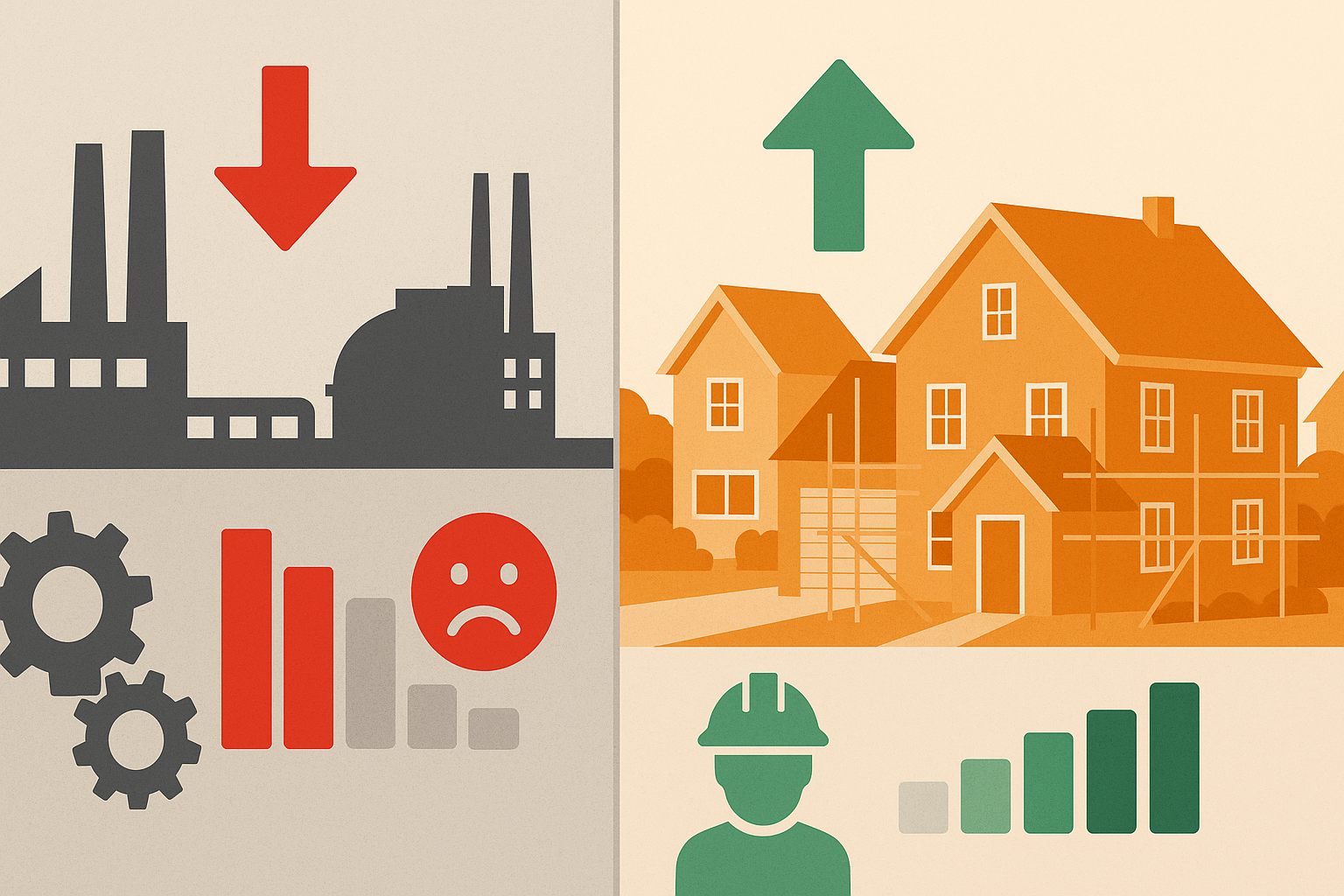
Philadelphia Fed & NAHB Prints Will Anchor Market View During U.S. Shutdown
Private and regional sentiment gauges now carry outsized weight
As the U.S. federal government remains partially shuttered, many high-profile economic data releases are delayed or truncated. Yet two private/regional surveys — the Philadelphia Fed Manufacturing Business Outlook Survey and the NAHB/Wells Fargo Housing Market Index (HMI) — are expected to publish on Thursday, October 16 (at 8:30 a.m. ET and 10:00 a.m. ET, respectively).
Because these indicators lie outside the direct purview of federal operations, they are likely to arrive as scheduled — and in today’s environment, that makes them especially valuable. Their signals on manufacturing momentum and builder sentiment may help fill gaps, guide market expectations, and even influence the Federal Reserve’s deliberations amid policy uncertainty.
produto:The Art of X: Build a Business That Makes You $100/Day
Why These Prints Matter Now
1. A data vacuum amid the shutdown
The federal shutdown is causing delays or selective publication of key reports — think the Census Bureau, parts of the Bureau of Labor Statistics, and other agencies. In that vacuum, markets and analysts will lean more heavily on regional and private data that remain on schedule. The Philadelphia Fed and NAHB prints are two among the few timely gauges that cross sectoral boundaries (manufacturing, housing) and offer a contemporaneous read on demand, cost pressures, and hiring intentions.
2. Early signals for inflation, hiring trends, and real activity
Both surveys tend to lead broader national indicators:
- The Philadelphia Fed diffusion index (and related subindexes like new orders, shipments, employment, prices paid/received) often foreshadows ISM manufacturing trends and helps track industrial momentum.
- The NAHB HMI — rooted in builder expectations and buyer traffic — often preempts movements in housing starts, residential investment, and demand for related goods and materials.
---
What to Watch in the Philadelphia Fed Survey
In September, the Philadelphia Fed’s diffusion index for current general activity rose sharply to +23.2 (from −0.3 in August) — its strongest reading since January. Some sub-components were more mixed:
- The prices paid index fell 20 points to 46.8, signaling easing input cost pressures.
- The prices received index dropped to 18.8, showing weak pricing power.
- The employment index hovered at ~5.6, showing modest hiring.
These data suggest firms saw a rebound in activity (particularly new orders and shipments) but continued to experience constraints on pricing. The sharp rise in the headline index likely reflected pent-up demand or catch-up orders, but the drop in price indexes warns against complacency on inflation.
For the October print, markets will key on:
- Whether the headline diffusion remains strong or softens (expectations are ~9.1 per economic calendars)
- Momentum in new orders and unfilled orders
- Employment intentions and hours worked
- The trajectory of prices paid / prices received, which may hint at input cost pass-through or slack
A sustained move above zero would reinforce optimism in the industrial sector, while a reversion or retreat could cast doubt on the September strength.
---
Builder Sentiment: NAHB at a Multi-Year Low
Builder confidence has been teetering near weak extremes. In June 2025, the NAHB HMI plunged to 32, down from 34 in May, marking the lowest reading since late 2022.
That decline was broad-based:
- Current sales conditions fell to ~35.
- Buyer traffic dropped to just 21 (among the survey’s weakest levels)
- Future sales expectations sank to 40.
- Price-cutting is widespread: 37 % of builders reported cutting prices, with an average 5 % reduction.
In September, the HMI stayed at 32, unchanged month-over-month — a plateau at depressed levels.
The share of builders cutting prices rose to 39 % (compared to 37 % prior), and 65 % employed sales incentives, underlining weak demand.
NAHB leadership has already flagged expectations for a further drop in single-family starts in 2025.
On Thursday, the key things to monitor are:
- Whether the headline HMI slips again (expectations center around 32–33)
- Any change in subcomponents (traffic, current vs. future sales)
- The prevalence of price cuts and incentives (which could signal desperation if elevated)
- Whether builder expectations for starts tilt more pessimistic
A renewed dip would reinforce downside risk for housing and could burnish expectations for muted residential investment later this year.
---
Interpreting the Composite Signal
Putting both prints side by side:
| Dimension | Positive Surprise | Weak or Negative Surprise |
| ---------- | ------------------------------------------------------------------------- | ------------------------------------------------------------ |
| Philly Fed | Sustained diffusion > 0, rising orders/employment | Reversion toward zero or negative, weakening orders |
| NAHB HMI | Rebound in buyer traffic, fewer price cuts, uptick in future expectations | Further slide in overall reading, more aggressive incentives |
If both surprise to the upside, that would offer a more robust narrative of resilience amid policy strain — strengthening confidence that mid-2025 weakness was episodic.
If both disappoint or diverge, the narrative will shift toward caution: manufacturing stalling and housing decaying under interest rate and uncertainty pressure.
For markets and the Fed, this matters. A soft duo could reinforce downside risk to growth and tilt sentiment toward more easing. A strong pair, however, would complicate the policy picture — inflation pressures might be rekindled, especially if input costs begin creeping upward again.
---
Risks & Caveats
- Regional vs. national representativeness: The Philadelphia Fed covers only parts of the Mid-Atlantic and may not capture trends in the Midwest, South, or West.
- Volatility in diffusion indices: These surveys are subject to month-to-month noise and lumpy order behavior.
- Builder expectations are notoriously fickle: They may overreact to mortgage rates, credit terms, or regulatory shifts, producing forward-looking surprises that don’t immediately materialize.
- Shutdown distortions: In an irregular environment, firms may adjust responses more on sentiment than fundamentals. The context of disruption may bias responses.
- Lag to actual starts or output: Even if sentiment recovers, material constraints (labor, permits, supply chain) may limit follow-through.
Nevertheless, in a period of constrained official data flow, these surveys may become de facto bellwethers for market positioning and policy narratives.
produto:The Art of X: Build a Business That Makes You $100/Day
What to Watch After the Prints
- ISM Manufacturing: The October 1 release (usually early November) will test whether the Philadelphia Fed trends carried broader weight.
- Housing Starts & Permits: Next month’s Census/HUD reports would confirm whether weaker sentiment is translating into real declines.
- Fed reaction and forward guidance: With fewer reliable data, the Fed may lean more on these prints and the Beige Book in its upcoming decisions.
- Yield curves and credit spreads: These prints may shift interest rate expectations, particularly in the 2–10 year segment.
In short: in this truncated data environment, Thursday’s Philadelphia Fed and NAHB prints are not just interest-rate fodder — they could help define the macro narrative for the remainder of 2025.
---
FAQ
Q: Why will these surveys publish despite the government shutdown?
Because the Philadelphia Fed’s business outlook survey and the NAHB’s housing index are funded and executed privately (or by nonfederal entities), they are insulated from many of the disruptions affecting federal agencies.
Q: How do these indicators "lead" national data?
They capture forward-looking sentiment (orders, hiring intentions, future sales) and often precede turning points in ISM or Census output measures by a month or more, especially when shifts in demand or cost conditions begin to cascade.
Q: Can a strong Philly Fed reading mask weakness elsewhere?
Yes — regional strength (in Mid-Atlantic manufacturing) may diverge from trends in the Midwest, South, or global supply constraints. Analysts will check broader manufacturing surveys (e.g. ISM, New York Fed) to triangulate.
Q: What would a weak NAHB signal imply about residential investment?
A weaker HMI often foreshadows softer housing starts, lower builder spending, and slower residential investment — particularly concerning given housing’s multiplier effects on employment and materials demand.
---
Sources and Further Reading
- September 2025 Manufacturing Business Outlook Survey — Philadelphia Fed — 09/18/2025
- "Philly Fed Index Surges to Eight-Month High in September" — RTT News
- "Philadelphia Fed Manufacturing Index Signals Continued Weakness in June 2025" — Advisor Perspectives
- NAHB/Wells Fargo Housing Market Index release and components — NAHB press release
- "Homebuilder sentiment skids to 2-1/2-year low, NAHB says" — Reuters — 06/17/2025
- NAHB “Builder Sentiment at Third Lowest Reading Since 2012” — NAHB press release
- “May Housing Starts Fall to Five-Year Low” — MortgagePoint / Census-HUD data
- Trading Economics: forecasts for Philadelphia Fed Index & NAHB HMI
---