Markets
The Psychology of Market Bubbles: Why 2026 Feels Familiar
From AI stocks to crypto volatility, investor behavior is reviving patterns seen in past speculative cycles.
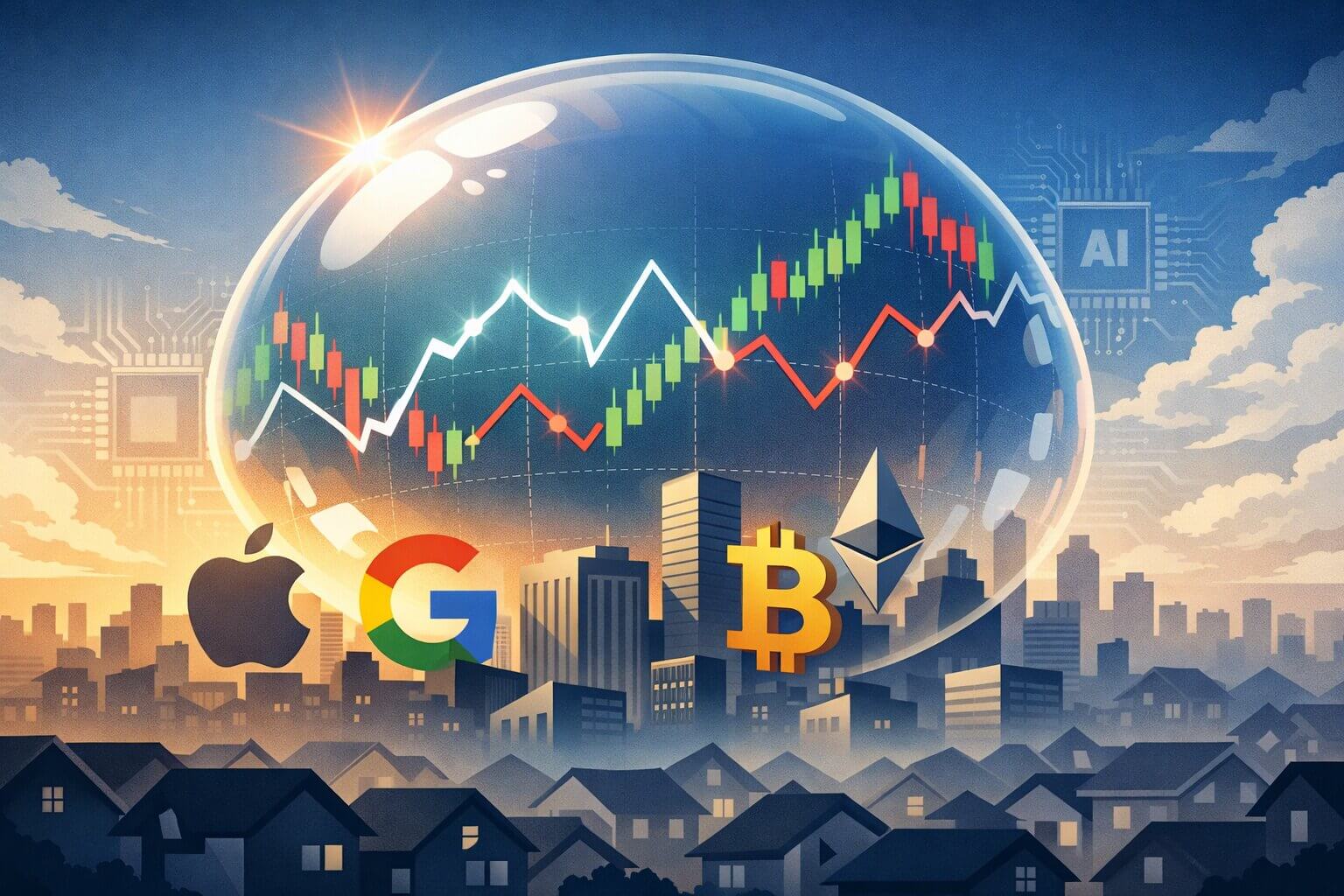
Financial bubbles rarely look identical in their details, yet they often follow remarkably similar psychological scripts. In early 2026, many investors are asking whether markets are once again drifting into a familiar narrative: concentrated gains in technology stocks, elevated valuation multiples, and renewed volatility in digital assets.
The debate has intensified as artificial intelligence–linked companies continue to dominate equity performance while crypto markets swing sharply between rallies and corrections. For seasoned market observers, the question is not simply whether prices are high, but whether investor behavior is beginning to resemble the late stages of previous speculative cycles.
History suggests that bubbles rarely begin with irrationality. They start with a compelling story.
---
---
Why Bubble Psychology Matters Again in 2026
By March 2026, the U.S. equity market remains heavily concentrated in a handful of technology companies associated with artificial intelligence infrastructure, cloud computing, and semiconductor manufacturing. Several of these firms trade at valuation multiples far above long-term historical averages.
At the same time, digital assets have experienced renewed volatility after major rallies and corrections between 2024 and early 2026. The combination has revived an old debate: when does innovation-driven optimism cross into speculative excess?
The answer often lies not in earnings forecasts or valuation models but in behavior. Behavioral finance research shows that bubbles tend to emerge when several psychological forces converge: herding, overconfidence, narrative-driven investing, and fear of missing out.
These forces can push asset prices far beyond underlying fundamentals, particularly when liquidity is abundant and risk tolerance is high.
---
Lessons From the Dot-Com Bubble
The late 1990s technology boom offers one of the clearest examples of bubble psychology at work. Between 1995 and March 2000, the Nasdaq Composite Index rose dramatically as investors poured capital into internet-related companies.
Many of these firms had little revenue and no path to profitability. Yet the prevailing narrative was powerful: the internet would transform every industry, and traditional valuation metrics no longer applied.
Herd behavior played a central role. Institutional investors feared underperforming peers if they failed to participate in the rally, while retail investors rushed to buy technology stocks through newly popular online brokerage platforms.
The bubble ultimately peaked on March 10, 2000, when the Nasdaq reached its historic high before entering a prolonged decline. Over the following two years, the index lost nearly 80 percent of its value as speculative companies collapsed and capital retreated from the sector.
Importantly, the underlying technology revolution proved real. But the market had simply priced that future too quickly.
---
The Housing Bubble and the Power of Collective Belief
The U.S. housing crisis of the 2000s followed a different asset class but a similar psychological pattern.
Between 2000 and 2006, home prices surged across much of the United States. The prevailing belief was that housing prices rarely decline nationwide, creating a sense of safety around leveraged real estate investments.
Financial innovation reinforced the narrative. Mortgage-backed securities and complex credit derivatives expanded access to capital, while low interest rates encouraged borrowing.
The turning point arrived gradually. As home price growth slowed in 2006 and mortgage delinquencies began rising, confidence weakened. Liquidity tightened, credit markets deteriorated, and the housing downturn evolved into a broader financial crisis.
The collapse reached a global climax in September 2008 with the bankruptcy of Lehman Brothers, triggering severe stress across the financial system.
Here again, psychology amplified the cycle: optimism fueled leverage, and fear accelerated the unwinding.
---
Crypto Cycles: The Modern Laboratory of Speculation
Digital asset markets have produced several mini versions of the bubble cycle over the past decade.
Bitcoin and other cryptocurrencies experienced explosive rallies in late 2017, again in 2020–2021, and multiple volatile swings between 2024 and early 2026. Each cycle has been driven partly by technological narratives and partly by behavioral dynamics.
FOMO, or fear of missing out, has been particularly visible in crypto markets. Social media amplification, retail participation, and rapid price momentum create feedback loops that accelerate rallies.
Behavioral economist George Soros described a similar mechanism as reflexivity: rising prices reinforce optimistic narratives, which attract more capital and push prices even higher.
Eventually, however, sentiment shifts. When momentum slows or liquidity tightens, the same feedback loop can operate in reverse.
Crypto markets have repeatedly demonstrated how quickly speculative enthusiasm can transform into abrupt risk aversion.
---
The Behavioral Forces Behind Every Bubble
Although each asset bubble emerges in a different economic context, several psychological drivers tend to appear consistently.
Herding
Investors often follow the crowd, particularly when asset prices rise rapidly. Professional managers may fear underperforming benchmarks if they avoid popular trades, creating powerful incentives to participate.
Overconfidence
Bull markets can reinforce the belief that investors possess superior insight or timing. This confidence frequently grows strongest late in the cycle.
Narrative Investing
Compelling stories—about transformative technologies, demographic shifts, or financial innovation—can dominate decision-making. Investors begin valuing assets based on the scale of the story rather than measurable fundamentals.
Leverage
Borrowed capital magnifies both gains and losses. In many historical bubbles, easy credit allowed speculative positions to grow far larger than they otherwise would have.
Together, these forces can detach market prices from underlying economic value for extended periods.
---
How Bubbles Usually Unwind
One of the most important lessons from history is that bubbles rarely burst instantly.
Instead, the unwinding typically progresses through several stages.
First, sentiment begins to weaken. Price momentum slows, and investors grow more sensitive to negative news.
Second, liquidity conditions tighten. Access to capital becomes more restrictive, particularly for speculative assets.
Third, leverage amplifies the downturn. As prices fall, margin calls and forced selling accelerate the decline.
Finally, the stress spreads beyond the original asset class. In the most severe cases, such as the 2008 financial crisis, the unwinding spills into credit markets and the broader economy.
Understanding this sequence can help investors recognize early warning signs before systemic damage emerges.
---
Are Today’s Markets Entering a Similar Phase?
As of March 15, 2026, markets do not necessarily show all the hallmarks of a late-stage bubble. Corporate earnings remain strong in several technology sectors, and the artificial intelligence boom has produced genuine productivity gains.
However, some behavioral signals are drawing attention.
Equity market gains have become highly concentrated in a small group of technology firms tied to AI infrastructure. At the same time, speculative activity in digital assets has surged during periods of momentum, only to reverse sharply during corrections.
These patterns do not guarantee a bubble. But they echo the psychological conditions that have preceded previous cycles.
For investors, the most important takeaway may be that bubbles rarely feel obvious while they are forming.
They often appear instead as the natural continuation of a powerful and convincing story.
---
---
FAQ
What is a market bubble?
A market bubble occurs when asset prices rise significantly above their intrinsic value, often driven by speculation, investor psychology, and excessive liquidity rather than fundamental economic factors.
What psychological factors create bubbles?
Common drivers include herding behavior, overconfidence, fear of missing out (FOMO), narrative-driven investing, and the use of leverage that amplifies gains and losses.
Are AI stocks forming a bubble in 2026?
As of March 15, 2026, strong earnings and innovation support the AI sector. However, concentrated gains and high valuation multiples have prompted debate among investors about whether speculative behavior may be emerging.
How do bubbles typically end?
Bubbles often unwind gradually. Sentiment weakens, liquidity tightens, leveraged positions unwind, and in some cases the stress spreads into broader financial markets.
---
Sources and Further Reading
- Irrational Exuberance — Princeton University Press — 03/01/2000 — https://press.princeton.edu/books/hardcover/9780691057536/irrational-exuberance
- Nasdaq Composite Historical Data — Nasdaq — 03/10/2000 peak reference — https://www.nasdaq.com/market-activity/index/comp/historical
- The Financial Crisis Inquiry Report — U.S. Financial Crisis Inquiry Commission — 01/27/2011 — https://www.govinfo.gov/content/pkg/GPO-FCIC/pdf/GPO-FCIC.pdf
- U.S. Housing Price Trends and Mortgage Market Conditions — Federal Reserve — 02/15/2007 — https://www.federalreserve.gov
- Crypto Market Cycles and Investor Behavior — CoinDesk Research — 11/15/2024 — https://www.coindesk.com/research
- Behavioral Finance and Investor Psychology — CFA Institute — 06/10/2023 — https://www.cfainstitute.org
- AI Equity Concentration and Market Structure — Bloomberg Intelligence — 01/22/2026 — https://www.bloomberg.com/professional/insights
---
---