Markets
Republic Services in the Hot Seat: Labor, ESG, and the Growth Challenge
Why 2025 has turned into a defining year for the waste giant’s strategy and reputation
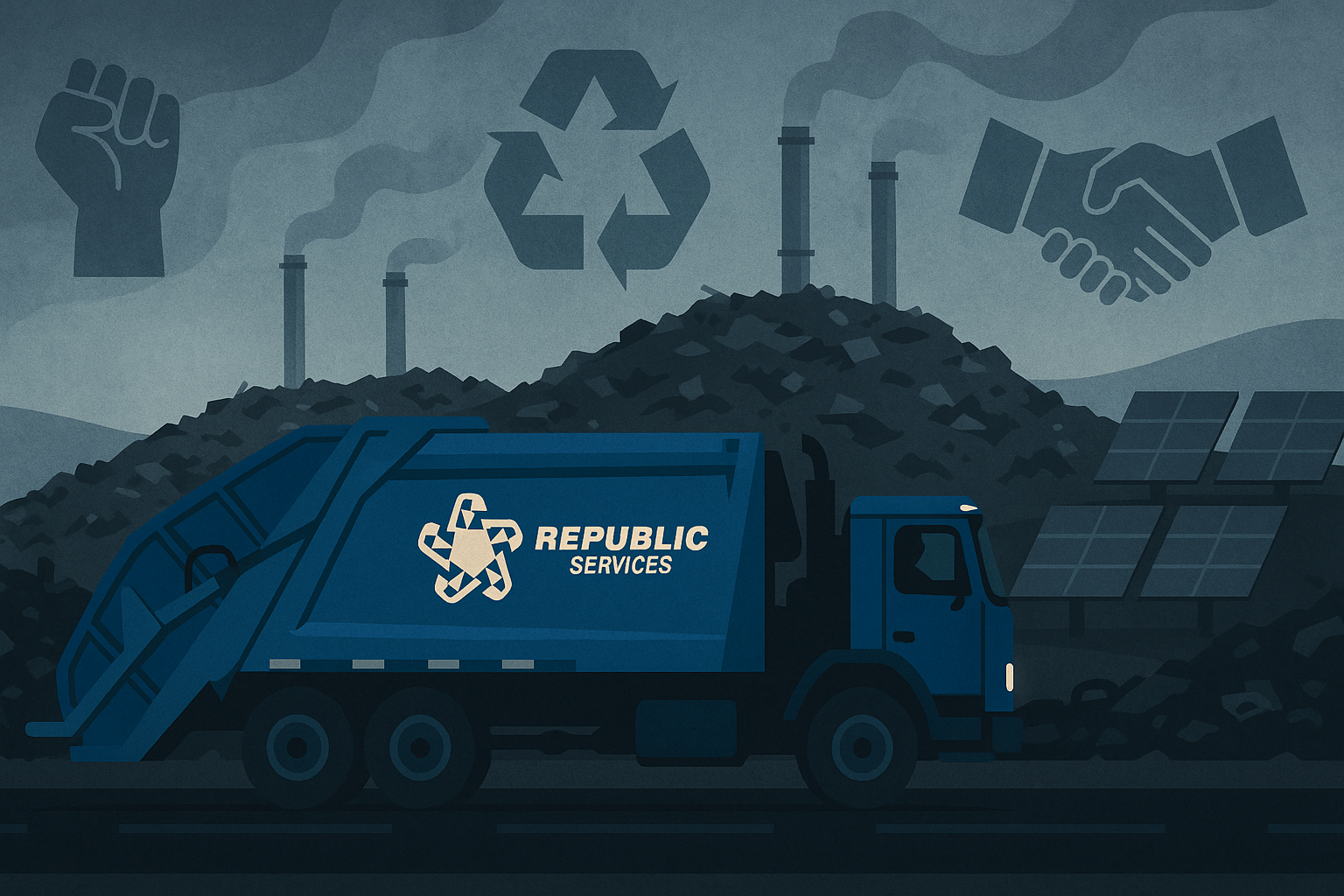
Republic Services (NYSE: RSG) has long been a relatively stable workhorse in the industrials and waste-management space. But in 2025 the company is suddenly finding itself under more pressure than usual—from labor unrest, ESG expectations, and a narrowing window to deliver on growth promises. Its recent deal-making and sustainability pivots are ambitious; the question is whether execution will match the rhetoric.
produto:The Art of X: Build a Business That Makes You $100/Day
Labor Turbulence: Strike Disruptions and a Fragile Truce
The Boston strike exposed fault lines
Beginning July 1, Teamsters Local 25 workers instigated a labor stoppage that disrupted collections across a dozen-plus municipalities in Massachusetts. The strike expanded, drawing solidarity actions across the country and affecting waste pickup in regions such as Northern California’s Bay Area. Republic responded forcefully, accusing the union of illegally blocking trucks and rejecting additional counteroffers. Municipalities in Orange County, California, are now demanding that Republic reimburse them \$5.4 million for service disruptions and customer credits tied to the labor dispute.
After 82 days, Republic and Local 25 reached a five-year collective bargaining agreement in mid-September, restoring order in Boston service zones. Under the deal, full service is being resumed, though residual tensions may persist.
Why this matters
- Operational risk has new visibility. Uncollected trash in dense metropolitan areas quickly becomes a public health and political issue, intensifying regulatory and reputational stakes.
- Union leverage is rising. The strike showed that Teamsters coordination can expand disruption regionally, not just in isolated locales.
- Cost pressure returns. Wage inflation, enhanced benefits, and liability demands can erode margin buffers unless offset by pricing or productivity gains.
- Legal exposure looms. Cities are pressing for damages and reimbursement, as seen in the Orange County claims.
Republic’s ability to now navigate back to smooth operations, absorb costs, and quell further escalations is arguably the litmus test for its management credibility.
---
Financials & Growth: Solid, But Not Invulnerable
Recent performance
In Q2 2025, Republic delivered adjusted EPS of \$1.75 (versus adjusted expectations of \$1.77) and showed margin expansion amid tough volume conditions. Across 2024, the company posted strong results: net income of \$512 million, a 12.7% margin, and \$1.18 billion returned to shareholders via dividends and buybacks.
Republic’s 2025 guidance—as of its February release—projected \$16.85–\$16.95 billion in revenue, EBITDA of \$5.275–\$5.325 billion, and adjusted EPS of \$6.82–\$6.90. Yet more recently, Republic slightly dialed back its top-line ambition, revising full-year revenue to \$16.675–\$16.75 billion, citing weak construction and manufacturing volumes.
In volume terms, the company reported flat-to-modest organic growth in Q2, aided primarily by landfill activity and pricing strength rather than collection or environmental solutions volume gains.
Strengths, vulnerabilities, and expectations
Strengths:
- Strong pricing discipline. Republic continues to push price increases above inflation to protect margins.
- Cash flow generation. The company expects adjusted free cash flow of \$2.32–\$2.36 billion per its original 2025 forecast.
- Shareholder alignment. Management has signaled material capital return (dividends and buybacks), and is deploying approximately \$1 billion toward M&A in 2025.
Risks and headwinds:
- Cyclical exposure. Demand from construction and manufacturing is soft — key sources of waste, especially C&D (construction & demolition) volumes.
- Execution stretch. The company’s 2028 projections, such as revenue of \$19.3 billion and \$2.7 billion in earnings, imply ~5.6% annual top-line growth — requiring consistent M&A success and sustained organic performance.
- Integration risk. The acquisition of Shamrock Environmental and other strategic deals tighten execution risk in technical industrial waste verticals.
- Inflation and cost escalation. Labor, fuel, and regulatory costs could erode margin resilience if pricing or productivity gains lag.
- Regulatory & ESG pressures. Environmental permit delays, emissions scrutiny, and community opposition are ever-present headwinds in the waste sector.
---
Sustainability & Differentiation: More Than Checkboxes
Emissions and carbon goals
Republic recently announced a 20% reduction in greenhouse gas emissions, surpassing its own 2025 target. The “Blue Planet” framework—its long-term climate strategy—guides investment in route electrification, landfill gas capture, and low-carbon technologies.
Polymer and recycling innovations
A standout is Republic’s Polymer Center in Las Vegas, which converts post-consumer plastics into new polymer feedstock with lower emissions relative to virgin or conventional recycling routes. This “back-to-feedstock” capability may offer higher-margin, circular revenue if scaled.
Renewable natural gas (RNG) & energy efforts
Republic operates landfill gas-to-energy and renewable energy projects—there are over 79 in its portfolio. Analysts estimate RNG and related energy ventures could provide 10–15% incremental earnings upside and 100–200 basis points of margin lift.
ESG credibility and risk
These investments enhance Republic’s narrative in the ESG space, but they also raise expectations. If capital deployment lags, or carbon-reduction targets slip, investor scrutiny may intensify. The bulk of ESG bets rest on future execution rather than legacy performance.
---
Outlook & Investment Case
Bull case
If Republic navigates labor disruptions, underwrites pricing, and converts M&A and ESG investments into earnings leverage, the upside is meaningful. Some analysts derive fair values near \$265 per share based on two-phased growth and multiple expansion. In such a scenario, its differentiated recycling, polymer, and RNG offerings could increasingly command premium margins relative to pure hauling peers.
Base case
Modest top-line growth (~3–5%) with stable margin compression from input inflation. M&A generates modest lift but integration drags limit upside. ESG investments add long-term optionality but little near-term earnings. Stocks trade within 6–8× forward EBITDA.
Bear case
Pricing pushback, regulatory lags, weaker volume trends, or renewed labor conflict constrain margin. M&A flops or capital overhang weigh. ESG projects underdeliver or attract public backlash. Under this scenario, multiples compress, and investors face downside of 10–20%.
---
What to Watch Next
- Q3 earnings (late 2025): Indicators of margin contraction, volume softness, or forward guidance revisions.
- Labor stability outside Boston: Whether the newly negotiated Local 25 deal deters further disruption in other geographies or emboldens union agenda.
- RNG & polymer scaling: Execution metrics (capital deployed, capacity utilization, customer wins) will be closely scrutinized.
- M&A execution: Integration status of Shamrock and pipeline announcements in specialty waste or ESG-adjacent fields.
- Municipal lawsuits & liabilities: How many cities demand reimbursement, claims judgments, or contract renegotiations post-disruption.
produto:The Art of X: Build a Business That Makes You $100/Day
Bottom Line
Republic Services finds itself at a critical inflection point in 2025. The company has all the right strategic ambitions—from greener waste innovations to deal-driven growth—but its success hinges on execution under strain. Labor unrest has exposed vulnerability, and the sector’s structural cycles are not fully kind. For investors, the story is now about credibility as much as promise. If Republic can prove discipline, stability, and delivery, the upside remains compelling. If not, valuation support may erode quickly.
---
FAQ
Why did Republic face a strike in 2025?
A widening wage and benefits gap, perceived weak bargaining flexibility, and union concerns about pay parity triggered the strike in Boston and solidarity actions elsewhere. The dispute underscores the risk inherent in labor-intensive, municipal-contract industries.
How material is the ESG angle to Republic’s earnings?
It’s still nascent. The polymer and RNG initiatives are intriguing and could unlock high-margin growth, but their scale is small relative to core hauling business. Success will depend heavily on execution and customer penetration.
Is the valuation justified today?
That depends on future delivery. If Republic can stabilize margins, ramp its sustainable technologies, and avoid repeat 'shock' events, the risk/reward leans favorable. But if volume and cost pressures intensify, downside becomes real.
How does Republic compare with peers like Waste Management (WM)?
Republic now differentiates more in ESG verticals (polymer, RNG) than many peers, but also faces higher execution and integration risk. Waste Management’s scale and healthier operating cash may make it a steadier choice in turbulent periods.
---
Sources and Further Reading
- Republic Services Reports Second Quarter 2025 Results — Republic Services (Investor Release) — 07/29/2025
- Republic Services and Teamsters reach 5-year agreement in Boston — WasteDive — 09/19/2025
- Provides 2025 Full-Year Financial Guidance — Republic Services (Investor Release) — 02/13/2025
- Republic Services Reports Strong 2024, Positive Outlook — Waste360 — 02/14/2025
- Republic Services Marks Emissions Reduction Milestone — Republic Services (Investor Release) — 07/28/2025
- Republic targets \$1B in M&A for 2025 after closing a major deal — WasteDive — (circa Feb 2025)
- Does Republic Services’ Sustainability Push Reveal a New Narrative? — SimplyWallSt — 10/04/2025
- Judge tosses trash company’s latest lawsuit over strike — WBUR — 07/31/2025