Business
Reshoring 2.0: America’s Manufacturing Boom and Who Wins
The latest wave of industrial rebalancing in the U.S. is reshaping jobs, capital, and supply chains
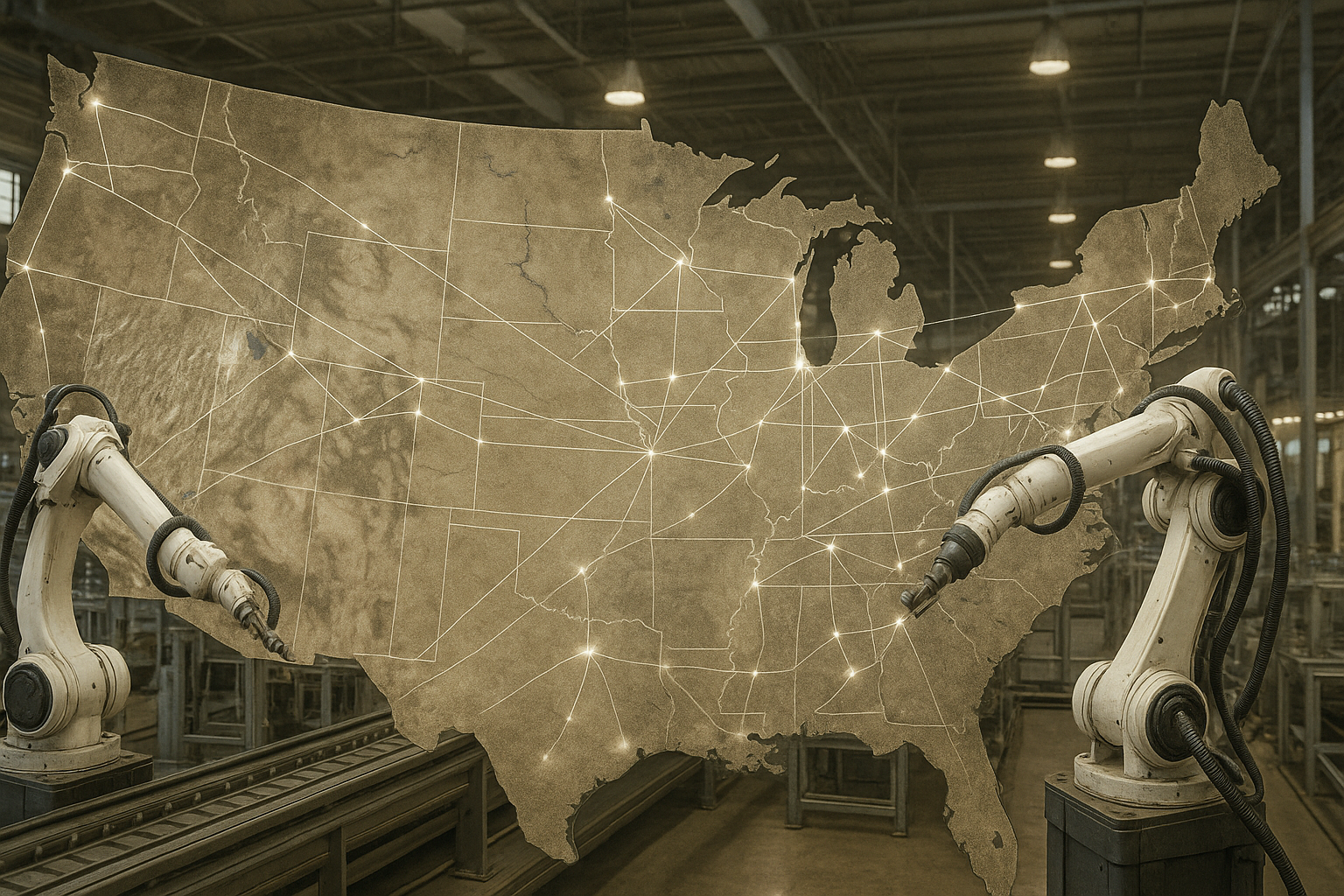
Even before the pandemic fractured global supply chains, experts warned that hyper-optimized manufacturing systems were fragile. Now, in late 2025, the United States may be witnessing an industrial inflection point: Reshoring 2.0.
This new phase isn’t simply about bringing factories back home. It’s about embedding advanced automation, shortening supply chains, and re-engineering production networks around resilience rather than cost alone.
But who truly benefits from this boom—and what are its limits? This analysis explores how policy, technology, and corporate strategy are converging, and which sectors and players appear best positioned to win.
produto:The Art of X: Build a Business That Makes You $100/Day
What’s Different About Reshoring 2.0
- ### The technology premium
Earlier reshoring efforts faced a steep cost disadvantage: U.S. labor and overhead often made domestic production far pricier than offshore alternatives. In Reshoring 2.0, that gap is narrowing thanks to AI, robotics, digital-twin systems, and predictive-maintenance platforms. These technologies allow firms to capture scale and responsiveness simultaneously, eroding the old labor arbitrage.
According to the National Institute of Standards and Technology (NIST), manufacturing in 2025 is being reshaped by the twin forces of automation and supply-chain resilience, making proximity newly competitive.
- ### From lean to “just-in-case”
Where corporate orthodoxy once idolized just-in-time efficiency, the new mantra is “just-in-case.” Companies now build buffers—multiple suppliers, nearshoring options, and regional redundancy. The premium for resilience has risen sharply in boardroom trade-off models.
- ### Industrial policy as catalyst
Public policy is the engine. The CHIPS and Science Act, signed on 08/09/2022, allocates roughly $39 billion in incentives and tax credits for U.S. semiconductor manufacturing. Meanwhile, the Inflation Reduction Act (IRA) and the Infrastructure Investment and Jobs Act (IIJA) combine to fund clean-energy incentives, infrastructure upgrades, and advanced-industry support.
These legislative anchors effectively lower the cost of capital and tilt private investment toward domestic projects—though their continuity remains politically sensitive.
---
Evidence So Far: Momentum, Bottlenecks, and Caveats
- ### Job announcements and softening momentum
In 2024, U.S. firms and foreign investors announced 244,000 manufacturing jobs linked to reshoring or FDI—156,973 from domestic firms and 87,968 from foreign entrants. That sustained a trend that has surpassed two million announced jobs since 2010.
Yet by Q1 2025, announcements were already slowing. Forecasts suggest the full-year total may drop to roughly 174,000 absent renewed policy impetus.
- ### Manufacturing employment: gains and losses
By the end of 2024, U.S. manufacturing employment stood at about 12.6 million, or 9.3 percent of private-sector payrolls. But volatility persists: in August 2025, factories shed 12,000 jobs, bringing total losses since April to about 42,000. Over the 12-month period ending August 2025, the sector lost nearly 80,000 positions—the longest losing streak since 2020.
The takeaway: the reshoring boom doesn’t automatically translate into steady hiring. Firms remain cautious, and productivity gains often offset new headcount.
- ### Bottlenecks and cost pressures
A key constraint is skilled labor. A 2025 GSCI white paper found persistent shortages in supply-chain operations, leadership, and problem-solving roles—gaps automation cannot yet close. Deloitte projects that 1.9 million manufacturing jobs could remain unfilled over the next decade without major training reforms.
Rising wages, higher input costs, and infrastructure bottlenecks compound the challenge. The OECD and ThinkBRG warn that over-localization can itself breed fragility, creating new chokepoints within national systems. Meanwhile, factory-construction investment—after surging since 2021—appears to have peaked about a year ago.
---
Who Wins: Sectors, Companies, and Regions
- ### Semiconductors and advanced electronics
No sector has benefited more visibly than semiconductors. The CHIPS Act’s subsidies and tax breaks have made new fabrication plants viable. In mid-2025, GlobalFoundries announced a $16 billion expansion across New York and Vermont—an emblem of how industrial policy and corporate strategy are aligning.
- ### EV batteries, renewable energy, and clean-tech components
Roughly 67 percent of reshoring and FDI announcements in 2024 centered on semiconductors, EV batteries, and solar-equipment manufacturing. These industries enjoy a dual tailwind: global demand for clean-energy hardware and alignment with federal subsidies. Battery-cell production and critical-minerals processing are being localized to mitigate geopolitical exposure.
- ### Consumer appliances and heavy machinery
A prominent example is GE Appliances, which in June 2025 unveiled a $490 million plan to move washing-machine production from China to Kentucky, creating about 800 U.S. jobs. The company’s broader reshoring program exceeds $3 billion, spanning refrigerators, gas ranges, and water heaters—a “zero-distance” strategy that brings manufacturing closer to demand.
- ### Suppliers and regional value chains
Mid-cap suppliers of components, tooling, and subsystems also stand to benefit, especially those clustered near industrial corridors in Texas, South Carolina, and Mississippi—among the top reshoring and FDI destinations in 2025. Shorter lead times, lower logistics costs, and tighter integration favor local ecosystems.
---
Economic and Financial Ripple Effects
- ### Regional multipliers and employment
Reshoring projects generate second-order effects across construction, logistics, housing, and local services. Communities landing new plants can see rising wage averages, expanding tax bases, and infrastructure upgrades.
- ### Capital flows and industrial real estate
The factory-construction surge has driven demand for industrial land, logistics parks, robotics firms, and engineering services. Long-term lease structures, mezzanine financing, and public-private infrastructure partnerships are becoming defining financial features of the reshoring era.
- ### Market implications
Publicly traded companies exposed to supply-chain hardware, industrial automation, and semiconductor equipment could see valuation reratings. Smaller-cap component suppliers tied to domestic clusters may find upside potential—provided balance sheets are solid and subsidy reliance is manageable.
- ### Risks and macro interactions
Inflationary pressure and elevated interest rates may compress margins. A political rollback of subsidies could stall projects mid-construction. Overreliance on national borders, meanwhile, may reduce flexibility: the OECD estimates aggressive reshoring could shrink global trade by roughly 18 percent and cut GDP in some economies by up to 12 percent.
---
- ## Risks, Trade-offs, and Limits
- Concentration risk: Over-centralized supply chains can create new single points of failure.
- Policy reversals: Fiscal tightening or political shifts could curtail incentives.
- Retaliation risk: Trade partners affected by U.S. reshoring may respond with tariffs or export limits.
- Structural cost disadvantage: Even with subsidies, U.S. labor and regulatory costs remain higher than many offshore benchmarks.
- Execution lag: Many announced projects take 12–24 months to translate into actual jobs, and some never materialize.
produto:The Art of X: Build a Business That Makes You $100/Day
Conclusion and Outlook
The U.S. is in the early innings of Reshoring 2.0—a transformation driven as much by technology and policy as by geopolitics. Sectors such as semiconductors, EV supply chains, and appliances show tangible traction, but headwinds remain: labor shortages, cost pressures, and policy uncertainty.
Key indicators to watch through 2025 include job-announcement follow-through, capital-expenditure trends, and the durability of federal and state incentives. For investors, firms with scalable automation, regional integration, and disciplined capital management may offer asymmetric upside in this evolving landscape.
---
FAQ
Q1: How is Reshoring 2.0 different from earlier reshoring efforts?
It integrates AI and digital manufacturing systems, reducing labor-cost penalties and emphasizing resilience over pure cost efficiency. Industrial policy plays a far larger role.
Q2: Why have some reshoring announcements slowed in 2025?
Higher interest rates, policy uncertainty, and cautious capital allocation have cooled momentum. The lag between announcements and actual hiring also distorts near-term data.
Q3: Which sectors benefit most?
Semiconductors, EV batteries, renewable-energy hardware, consumer appliances, and precision machinery stand out as the biggest winners.
Q4: What are the major risks?
Persistent labor shortages, cost inflation, political reversals of subsidies, and reduced global trade efficiency remain the key vulnerabilities.
---
Sources and Further Reading
- National Institute of Standards and Technology (NIST), Manufacturing USA Blog, 2025.
- U.S. Department of Commerce, CHIPS and Science Act Implementation Reports, 2023–2025.
- Deloitte, 2025 Manufacturing Talent Study.
- GSCI, White Paper on Supply-Chain Workforce Gaps, 2025.
- OECD & ThinkBRG, Resilience and Localization Trade-Offs, 2025.
- Reshoring Initiative, Annual Data Report, 2024–2025.
- U.S. Bureau of Labor Statistics, Employment Situation Summary, August 2025.
- GlobalFoundries, Press Release: U.S. Expansion Plan, 06/2025.
- GE Appliances, U.S. Manufacturing Investment Update, 06/2025.
---