Crypto
Binance vs Bybit vs MEXC: Which Crypto Exchange Is Safest?
Learn how to evaluate exchange safety using regulation and custody risk.
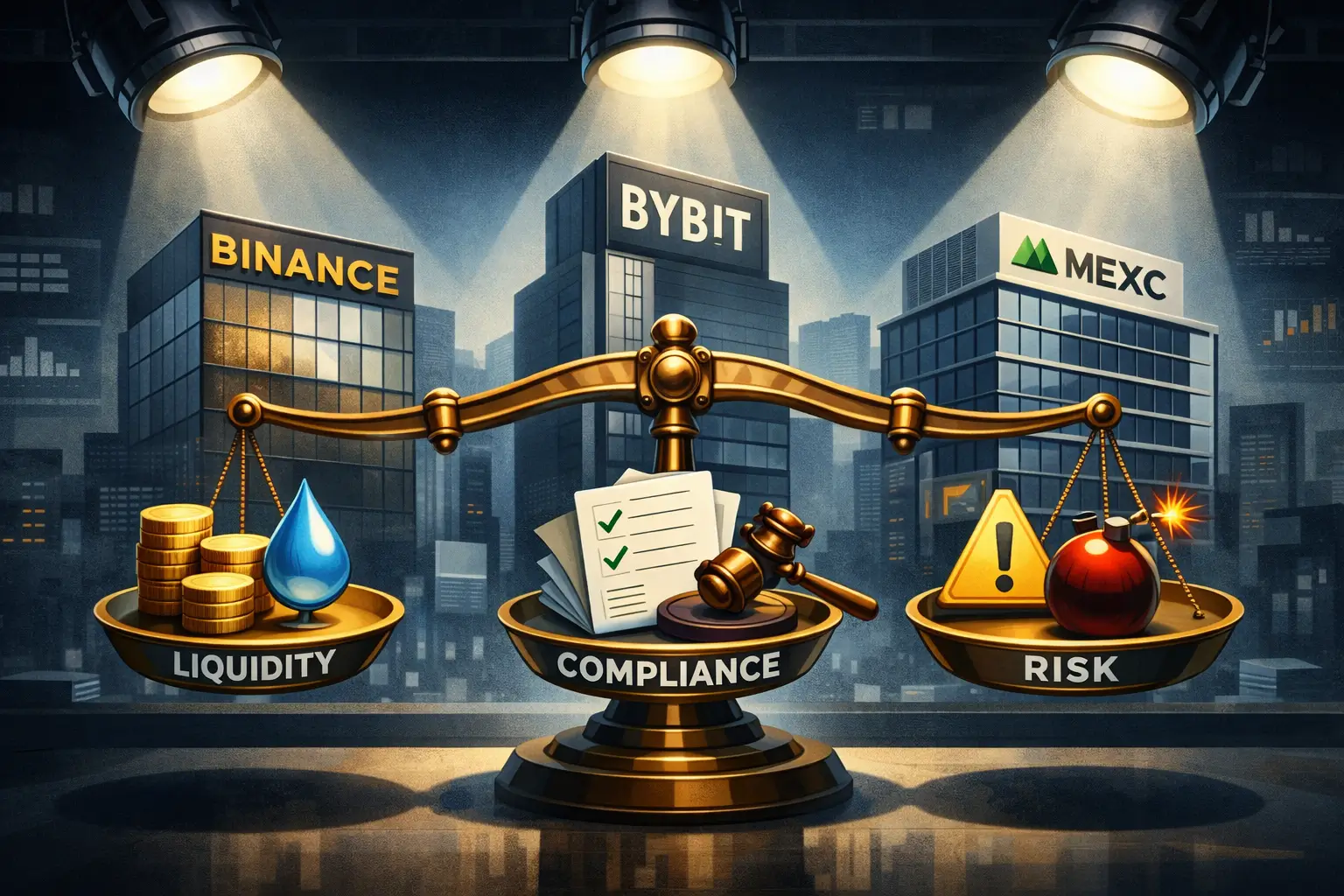
Many investors ask the same question: Which crypto exchange is actually safe to use? In 2026, the answer depends less on cybersecurity and more on regulation, solvency, and operational stability.
This guide explains how exchange safety works today, what risks matter most, and how Binance, Bybit, and MEXC compare using practical indicators. You will learn how to choose the right platform for your strategy and reduce the risk of frozen funds or service disruptions.
---
Why Exchange Safety Now Depends on Regulation and Structure
Crypto exchange safety changed significantly after major enforcement actions earlier in the decade. One of the most important events occurred on 11/21/2023, when Binance agreed to a $4.3 billion settlement with U.S. authorities, triggering sweeping compliance reforms across the industry.
At the same time, global regulation became more standardized.
Europe introduced the Markets in Crypto-Assets (MiCA) framework in 2024, creating clear licensing and consumer protection rules for centralized exchanges. These rules established a new benchmark for operational credibility.
As a result, the biggest risks for users today are structural.
Common real-world risks include:
- withdrawals temporarily frozen during investigations
- sudden restrictions in certain countries
- operational shutdowns due to licensing issues
- liquidity stress during market volatility
Understanding these risks helps investors evaluate exchanges more realistically.
---
The Key Indicators That Define Exchange Safety
Professional investors rely on measurable indicators to assess exchange risk. These factors provide a consistent way to compare platforms.
Regulatory Licensing and Jurisdiction
Regulation is the most important safety factor.
Licensed exchanges operating under recognized frameworks are less likely to face abrupt shutdowns. They must also meet capital and reporting requirements.
Key signal:
- formal regulatory licensing
---
Proof-of-Reserves Transparency
Proof-of-reserves reporting became standard after the liquidity crises of 2022.
Reliable transparency should include:
- regular financial disclosures
- independent verification
- clear asset segregation
Incomplete reporting is often a warning sign.
---
Protection Funds and Financial Buffers
Many exchanges maintain protection funds to cover losses during operational incidents.
These reserves typically protect against:
- system failures
- liquidation events
- security breaches
However, they do not protect users from regulatory actions.
---
Compliance History
Past regulatory violations are strong indicators of future risk.
Investors monitor:
- enforcement settlements
- licensing disputes
- regulatory investigations
A consistent compliance record reduces uncertainty.
---
Operational Reliability
Operational resilience determines whether users can access funds during market stress.
Reliable exchanges demonstrate:
- stable withdrawals during volatility
- consistent platform uptime
- sufficient liquidity reserves
These factors are critical during sudden market movements.
---
Binance vs Bybit, vs MEXC : Side-by-Side Safety Comparison
Each exchange represents a different balance between liquidity, regulation, and accessibility. Understanding these trade-offs helps investors align platform choice with their goals.
Binance: Strong Liquidity and Global Scale
Binance remains the largest crypto exchange by trading volume as of 04/16/2026. Its deep liquidity and broad asset coverage make it a preferred platform for active traders.
Strengths
- highest liquidity among major exchanges
- large trading ecosystem
- strong infrastructure
Risks
- elevated regulatory scrutiny
- potential service restrictions during enforcement events
Best for
Traders who prioritize liquidity and execution efficiency.
---
Bybit: Focus on Regulatory Expansion
Bybit has invested heavily in regulatory compliance and licensing. The company has expanded into regulated jurisdictions, including regions operating under MiCA standards.
This strategy signals long-term operational stability.
Strengths
- growing regulatory presence
- improving institutional credibility
- stable operational positioning
Risks
- smaller liquidity pool than the largest exchanges
- evolving global footprint
Best for
Investors who prioritize regulatory clarity and predictable service continuity.
---
MEXC : Broad Access to Altcoins
MEXC operates primarily through offshore jurisdictions and focuses on accessibility. The platform offers a wide selection of tokens and competitive trading fees.
This model provides flexibility but reduces regulatory protection.
Strengths
- extensive altcoin selection
- low trading costs
- fast token listings
Risks
- limited regulatory oversight
- higher jurisdictional uncertainty
Best for
Traders seeking early access to emerging assets.
---
How to Choose the Right Exchange for Your Needs
The safest exchange depends on how you plan to use it.
Different strategies require different risk profiles. Matching platform features to your behavior reduces exposure to custodial risk.
Use this simple decision framework:
Choose Binance if you need
- deep liquidity
- advanced trading tools
- fast execution
Choose Bybit if you value
- regulatory stability
- structured compliance
- predictable operations
Choose MEXC if you want
- access to new tokens
- lower trading costs
- flexible onboarding
A widely used risk management practice is to keep only active trading funds on exchanges. Long-term holdings are often stored in self-custody wallets.
---
Risks to Watch in the Future
Exchange safety will continue evolving as regulation expands.
Key developments to monitor include:
- stricter global licensing requirements
- mandatory asset segregation rules
- increased cross-border enforcement
- higher capital standards for exchanges
These changes will shape which platforms remain stable during future market stress events.
Understanding these trends helps investors prepare before risks materialize.
---
Choose Structure Over Marketing Claims
Crypto exchange safety is no longer defined by technology alone. It is defined by regulation, financial stability, and operational reliability.
Binance offers unmatched liquidity.
Bybit emphasizes compliance and stability.
MEXC provides accessibility and flexibility.
The practical takeaway is clear:
Select the exchange that matches your risk tolerance, and limit the amount of funds you keep on any centralized platform.
As regulation continues to mature, the safest exchanges will be those with strong governance, transparent operations, and resilient infrastructure.
---
FAQ
Which crypto exchange is safest in 2026?
There is no single safest exchange. Platforms with strong regulatory licensing and transparent operations generally offer the most predictable service reliability.
Is Binance safe after its regulatory settlement?
Yes. The settlement required compliance reforms and increased oversight. The main risk today is regulatory disruption rather than security failure.
Why is regulation more important than cybersecurity now?
Most major exchanges have strong security systems. The larger risk is operational disruption caused by regulatory actions.
Should I keep all my crypto on an exchange?
Many experienced investors keep only trading funds on exchanges and store long-term holdings in self-custody wallets.
---