Markets
SEC on Ice: How the Shutdown Froze IPOs, Spin-offs, and ETFs
Inside the October 2025 pause at the U.S. Securities and Exchange Commission — and the workarounds, risks, and timing traps issuers face
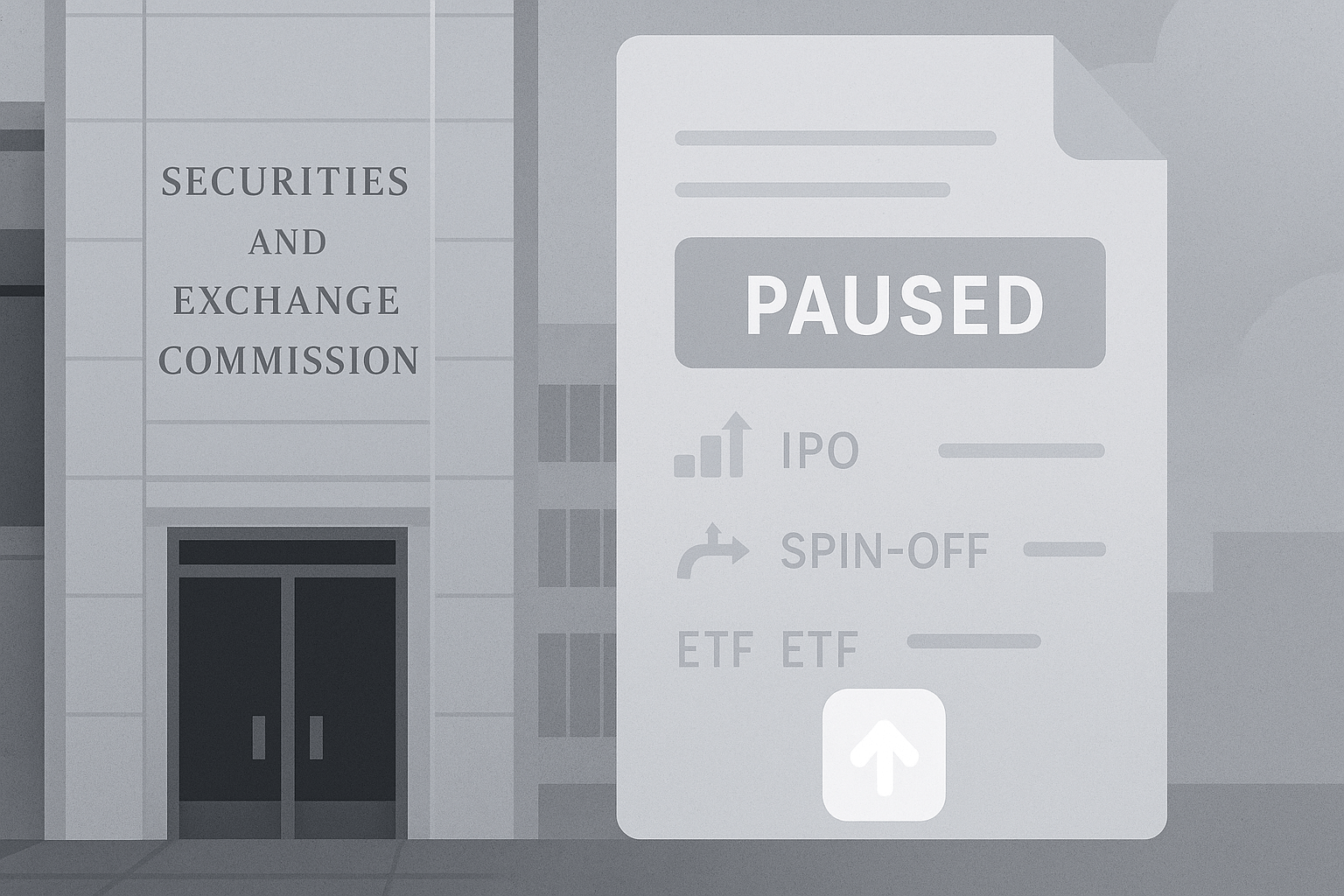
What happened: At 12:01 a.m. ET on 10/01/2025, a lapse in federal appropriations triggered a government shutdown that pushed the U.S. Securities and Exchange Commission (SEC) into “extremely limited” operations. Divisions from Corporation Finance to Investment Management halted routine reviews, accelerations, and most day-to-day interpretive work. EDGAR stayed open for filings, but the staff could not declare registration statements effective, qualify offering statements, or process exemptive relief.
Why it matters: That staffing freeze ripples through public-markets plumbing. IPO timetables stretch, de-mergers and spin-offs relying on Form 10 can be forced onto an automatic path, and the ETF launch pipeline sits in limbo except where rules allow automatic effectiveness. The SEC has since posted targeted guidance to keep parts of the capital markets moving, but the responsibility — and liability — shifts squarely to issuers, boards, and underwriters.
What to watch next: As of 10/22/2025 (ET), the SEC’s contingency posture and staff Q&As remain the operating map. Expect a backlog when funding resumes. IPO candidates using automatic effectiveness will still face post-shutdown staff scrutiny, and ETF applicants should plan for delayed approvals even if filings continue through EDGAR.
produto:The Art of X: Build a Business That Makes You $100/Day
The SEC’s shutdown posture: open pipes, closed valves
The SEC’s operations plan for a lapse in appropriations keeps core systems running but sharply limits people. EDGAR remains functional and accepts filings, and a small number of “excepted” personnel handle emergencies and fee questions. Divisions cannot conduct normal reviews, issue no-action letters, or accelerate effectiveness. In Trading and Markets, self-regulatory organization filings submitted when the Commission is closed receive the next business day’s date when the Commission reopens. In Investment Management, staff cannot accelerate effective dates or act on pending orders; only those fund filings that become effective automatically by rule continue to move.
Practically, that means filings flow, but approvals do not — unless a rule already provides for automatic effectiveness.
---
IPOs: the narrow path forward
Historically, IPOs stall in a shutdown because staff cannot declare registration statements effective. On 10/09/2025 (ET), the Division of Corporation Finance updated its Q&A to outline a temporary path: issuers may remove the Rule 473 “delaying amendment” and allow a Securities Act registration statement to become effective automatically 20 calendar days after filing under Section 8(a). Ordinarily, Rule 430A (which permits omission of final pricing and other price-dependent terms when the SEC accelerates effectiveness) is tied to declared effectiveness. The staff stated it will not recommend enforcement action if an IPO prospectus omits Rule 430A-permitted pricing information and the registration statement becomes effective by operation of Section 8(a) during the shutdown.
Three critical mechanics follow:
- Starting (and restarting) the 20-day clock. To remove the delaying amendment, issuers must amend to include the Rule 473(b) sentence that the registration statement “shall hereafter become effective in accordance with Section 8(a).” Any further pre-effective amendment restarts the 20-day period.
- Liability does not shut down. Automatic effectiveness does not dilute Securities Act liability. If the document is materially misleading, exposure attaches as usual. The staff also notes it may ask issuers to reinsert a delaying amendment if operations resume before the 20 days run, and it may request post-shutdown amendments even if the registration went effective automatically.
- Rule 430A pricing workflow. If a registration was already declared effective before 10/01/2025 but missed the 15 business-day pricing window under Rule 430A, the issuer can file a Rule 462(c) post-effective amendment (effective upon filing) to restart the 15-day clock and then price, followed by a Rule 424(b) prospectus.
Bottom line: IPOs are possible without staff acceleration, but diligence, disclosure controls, and underwriter comfort must do more of the risk-management work that a comment process typically helps address.
---
Shelf takedowns and WKSIs: the parts still moving
Seasoned issuers enjoy more flexibility:
- Shelf takedowns from an already effective shelf. A prospectus supplement does not require staff action, so issuers can proceed with offerings off an effective Form S-3/F-3 shelf during the shutdown.
- Automatic shelves for WKSIs. Well-known seasoned issuers can continue to file automatic shelves that become effective upon filing.
- Post-effective updating. If a shelf needs a post-effective amendment for a material update and that amendment requires effectiveness, the offering must wait until the Commission reopens; issuers should assess whether required updates can be made via a supplement instead.
The upshot: investment-grade debt, follow-ons, and similar transactions can keep printing, so long as the legal path avoids staff effectiveness.
---
Spin-offs and de-mergers: the Form 10 time bomb
Spin-offs registered on Form 10 present a distinct timing trap. Unless accelerated, a Form 10 becomes effective 60 days after the initial public filing. The Division cannot act on acceleration requests during a shutdown. If issuers do not want effectiveness to occur without staff review, the remedy is to withdraw the Form 10 before day 60 and refile later. Companies eyeing late-year separations should map the 60-day calendar carefully and align audit, governance, and listing readiness to avoid unintended effectiveness.
---
ETFs and registered funds: automatic where the rules allow, stalled otherwise
In the Division of Investment Management, routine actions are paused. However, many open-end fund filings made under Rule 485 become effective automatically on a set timetable, and that automatic effectiveness continues. By contrast, novel ETF launches, exemptive applications, and requests for acceleration are on hold until appropriations return. The pipeline reflects that divide: traditional post-effective amendments march forward by rule, but new or complex ETF approvals, including leveraged or crypto-linked proposals, face uncertainty and delay.
---
What companies can do — and cannot do — during the shutdown
You can:
- File registration statements and amendments on EDGAR.
- Remove the delaying amendment and rely on Section 8(a) automatic effectiveness, with the staff’s 430A non-enforcement position for omitted pricing.
- Execute shelf takedowns off an effective shelf via prospectus supplement.
- For WKSIs, file automatic shelves and proceed immediately.
- File definitive proxy materials after the 10-day preliminary period has run (staff review is not a prerequisite).
- Continue certain registered fund filings that become effective automatically by rule.
You cannot (during the shutdown):
- Obtain acceleration of the effective date of a Securities Act registration or qualification of a Regulation A offering statement.
- Receive routine interpretive advice, no-action relief, or exemptive orders.
- Expect staff to process post-effective amendments that require declaration of effectiveness.
- Count on the normal cadence of ETF approvals or complex fund actions.
---
Timing and liability risks to manage now
- Calendar discipline. The 20-day Section 8(a) clock resets with each pre-effective amendment; business days continue to count for most rules even when the government is shut, and the Commission’s closure affects certain market-structure clocks.
- Disclosure readiness. Without back-and-forth comments, issuers should bolster internal disclosure committees, refresh risk factors for a volatile macro backdrop, and ensure auditor comfort letters and bring-downs support the timetable.
- Contingency language. Be prepared to reinsert a delaying amendment if the SEC reopens mid-clock; that preserves the option to seek acceleration and engage on any unresolved staff comments.
- Post-reopening scrutiny. Expect staff to review automatically effective IPOs once operations resume. Budget time for amendments, even if trading has begun.
- Spin-off safeguards. Track the Form 10 day-60 trigger; if you need staff review, consider withdrawing and refiling to avoid automatic effectiveness.
produto:The Art of X: Build a Business That Makes You $100/Day
The market lens
For markets, the October shutdown created a two-speed capital-raising environment: seasoned issuers with shelves and WKSIs kept tapping debt and equity, while IPOs and ETFs navigated bottlenecks or paused. The SEC’s targeted guidance prevented a total freeze, but it shifted risk management from a public comment process to issuer and underwriter judgment. When the Commission returns to full capacity, the backlog — and potentially sharper staff scrutiny of deals that went effective by operation of law — will test timetables through year-end.
AlphaPulse view: the guidance is pragmatic and preserves market access, but it is no substitute for a functioning review apparatus. Issuers should treat automatic effectiveness as a tool of last resort, not a new normal.
---
FAQ
Can a company complete an IPO during the shutdown?
Yes. An issuer can remove the delaying amendment, let the registration become effective automatically after 20 days under Section 8(a), rely on the staff’s Rule 430A non-enforcement to omit pricing at effectiveness, then price and file a 424(b) prospectus.
Can I do a shelf takedown or file an automatic shelf?
Yes. Takedowns from an already effective shelf proceed via prospectus supplement. WKSIs can file automatic shelves that are effective upon filing.
What happens to spin-offs using Form 10?
Form 10 becomes effective 60 days after initial filing unless accelerated. Because the SEC cannot accelerate during the shutdown, issuers should withdraw before day 60 if they want to avoid automatic effectiveness.
Are ETF launches on hold?
Most new ETF approvals and accelerations are paused. Some registered fund filings that become effective automatically by rule continue, but complex or novel ETFs generally must wait for staff action.
---
Sources and Further Reading
- Updated Division of Corporation Finance Actions In Advance of a Potential Government Shutdown — SEC — 10/09/2025 — https://www.sec.gov/newsroom/whats-new/updated-division-corporation-finance-actions-advance-potential-government-shutdown-october-09-2025
- Division of Corporation Finance Actions During Government Shutdown — SEC — 10/01/2025 — https://www.sec.gov/newsroom/whats-new/division-corporation-finance-actions-during-government-shutdown-october-2025
- Division of Investment Management Actions During Government Shutdown — SEC — 09/30/2025 — https://www.sec.gov/newsroom/whats-new/division-investment-management-actions-during-government-shutdown-october-2025
- Division of Trading and Markets Actions During Government Shutdown — SEC — 09/30/2025 — https://www.sec.gov/newsroom/whats-new/division-trading-markets-actions-during-potential-government-shutdown-october-2025
- Operations Plan Under a Lapse in Appropriations and Government Shutdown — SEC — 08/07/2025 — https://www.sec.gov/files/sec-plan-operations-during-lapse-appropriations.pdf
- Wall Street regulator eases IPO path during government shutdown — Reuters — 10/09/2025 — https://www.reuters.com/legal/government/wall-street-regulator-eases-ipo-path-during-government-shutdown-2025-10-09/
- SEC Staff Updates Guidance to Enable IPOs During Government Shutdown — Skadden — 10/10/2025 — https://www.skadden.com/insights/publications/2025/10/new-sec-guidance-allows-companies-to-proceed-with-ipos-during-government-shutdown
- SEC Staff Updates its Guidance to Enable IPO Registration Statements to Go Effective During Government Shutdown — Ropes & Gray — 10/09/2025 — https://www.ropesgray.com/en/insights/alerts/2025/10/sec-staff-updates-its-guidance-to-enable-ipo-registration-statements-to-go-effective-during
- Implications of the Government Shutdown on SEC-Registered Securities Transactions — Sullivan & Cromwell — 10/06/2025 — https://www.sullcrom.com/insights/memo/2025/October/Implications-Government-Shutdown-SEC-Registered-Securities-Transactions
- SEC Shutdown: 10 FAQs About Removing the Delaying Amendment — Latham & Watkins — 10/2025 — https://www.jdsupra.com/legalnews/sec-shutdown-10-faqs-about-removing-the-7541069/
- SEC says “unclear” if proposed 3x and 5x leveraged ETFs would be approved — Reuters — 10/16/2025 — https://www.reuters.com/legal/government/sec-says-unclear-if-proposed-3x-5x-leveraged-etfs-would-be-approved-2025-10-16/
---