Economy
Shutdown Scrambles the Fed’s Roadmap: Why September CPI & PPI Now Matter Even More
With the CPI delayed to 10/24 and PPI arriving first, traders recalibrate rate-cut odds ahead of the Oct. 28–29 FOMC as a federal shutdown clouds the data picture.
What happened
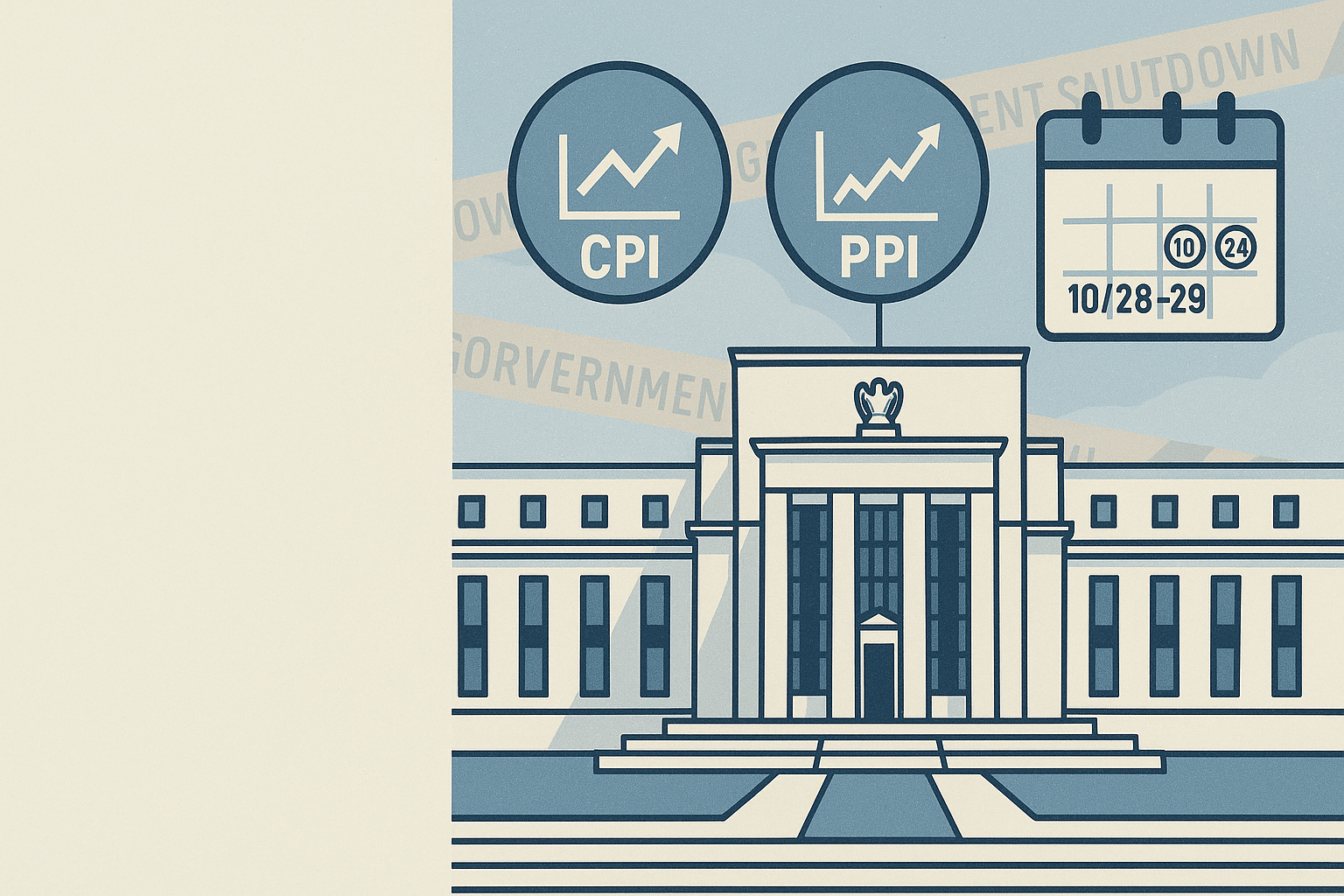
The U.S. entered a federal government shutdown on 10/01/2025, triggering an unprecedented data blackout just as policymakers, investors, and companies were preparing for the final Federal Open Market Committee meeting before November. Most regular federal statistics have been paused, but two releases are set to shape the macro narrative: September Producer Price Index (PPI) published on 10/16/2025 at 8:30 a.m. ET, and September Consumer Price Index (CPI), rescheduled to 10/24/2025 at 8:30 a.m. ET. The two prints will be the market’s best look at inflation trends heading into the 10/28–10/29 FOMC.
produto:The Art of X: Build a Business That Makes You $100/Day
Why it matters
The Fed has emphasized data dependence. In normal times, that means a full dashboard—jobs, retail sales, housing, and inflation. During a shutdown, the dashboard goes dim. The late-October CPI—now landing just days ahead of the meeting—could swing expectations on whether policymakers move in quarter-point steps, consider a larger adjustment, or simply reinforce guidance for a gradual path. PPI’s read on pipeline pressures, one week earlier, provides an initial temperature check.
---
The State of Play Heading Into Late October
PPI: The pipeline preview (10/16/2025, 8:30 a.m. ET)
September PPI arrives first, offering a look at wholesale cost dynamics after a volatile summer. Earlier months saw a July surge and an August pullback, leaving investors eager to see whether services margins and core trade-sensitive categories continue to cool or re-accelerate. With many top-tier indicators dark, PPI’s composition—final demand goods vs. services, and core measures excluding food, energy, and trade services—takes on outsized importance for forward inflation risk.
What to watch inside PPI
- Final demand services: Margins for trade services and transportation have been swing factors; continued easing would reinforce the disinflation narrative.
- Core “ex-food, energy, and trade”: A steadier gauge of underlying pipeline inflation that feeds through to PCE over coming months.
- Energy-linked goods: Fuel volatility can mask underlying trend but still affects near-term price transmission.
CPI: The main event (rescheduled to 10/24/2025, 8:30 a.m. ET)
CPI is the centerpiece for markets into the FOMC. The delay compresses the reaction window: investors, sell-side desks, and the Fed will have just business days to digest composition effects—shelter, core services ex-housing, and goods—before rate deliberations begin. The BLS is releasing September CPI to meet statutory requirements tied to Social Security’s cost-of-living adjustment, making this one of the only marquee indicators available during the shutdown.
Why the timing is pivotal
- Near-term policy signaling: A benign CPI print would validate easing financial conditions and keep quarter-point cut expectations intact. A firmer print—especially in sticky services—could complicate the cadence of cuts.
- Breakevens and term premium: The CPI composition will filter quickly into inflation compensation and term structure, influencing how the Fed communicates risk management.
The FOMC calendar anchor (10/28–10/29, ET)
The October meeting is the last major policy checkpoint before year-end. With the economy already absorbing tighter corporate credit conditions and a maturing capex cycle, the Committee’s balance of risks—employment softening versus still-above-target inflation—will be informed largely by these two inflation reports and select private or regional indicators.
---
Reading the Economy Without the Full Dashboard
Regional business surveys: Mixed growth, sticky input costs
With national data sparse, investors have leaned on regional Fed surveys:
- New York Fed Empire State (10/09/2025 reference): Headline general business conditions rose to a positive reading in October, with modest gains in new orders and shipments. Price indices edged higher, suggesting some pressure in input costs even as activity improved.
- Philadelphia Fed Manufacturing (10/06/2025 reference; reported 10/16/2025 by media): The headline diffusion index slipped into contraction in October, while the “prices paid” and “prices received” measures advanced. That combination—softer activity with firmer price pressures—keeps attention on margins and pass-through.
- NFIB Small Business Optimism (released 10/14/2025; September month): The index fell to 98.8, its first decline in three months, with the Uncertainty Index rising to 100. More owners reported excess inventories and plan price increases, a signal of uneven demand and lingering cost pressures at Main Street level.
Takeaway: The regional and small-business lens implies a cooling but not collapsing growth backdrop, with price pressure pockets that remain sensitive to wages, logistics, and tariff-affected inputs.
---
Rate-Cut Odds and Scenario Map
Even before the shutdown, futures markets were leaning toward continued easing after the Fed’s initial cut in September. As of 10/17/2025, pricing remains consistent with a quarter-point reduction at the 10/28–10/29 meeting, with debate focused on the follow-through in December.
Three scenarios to watch
- Soft pipeline + benign CPI (base case):
- PPI composition points to easing services margins and tame core trade services.
- Sticky services in CPI (hawkish-leaning cut):
- PPI mixed, but CPI surprises with firm core services.
- Re-acceleration across PPI and CPI (risk case):
- A broad-based firming, especially in services and shelter.
Why the shutdown amplifies market swings: With fewer reference points, each datapoint carries more weight. The CPI landing just four trading days before the meeting compresses market digestion time, magnifying moves in front-end rates and breakevens.
produto:The Art of X: Build a Business That Makes You $100/Day
What Markets Are Trading
- Fed funds futures: Pricing implies a quarter-point cut on 10/29, consistent with the reaction to softer producer inflation in August and ongoing growth concerns. The curve sketches a modest total easing through year-end, contingent on CPI.
- Treasuries: Term premium remains sensitive to inflation surprises and policy uncertainty. A “clean” CPI print would support a bull-flattening bias; a sticky core services read risks bear-steepening.
- Equities and credit: Cyclical sectors hinge on the growth-inflation mix—industrial orders and margins vs. the path of policy easing. High-quality credit benefits from lower policy rates but remains tethered to earnings resilience.
---
The AlphaPulse View
The risk balance still tilts toward gradual easing. Pipeline pressures are not uniformly hot, small-business uncertainty is rising, and regional surveys show uneven activity with elevated “prices paid.” In this setting, a quarter-point move on 10/29 remains the most reasonable default—unless the 10/24 CPI delivers a clear upside surprise in services. Either way, the shutdown’s data scarcity argues for caution in guidance and humility in market positioning.
---
FAQ
When will the September CPI be released?
On 10/24/2025 at 8:30 a.m. ET. The release was rescheduled due to the federal shutdown.
Why is PPI important this month?
PPI (released 10/16/2025 at 8:30 a.m. ET) provides an early read on wholesale costs and margins that can foreshadow CPI and PCE trends, especially when other data are unavailable.
What surveys help fill the data gap?
Regional Fed reports (Empire State and Philly Fed) and the NFIB Small Business Optimism Index offer timely signals on new orders, hiring, inventories, and price pressures.
What is the most likely policy outcome on 10/28–10/29?
Baseline remains a 25bp cut, but the CPI print on 10/24 could sway the guidance and the probability of an additional move in December.
---
Sources and Further Reading
- September 2025 CPI Release Rescheduled — U.S. Bureau of Labor Statistics — 10/10/2025 — https://www.bls.gov/bls/092025-cpi-reschedule-notice.htm
- Schedule of Releases for the Consumer Price Index — U.S. Bureau of Labor Statistics — 10/2025 — https://www.bls.gov/schedule/news_release/cpi.htm
- Producer Price Index Home / August 2025 Summary and Release Timing — U.S. Bureau of Labor Statistics — 09/10/2025 — https://www.bls.gov/ppi/
- Producer Price Index News Release (August 2025) — U.S. Bureau of Labor Statistics — 09/10/2025 — https://www.bls.gov/news.release/ppi.nr0.htm
- US to publish September CPI report this month despite government shutdown — Reuters — 10/10/2025 — https://www.reuters.com/business/us-publish-september-cpi-report-this-month-despite-government-shutdown-2025-10-10/
- US government shutdown: How it affects key economic data publishing — Reuters — 10/13/2025 — https://www.reuters.com/world/us/us-government-shutdown-how-it-affects-key-economic-data-publishing-2025-10-06/
- The Fed — Meeting calendars and information (FOMC Oct. 28–29, 2025) — Federal Reserve — 2025 — https://www.federalreserve.gov/monetarypolicy/fomccalendars.htm
- Federal Reserve Events Calendar (October 2025) — Federal Reserve — 10/2025 — https://www.federalreserve.gov/newsevents/calendar.htm
- Empire State Manufacturing Survey — Federal Reserve Bank of New York — 10/09/2025 — https://www.newyorkfed.org/survey/empire/empiresurvey_overview
- October 2025 Manufacturing Business Outlook Survey — Federal Reserve Bank of Philadelphia — 10/06/2025 — https://www.philadelphiafed.org/surveys-and-data/regional-economic-analysis/mbos-2025-10
- US mid-Atlantic manufacturing contracts in October; price measures increase — Reuters — 10/16/2025 — https://www.reuters.com/business/us-mid-atlantic-manufacturing-contracts-october-price-measures-increase-2025-10-16/
- NFIB Small Business Optimism Index — NFIB Press Release — 10/14/2025 — https://www.nfib.com/news/press-release/new-nfib-survey-small-business-optimism-declines-in-september/
- How the Shutdown Has Cut Off Key Data Guiding the Fed’s Decisions — Bloomberg — 10/16/2025 — https://www.bloomberg.com/news/articles/2025-10-16/how-government-shutdown-cuts-off-key-data-guiding-the-fed-s-decisions
- CME FedWatch Tool — CME Group — 10/17/2025 — https://www.cmegroup.com/markets/interest-rates/cme-fedwatch-tool.html
---