Markets
What Smart Money Watches Before a Market Crash
Credit spreads, liquidity, and volatility often signal stress before equities react
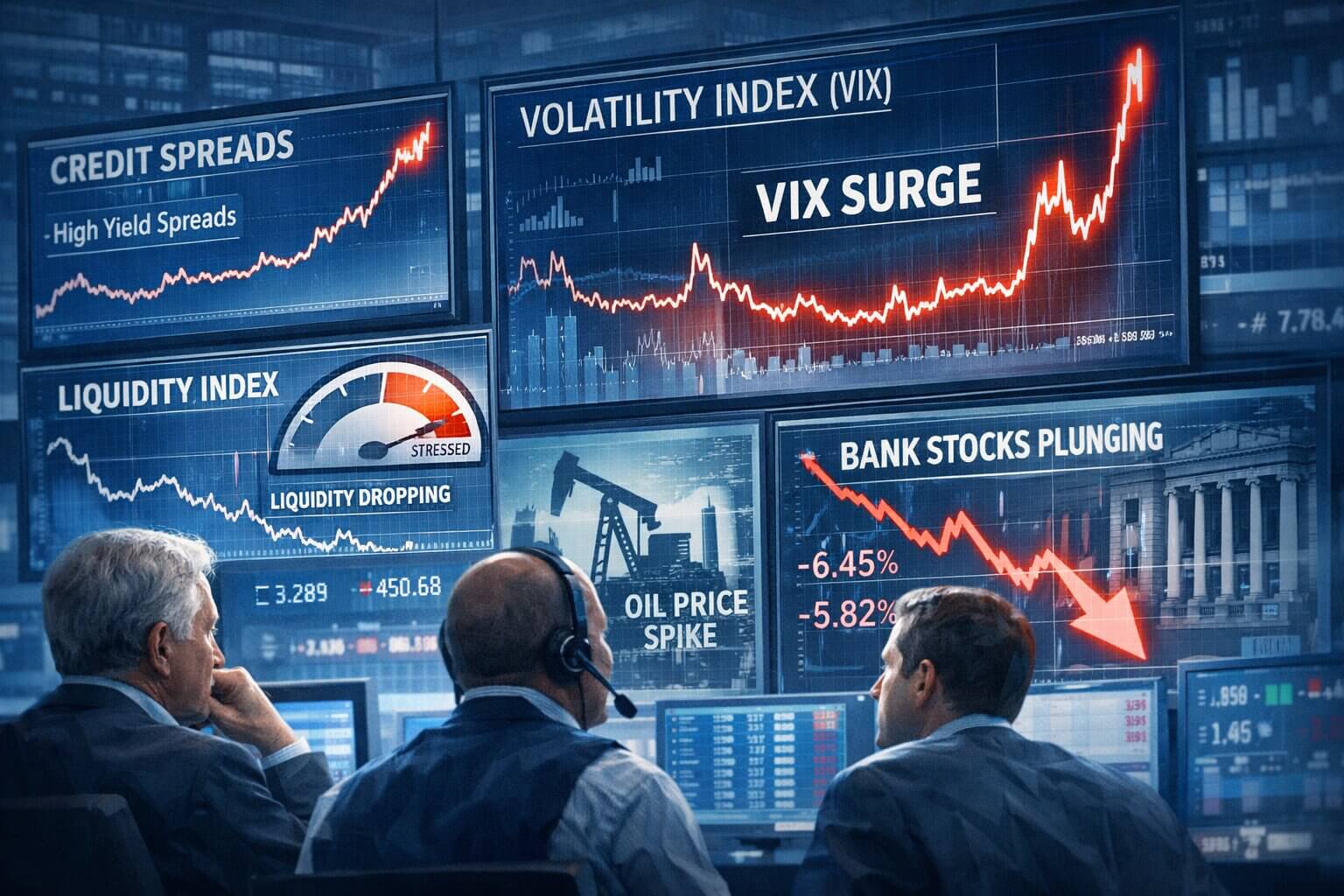
Financial markets rarely collapse without warning. Long before stock indexes tumble, professional investors tend to notice subtle shifts in credit markets, liquidity conditions, and volatility regimes.
These signals rarely make headlines immediately. But for hedge funds, banks, and institutional investors, they function as an early-warning system — the financial equivalent of a pressure gauge before a storm.
In early March 2026, several of those gauges began flashing yellow.
Concerns about stress in private credit markets, combined with geopolitical volatility tied to the Iran conflict and aggressive hedge fund positioning against financial stocks, have pushed investors to reassess systemic risk.
For professionals, the key question is not whether markets will experience volatility — they always do — but whether today’s signals resemble the early stages of a broader financial shock.
---
Credit Spreads — The Market’s First Warning System
Among institutional investors, credit markets are often viewed as the most sensitive indicator of financial stress.
Credit spreads — the extra yield investors demand to hold corporate debt over U.S. Treasurys — tend to widen when lenders begin to worry about default risk.
Equities often react later.
The reason is simple: lenders typically demand compensation for risk before shareholders begin selling stocks.
Private Credit Stress Enters the Picture
In 2026, attention has shifted toward a rapidly growing corner of global finance: private credit.
The roughly $2 trillion sector has expanded dramatically over the past decade as non-bank lenders filled the financing gap left by stricter bank regulations after the global financial crisis.
But recent developments suggest the market may be entering a period of stress.
On March 11, 2026, JPMorgan marked down the value of certain loans tied to private credit funds after reviewing exposure to software-sector borrowers. A day later, the bank moved to restrict lending against those assets, limiting leverage available to some borrowers.
The moves were not large enough to destabilize markets. Yet the signal mattered.
Loan markdowns are rare and typically occur only when lenders believe collateral values have deteriorated.
Publicly traded vehicles linked to private credit have also begun trading at notable discounts relative to their reported asset values — another sign that investors are questioning valuations.
Historically, widening credit spreads and declining loan valuations have preceded periods of equity market stress.
---
Liquidity Conditions — When Market Depth Starts to Disappear
Another signal professionals monitor closely is liquidity.
Markets appear stable when buyers and sellers can transact easily. But when liquidity begins to deteriorate, price swings can accelerate rapidly.
In early 2026, several private credit funds began limiting withdrawals as redemption requests surged.
Funds managed by Morgan Stanley and Cliffwater capped redemptions after investor requests exceeded their liquidity thresholds.
Such limits are typically designed to prevent forced asset sales.
However, they also highlight a structural issue: many private credit vehicles promise periodic liquidity while holding assets that can take months — or longer — to sell.
When redemption pressure rises, those mismatches become visible.
Liquidity stress in one part of the financial system does not always lead to a crisis.
But it often reveals where leverage and funding conditions may be tightening.
---
Volatility Regimes — The Signal Behind the VIX
Volatility itself can also provide important clues.
Professional investors often talk about “volatility regimes” — extended periods when markets operate under different levels of uncertainty.
During calm regimes, volatility measures such as the VIX remain low and stable.
But when systemic risks begin to emerge, volatility tends to cluster and rise across asset classes.
That pattern has started to appear in recent weeks.
Energy prices surged following geopolitical tensions tied to the Iran conflict, pushing inflation expectations higher and adding uncertainty to global markets.
At the same time, hedge funds aggressively shorted financial stocks during the week ended March 13, 2026, according to a Goldman Sachs client note.
Financial companies often serve as proxies for broader credit conditions. When investors become worried about credit stress, bank and financial stocks frequently become hedging vehicles.
The result can be a feedback loop in which volatility spreads from credit markets to equities.
---
The Smart Money Dashboard
Institutional investors typically track a range of indicators simultaneously rather than relying on any single signal.
Among the most widely monitored metrics:
Credit Indicators
- Corporate credit spreads versus Treasurys
- Loan pricing in leveraged and private credit markets
- Discounts to net asset value in credit funds
Liquidity Measures
- Redemption pressure in semi-liquid funds
- Funding spreads and repo market conditions
- Market depth in corporate bond trading
Volatility Signals
- Volatility index levels and term structure
- Cross-asset volatility (rates, equities, commodities)
- Options demand for downside protection
When several of these indicators begin moving in the same direction, professional investors pay close attention.
---
What Investors Should Watch Next
None of the recent developments necessarily imply that a market crash is imminent.
Credit markets regularly experience bouts of stress without triggering broader financial instability.
But the combination of private credit concerns, rising volatility, and heavy hedge fund positioning against financial stocks has prompted institutional investors to reassess risk.
In modern markets, systemic stress rarely emerges overnight.
Instead, it tends to develop gradually — through widening spreads, tightening liquidity, and shifts in investor behavior.
For professional investors, those signals are less about predicting the exact timing of a crash and more about recognizing when financial conditions are deteriorating.
The real advantage of “smart money” may simply be that it pays attention to these warning lights before they reach the front page.
---
FAQ
What are credit spreads and why do they matter?
Credit spreads measure the extra yield investors demand to hold corporate bonds instead of U.S. Treasurys. When spreads widen, it typically indicates rising concerns about corporate defaults or economic stress.
Why does liquidity matter in financial markets?
Liquidity determines how easily assets can be bought or sold without moving prices significantly. When liquidity deteriorates, markets can experience sudden and severe price swings.
What role does the VIX play in market risk?
The VIX reflects expectations of future volatility in the S&P 500. Rising VIX levels often signal increased uncertainty or demand for downside protection.
Does stress in private credit threaten the broader financial system?
Private credit markets are large and interconnected with banks and institutional investors. While stress does not always lead to systemic risk, problems in the sector can influence broader credit conditions.
---
Sources and Further Reading
- JPMorgan marks down loan portfolios of private credit groups — Reuters — 03/11/2026 — https://www.reuters.com/business/finance/jpmorgan-marks-down-loan-portfolios-private-credit-groups-ft-reports-2026-03-11/
- JPMorgan restricts lending to private credit firms after markdowns — Reuters — 03/12/2026 — https://www.reuters.com/business/finance/jpmorgan-restricts-private-credit-lending-after-markdowns-bloomberg-news-reports-2026-03-12/
- Private credit funds slide as investors sell out — Reuters — 03/12/2026 — https://www.reuters.com/business/finance/private-credit-funds-slide-investors-sell-out-2026-03-12/
- Hedge funds aggressively short financial stocks — Reuters — 03/16/2026 — https://www.reuters.com/sustainability/boards-policy-regulation/hedge-funds-aggressively-short-financial-stocks-says-goldman-2026-03-16/
- Morgan Stanley and Cliffwater limit private credit withdrawals — Financial Times — 03/12/2026 — https://www.ft.com/content/22454850-a7da-4089-af17-a223fa11f31f
- Private credit woes come for Larry Fink’s legacy — Reuters Breakingviews — 03/06/2026 — https://www.reuters.com/commentary/breakingviews/private-credit-woes-come-larry-finks-legacy-2026-03-06/
---