Personal Finance
Trading vs. Investing: Why Time Horizon Is Back at the Center of U.S. Markets
As volatility returns and retail participation cools, investors are rethinking the difference between short-term trading and long-term investing.
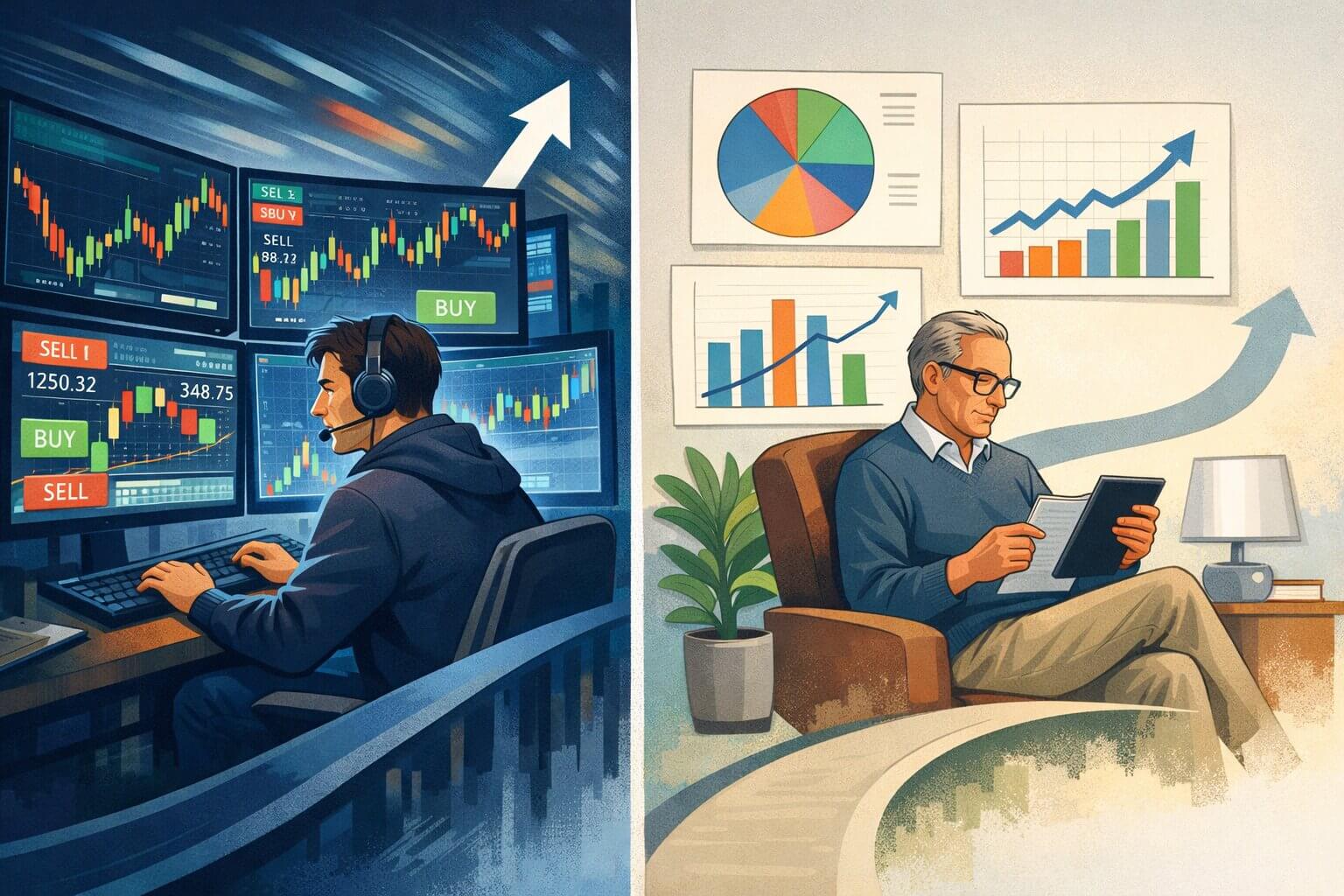
For much of the early 2020s, the line between trading and investing blurred. Zero-commission brokerages, pandemic stimulus liquidity, and social-media driven speculation helped millions of Americans treat financial markets like fast-moving arenas of opportunity.
But by early 2026, the tone of the market has shifted. Higher interest rates, uneven equity performance, and a measurable slowdown in retail trading activity have pushed investors to reassess risk and time horizon. Assets in money market funds surged to more than $6 trillion in late 2024, according to Federal Reserve data, reflecting growing demand for short-duration and lower-risk instruments. Meanwhile, surveys from major brokerage platforms suggest many retail investors are trading less frequently than during the speculative peak of 2021–2022.
Against this backdrop, a fundamental question is re-emerging across portfolio discussions: what is the real difference between trading and investing?
At first glance, the two appear similar—they both involve buying and selling financial assets. In practice, however, they reflect fundamentally different approaches to time horizon, decision-making, risk tolerance, and portfolio construction.
Understanding those distinctions is increasingly critical in a market where volatility is no longer an anomaly, but a structural feature.
---
The Core Difference: Time Horizon
The simplest distinction between trading and investing is time horizon.
Investors typically buy assets with the expectation of holding them for years or even decades. Their decisions are driven by long-term fundamentals: corporate earnings growth, macroeconomic trends, and the power of compounding returns.
Traders, by contrast, operate on shorter timeframes—from minutes to weeks. Their focus is less about long-term value and more about price movements, market sentiment, and technical signals.
This difference shapes everything from research methods to emotional discipline.
Investing: Compounding Over Time
Long-term investing is built on the premise that financial markets reward patience. Historical data supports that view. The S&P 500 delivered an annualized return of roughly 10% between 1928 and 2024, according to market research compiled by NYU Stern.
Investors typically allocate capital across diversified portfolios of equities, bonds, and other assets, rebalancing periodically but avoiding frequent trades.
Key characteristics of investing include:
- Long holding periods (years to decades)
- Fundamental analysis of companies or economies
- Diversification across asset classes
- Lower trading frequency
- Focus on compounding returns
For retirement savers, pension funds, and endowments, this framework remains the dominant model.
Trading: Capturing Short-Term Price Moves
Trading, on the other hand, seeks to exploit short-term market inefficiencies.
Traders rely heavily on:
- Technical analysis
- Price momentum
- Volatility signals
- Market liquidity
Holding periods may last hours, days, or weeks.
While successful trading strategies exist, they typically require constant monitoring, strict risk management, and significant expertise. Transaction costs, slippage, and emotional decision-making can erode performance quickly.
---
Strategy and Decision-Making: Two Different Mindsets
Beyond time horizon, the two approaches demand fundamentally different decision frameworks.
The Investor’s Approach
Investors prioritize economic narratives and business fundamentals.
Questions guiding their decisions include:
- Is this company growing earnings sustainably?
- Does the valuation make sense relative to long-term growth?
- How does this asset fit within the broader portfolio?
Investing decisions therefore tend to be deliberate and infrequent, guided by long-term thesis development.
The Trader’s Approach
Traders focus on market behavior rather than intrinsic value.
Their decisions revolve around:
- Entry and exit points
- Technical indicators
- Liquidity flows
- Event-driven catalysts
Speed becomes an essential component of the process. The goal is not to own a great company for decades, but to profit from price fluctuations.
---
Risk Tolerance and Capital Allocation
Risk management also differs dramatically between trading and investing.
Investors: Managing Long-Term Risk
Investors typically mitigate risk through:
- Diversification
- Asset allocation
- Long holding periods
Because their horizon extends over years, short-term volatility is often tolerated as part of the broader market cycle.
Traders: Managing Immediate Risk
Traders face a different set of risks. Rapid position turnover exposes them to:
- Leverage amplification
- Liquidity shocks
- Short-term volatility spikes
Professional traders often rely on strict stop-loss rules and position sizing models to limit losses.
However, retail traders frequently underestimate these risks.
During the retail trading boom of 2020–2021, many new market participants used options and leveraged products without fully understanding the downside scenarios. Regulators and brokerage firms have since increased warnings about derivatives risks.
---
Where Investors Often Go Wrong
The most common mistake in markets is not choosing the wrong asset—it is choosing the wrong strategy for one’s temperament and time horizon.
Three errors appear repeatedly among retail investors.
1. Overtrading
Frequent buying and selling can erode returns through transaction costs, taxes, and poor timing. Academic studies have repeatedly shown that the most active retail traders often underperform the broader market.
2. Leverage Misuse
Margin trading and options strategies can magnify gains—but also accelerate losses. In volatile markets, leverage quickly becomes a destabilizing force.
3. Horizon Mismatch
Many investors claim to be long-term investors but react emotionally to short-term price swings.
This mismatch leads to classic behavioral mistakes:
- Selling during market drawdowns
- Buying after speculative rallies
- Abandoning long-term strategies prematurely
Behavioral finance research has consistently shown that investor psychology—rather than market structure—is often the largest driver of underperformance.
---
Why the Debate Matters Again in 2026
The renewed interest in trading versus investing reflects broader changes in the macro environment.
Several trends have reshaped investor behavior:
Higher interest rates. After the Federal Reserve raised rates aggressively between 2022 and 2023, risk-free yields increased dramatically compared with the near-zero environment of the previous decade.
Volatility normalization. Equity markets have experienced sharper rotations between sectors and asset classes since 2024, making short-term trading both more tempting and more dangerous.
Retail participation shifts. Data from brokerage platforms suggests that the surge of retail speculation seen during the pandemic has moderated as stimulus liquidity faded.
As a result, investors are once again focusing on portfolio construction rather than rapid trading opportunities.
---
Choosing the Right Approach
In reality, trading and investing are not mutually exclusive.
Professional asset managers often combine elements of both strategies. A portfolio might be built around long-term investments while allowing a smaller allocation for tactical trading opportunities.
However, the key question remains psychological rather than technical.
Can the investor tolerate volatility and maintain discipline?
For many individuals, long-term investing provides a more sustainable framework. Trading, while potentially profitable, demands time, skill, and emotional control that few retail participants consistently maintain.
In a market environment where uncertainty has returned, rediscovering the difference between these two approaches may prove as valuable as any individual stock pick.
For investors navigating the next phase of market cycles, the lesson is simple: strategy should match time horizon—and temperament.
---
FAQ
What is the main difference between trading and investing?
The primary difference is time horizon. Trading focuses on short-term price movements, often holding assets for hours or days. Investing focuses on long-term value creation, typically holding assets for years.
Is trading riskier than investing?
Generally yes. Trading often involves higher leverage, frequent transactions, and exposure to short-term volatility, which can increase the probability of losses.
Can someone be both a trader and an investor?
Yes. Many professionals maintain long-term investment portfolios while allocating a smaller portion of capital to tactical or short-term trading strategies.
Why do retail investors often underperform the market?
Research suggests behavioral biases—such as overtrading, panic selling, and chasing momentum—are major contributors to underperformance.
---
Sources and Further Reading
- Retail Trading and Market Quality — U.S. Securities and Exchange Commission — 01/26/2021 — https://www.sec.gov
- Money Market Fund Assets Data — Federal Reserve — 12/2024 — https://www.federalreserve.gov
- Historical Returns of the S&P 500 — NYU Stern School of Business — Updated 01/2025 — https://pages.stern.nyu.edu
- Retail Investor Behavior and Trading Activity — FINRA Investor Education Foundation — 10/2023 — https://www.finrafoundation.org
- U.S. Household Equity Ownership Trends — Federal Reserve Survey of Consumer Finances — 10/2023 — https://www.federalreserve.gov
- Pandemic Retail Trading Boom Analysis — Reuters — 06/15/2023 — https://www.reuters.com
---