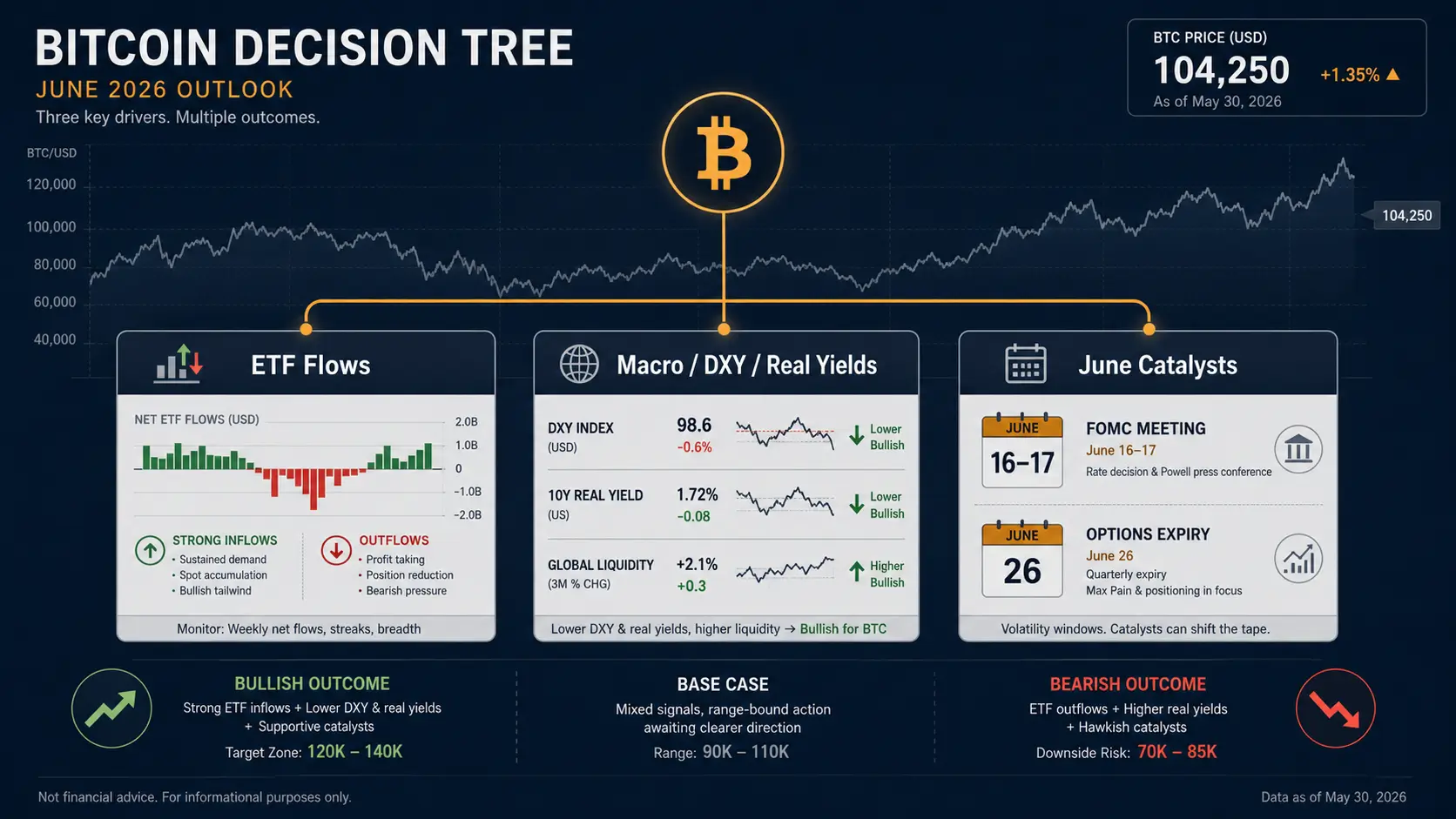
The bitcoin price outlook June 2026 is less about guessing a headline price target and more about reading three pressure points at the same time: institutional flows, macro liquidity and June’s catalyst calendar.
May did not give Bitcoin a clean signal. Washington moved closer to a clearer digital-asset framework. U.S. spot Bitcoin ETFs still saw heavy redemptions. Inflation data pushed the Federal Reserve back toward caution. That combination makes June a decision-tree month, not a conviction month.
For investors, the question is not whether Bitcoin is “bullish” or “bearish.” The better question is which force dominates first.
Force One: The Post-CLARITY Trade Is Not Purely Bullish
The biggest policy event in May was the Senate Banking Committee’s May 14, 2026 advance of the CLARITY Act, a crypto market-structure bill that would clarify regulatory jurisdiction over digital assets. That matters because institutional investors dislike legal ambiguity more than volatility.
But the market reaction exposed a gap between regulatory progress and actual demand.
During the week reported on May 26, 2026, digital asset investment products recorded $1.47 billion in outflows. Bitcoin products accounted for $1.32 billion of that total, and the 11 U.S.-listed spot Bitcoin ETFs saw about $1.26 billion in withdrawals.
That is the core lesson from May: policy clarity can improve the long-term investability of crypto without forcing immediate buying.
The institutional flow channel now has two branches. If ETF outflows slow in early June, the CLARITY narrative can regain importance because investors may treat regulation as a reason to rebuild exposure. If outflows continue, the policy win becomes background noise.
Stablecoin reserve mechanics add another layer. The 2025 stablecoin framework and the CLARITY debate pull crypto closer to Treasury-market plumbing. That can make the ecosystem more acceptable to institutions, but it also ties digital-asset liquidity more closely to dollar funding, short-term rates and collateral demand.
That is why Bitcoin’s post-ETF era is different from earlier cycles. The asset is still scarce, but the access points are increasingly institutional. Our earlier breakdown of Bitcoin after ETFs remains central to this June setup: the wrapper now matters almost as much as the coin.
Force Two: PCE Keeps the Dollar and Real Yields in Control
Macro is the second force because Bitcoin is trading less like an isolated crypto asset and more like a high-duration liquidity asset.
The April 2026 PCE report, released on May 28, showed the PCE price index up 3.8% from a year earlier. Core PCE rose 3.3%. Real disposable personal income fell 0.5% month over month, while the personal saving rate stood at 2.6%.
That mix matters for Bitcoin because it limits the market’s ability to price an easy Fed pivot. A stronger dollar, firmer real yields or a more hawkish June Fed meeting can all pressure Bitcoin even when crypto-specific policy news is positive.
The practical test for June is simple. If DXY and real yields fall after incoming labor and inflation data, Bitcoin gets room to behave like a risk asset again. If DXY and real yields rise together, ETF buyers may stay cautious and leveraged crypto positioning may remain defensive.
That does not mean Bitcoin must fall when yields rise. It means the hurdle for upside becomes higher. The market needs either renewed ETF accumulation, a softer Fed signal, or a clear rotation back into risk.
This is also where Bitcoin differs from fiat-currency hedging narratives. Bitcoin can benefit from long-term concerns about currency debasement, but in short windows it still reacts to dollar liquidity. The tension between those two ideas is why Bitcoin versus fiat currencies is no longer just a philosophical debate. It is a portfolio-timing question.
Force Three: June Has Known Catalysts and Unverified Hype
June’s catalyst calendar has three layers.
The first is the Federal Reserve. The next FOMC meeting is scheduled for June 16–17, 2026, and it is associated with a Summary of Economic Projections. That makes the meeting more important than a routine hold-or-cut decision because the dot plot can change the market’s path for real rates.
The second is options positioning. Month-end and quarter-end options expiries can amplify short-term moves when spot price, dealer hedging and ETF flows line up in the same direction. The June 26, 2026 expiry should be watched as a volatility event, not as a standalone reason to buy or sell.
The third is ETF headline risk. New crypto ETF approvals can affect sentiment, especially if they validate broader regulated access to digital assets. But investors should separate verified approval dates from speculation. A confirmed approval can improve breadth. A rumored approval can fade quickly if macro remains tight.
That distinction matters for the bitcoin price outlook June 2026 because Bitcoin’s strongest scenario is not “more headlines.” It is alignment: stable ETF flows, softer dollar pressure and a Fed message that does not push real yields higher.
The June Decision Tree for Bitcoin
A constructive June setup would require three signals.
First, Bitcoin ETF outflows need to stabilize or reverse. Second, DXY and real yields need to stop tightening financial conditions. Third, the June Fed meeting needs to avoid a hawkish reset in rate expectations.
If those signals align, Bitcoin can rebuild momentum without needing a dramatic new narrative.
A neutral setup is more likely if ETF flows improve but macro remains restrictive. In that case, Bitcoin may trade as a tactical asset, with rallies capped by dollar strength and rate uncertainty.
The bearish setup is straightforward: continued ETF redemptions, firmer real yields and a Fed message that keeps cuts distant. That would make June less about adoption and more about liquidity stress.
The key takeaway is that May narrowed the question. Bitcoin has institutional structure, regulatory momentum and deeper ETF access. What it still needs in June is confirmation that investors are willing to add exposure while macro conditions remain demanding.
FAQ
What is the main bitcoin price outlook June 2026 signal to watch?
The cleanest signal is U.S. spot Bitcoin ETF flow stabilization. If redemptions slow or reverse in early June, Bitcoin has a stronger base for upside.
Does the CLARITY Act make Bitcoin automatically bullish?
No. The CLARITY Act can reduce long-term regulatory uncertainty, but May 2026 showed that ETF outflows can overpower policy optimism in the short term.
Why does PCE inflation matter for Bitcoin?
PCE matters because it affects Fed expectations, real yields and the dollar. Higher inflation can keep monetary policy restrictive, which can pressure Bitcoin’s liquidity-sensitive demand.
What are the biggest June 2026 Bitcoin catalysts?
The main catalysts are the June 16–17 FOMC meeting, month-end options expiry on June 26 and any verified crypto ETF approval developments.
Sources and Further Reading
- U.S. Senate committee advances crypto bill in milestone for digital assets — Reuters — 05/14/2026 — https://www.reuters.com/legal/transactional/us-senate-committee-weigh-crypto-bill-milestone-digital-assets-2026-05-14/ ([Reuters][1])
- Bitcoin ETFs crushed by outflows as bond market stifles rate-cut hopes — CoinDesk — 05/26/2026 — https://www.coindesk.com/daybook-us/2026/05/26/bitcoin-etfs-crushed-by-billions-in-outflows-as-treasuries-stifle-interest-rate-cut-hopes ([CoinDesk][2])
- Personal Income and Outlays, April 2026 — U.S. Bureau of Economic Analysis — 05/28/2026 — https://www.bea.gov/news/2026/personal-income-and-outlays-april-2026 ([Bureau of Economic Analysis][3])
- Investors expect U.S. dollar to break higher as Fed battles inflation — Reuters — 05/27/2026 — https://www.reuters.com/world/africa/investors-expect-us-dollar-break-higher-fed-battles-inflation-2026-05-27/ ([Reuters][4])
- The Fed: Meeting calendars and information — Federal Reserve — 2026 calendar — https://www.federalreserve.gov/monetarypolicy/fomccalendars.htm ([Federal Reserve][5])