The Fed’s rate-cut debate just became harder to trade.
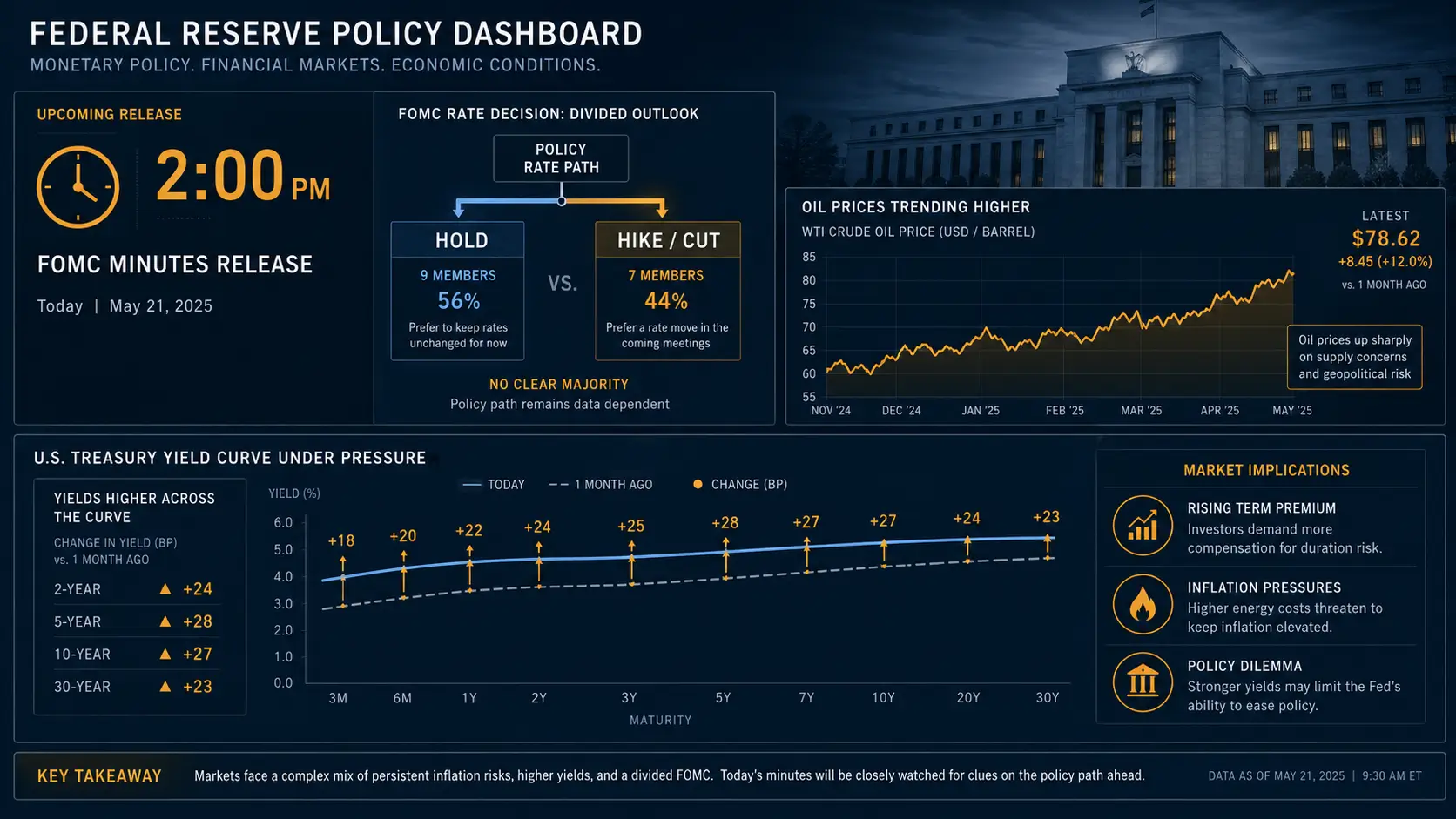
The fomc minutes may 2026 release, due at 2:00 p.m. ET on 05/20/2026, will give investors the clearest look yet at how divided Jerome Powell’s final committee meeting became before Kevin Warsh takes over the central bank’s June decision.
This is not a routine minutes release. At the April 28-29 meeting, the Federal Open Market Committee held the federal funds rate at 3.50% to 3.75%. But four officials dissented, exposing a split that matters directly for Treasurys, mortgage rates, growth stocks, bank shares, and any portfolio positioned for easier policy.
The market question is simple: was April a messy pause, or the start of a more hawkish Fed reset?
FOMC Minutes May 2026 Signal No. 1: The Dissent Map
The first thing to watch is not whether the Fed held rates. That is already known.
The real signal is how many officials sounded uncomfortable with the policy message.
The April statement showed one dissent from Governor Stephen Miran, who preferred a 25-basis-point cut. Three other officials — Beth Hammack, Neel Kashkari, and Lorie Logan — supported holding rates but opposed keeping language that implied future cuts were still on the table.
That split creates two different risks for markets.
If the minutes show only a narrow group wanted tougher guidance, investors may read April as a transition meeting distorted by leadership change. That would keep a late-2026 cut scenario alive.
If the minutes show broader concern about inflation persistence, the reaction could be different. A wider hawkish bloc would make the June 16-17 meeting less about Warsh’s preference and more about whether the committee is willing to remove its easing bias altogether.
That is why the dissent map matters more than the headline rate decision. For readers who need the basic mechanics, AlphaPulse’s guide to how the Fed sets interest rates explains why committee language can move markets even when rates do not change.
Signal No. 2: Oil, Yields, and the Inflation Bar
The second signal is how the minutes describe the oil shock and Treasury yield spike.
The April statement said inflation reflected the increase in global energy prices and that Middle East developments were creating uncertainty around the outlook. Since then, the rate-cut story has weakened.
Reuters reported on 05/19/2026 that the 10-year Treasury yield had moved above 4.6%, while futures markets were narrowly pricing a 25-basis-point hike by the end of January 2027. That matters because the market is no longer debating only how soon cuts arrive. It is debating whether the next Fed move could eventually be up.
The minutes should show whether officials viewed the oil shock as temporary or as a risk that could bleed into broader prices.
That distinction is critical.
A temporary-energy-shock reading supports patience. The Fed can wait, avoid overreacting to oil, and keep future cuts possible if inflation cools.
A persistence reading raises the bar for cuts. It tells investors that the committee may need more than one softer inflation print before it considers easing again.
The practical consequence is direct: rate-sensitive trades become harder to justify if the minutes frame inflation as spreading beyond energy. Long-duration tech, housing-linked names, and bond portfolios would all face a less forgiving discount-rate backdrop.
Signal No. 3: Warsh’s Forward-Guidance Fingerprints
The third signal is forward guidance.
Warsh has not yet chaired a meeting, but the May minutes could still define the room he walks into on June 16-17. The key phrase to watch is whether officials still want language that leaves cuts as the next likely move.
If the minutes show deep discomfort with that easing bias, Warsh may inherit a committee already leaning toward neutral or even two-sided guidance. That would make June less about a dramatic leadership pivot and more about formalizing a shift that began under Powell.
If the minutes show the opposition was limited to the three dissenters, Warsh could have more room to shape the message himself.
This matters because investors often focus too much on personalities and too little on the committee’s constraint set. A new chair can change tone. A new chair cannot ignore inflation data, bond yields, dissents, and the Summary of Economic Projections arriving at the same June meeting.
For portfolios, the decision point is not whether Warsh is “dovish” or “hawkish.” It is whether the June Fed can credibly keep cuts on the table while inflation remains above target and yields are already tightening financial conditions.
That is the same tension behind AlphaPulse’s broader Fed rate cuts 2026 investor guide.
What Markets Should Watch After 2 p.m.
The strongest market reaction would likely come from one of three surprises.
First, the minutes could show that more officials wanted to remove easing language than the formal dissents suggested. That would pressure the front end of the Treasury curve and weaken cut-sensitive equity trades.
Second, the minutes could show officials still viewed the oil shock as temporary. That would support the idea that the Fed is waiting, not pivoting hawkishly.
Third, the minutes could point to June as a meeting where guidance changes even if rates stay unchanged.
The base case remains a hold. But the risk around that hold has changed. The May minutes may not answer where rates go next, but they can show whether the Fed’s center of gravity has moved before Warsh gets the gavel.
If the 2 p.m. release shows a wider inflation-first coalition, markets may have to price a Fed that is not just delaying cuts — but questioning whether cuts still belong in the 2026 story.
FAQ
What time are the FOMC minutes released today? The minutes from the April 28-29, 2026 FOMC meeting are scheduled for release at 2:00 p.m. ET on 05/20/2026.
Why do the FOMC minutes matter if the rate decision is already known? The minutes reveal the debate behind the decision. Investors watch them for signs of how many officials support cuts, holds, hikes, or changes in forward guidance.
What was the Fed’s rate decision in April 2026? The Fed held the federal funds rate at a target range of 3.50% to 3.75% on 04/29/2026.
What is the main market risk in the May 2026 FOMC minutes? The main risk is that the minutes show broader concern about inflation persistence, making 2026 rate cuts less likely and keeping pressure on rate-sensitive assets.
Sources and Further Reading
- Federal Reserve Calendar: May 2026 — Federal Reserve — 05/20/2026 — https://www.federalreserve.gov/newsevents/2026-may.htm ([Federal Reserve][1])
- Federal Reserve issues FOMC statement — Federal Reserve — 04/29/2026 — https://www.federalreserve.gov/newsevents/pressreleases/monetary20260429a.htm ([Federal Reserve][2])