Business owners, managers, and investors often ask how interest rates affect hiring decisions because the connection is not always visible in a single payroll report.
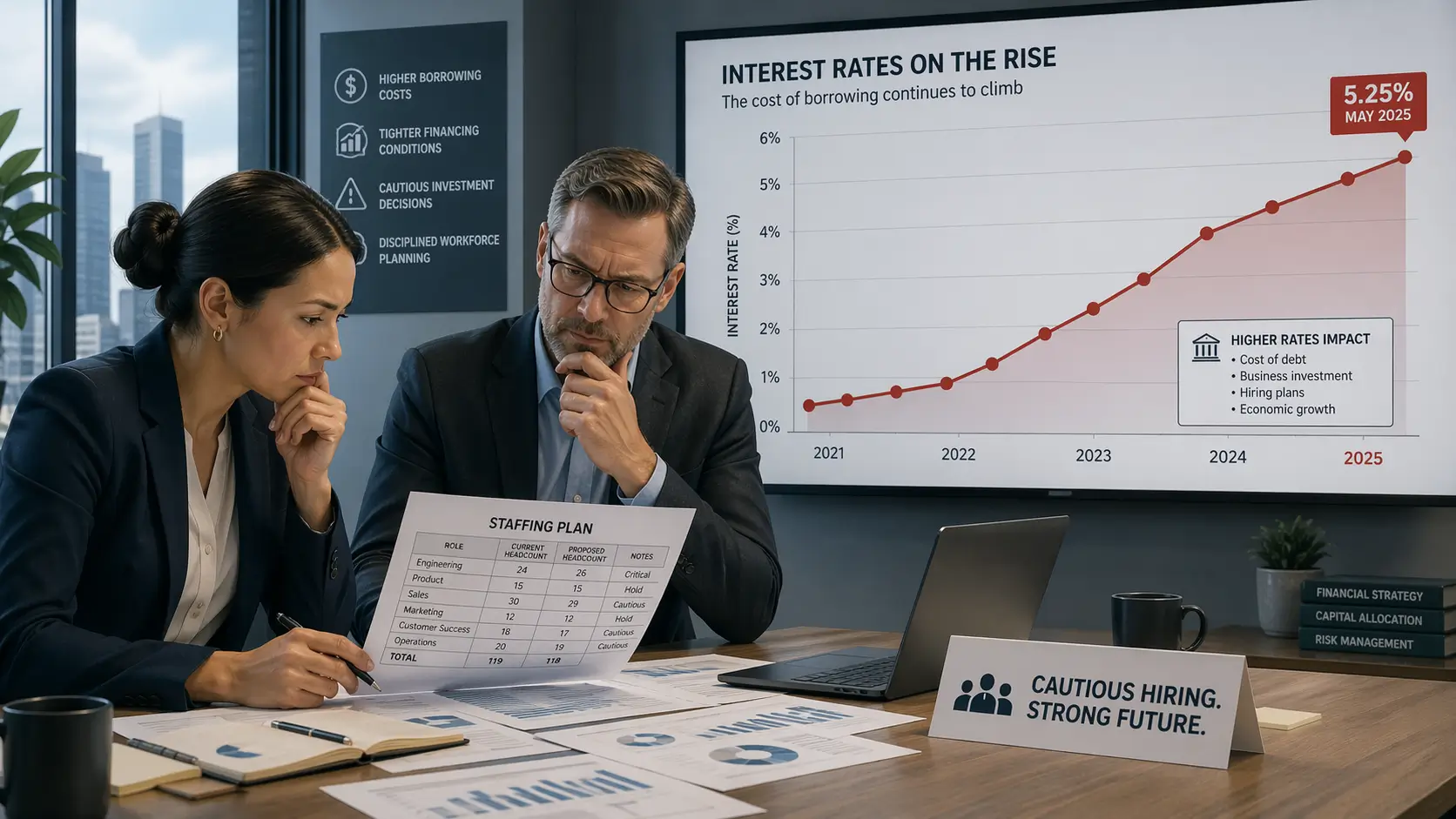
The answer is that interest rates change the cost of growth. When financing costs rise, companies rethink expansion, debt refinancing, inventory, equipment purchases, and payroll commitments. Hiring usually slows before layoffs rise because adding workers is easier to delay than cutting trained employees.
That pattern matters again in 2026. On 05/08/2026, the U.S. Bureau of Labor Statistics reported that nonfarm payrolls increased by 115,000 in April 2026, while the unemployment rate stayed at 4.3%. Average hourly earnings rose 0.2% in April and 3.6% over the year. The labor market is not collapsing, but hiring momentum is more selective.
Why Interest Rates Influence Hiring in the First Place
Interest rates determine how expensive it is for companies to borrow money. That affects hiring because many business plans depend on financing before they produce revenue.
Companies often use debt or credit lines to open locations, buy machinery, expand warehouses, build inventory, or hire teams before sales materialize. When the cost of that capital rises, each new employee has to clear a higher financial hurdle.
That is why payroll becomes part of the capital-allocation process.
Common adjustments include:
- Reducing recruitment plans
- Delaying expansion projects
- Preserving cash reserves
- Prioritizing revenue-producing roles
- Replacing full-time hiring with contract or part-time labor
Payroll is one of the most flexible costs in a company budget. A lease, loan, or equipment contract may be difficult to change quickly. A job posting can be paused immediately.
For investors, that makes hiring behavior an early signal of corporate caution.
How Debt and Refinancing Costs Shape Workforce Planning
Debt is one of the strongest links between interest rates and employment decisions.
Many companies borrow when rates are lower, then refinance when loans mature. If the new rate is costlier, debt service absorbs more cash even if revenue has not changed. That leaves less room for headcount growth, bonuses, training, and wage increases.
The Federal Reserve kept the federal funds target range at 3.50% to 3.75% on 04/29/2026 and said it would assess incoming data, the economic outlook, and the balance of risks before making additional adjustments. That policy stance keeps financing decisions closely tied to inflation and labor-market data.
The credit channel also matters. In the Fed’s April 2026 Senior Loan Officer Opinion Survey, banks reported tighter lending standards for commercial and industrial loans to firms of all sizes during the first quarter of 2026. Banks also reported weaker or basically unchanged demand for commercial real estate loans.
That combination can affect hiring in two ways. Some firms cannot borrow as easily. Others can borrow, but decide not to expand until demand or financing conditions improve.
Why Hiring Can Slow Without a Recession
A slower hiring pace does not automatically mean companies are preparing for mass layoffs.
The March 2026 JOLTS report, released on 05/05/2026, showed job openings unchanged at 6.9 million, hires rising to 5.6 million, and layoffs and discharges little changed at 1.9 million. That is a labor market where firms are still hiring, but the pace is uneven across industries.
This is where “labor hoarding” matters. Companies may avoid layoffs because replacing experienced workers later can be expensive. Instead, they slow new hiring, leave some roles unfilled, and try to raise productivity with existing staff.
That strategy is especially common when demand is uncertain but not weak enough to justify broad job cuts.
For managers, labor hoarding protects operating capacity. For investors, it signals caution rather than immediate distress. The risk is that if financing costs remain restrictive and sales weaken, hiring freezes can eventually turn into workforce reductions.
Why This Matters Again Now
The 2026 labor signal is not only about interest rates. It is about the interaction between financing costs, inflation pressure, and weaker expansion plans.
Small businesses show that tension clearly. NFIB reported on 05/12/2026 that its Small Business Optimism Index rose slightly to 95.9 in April 2026, still below its 52-year average of 98.0. Its Employment Index fell from 101.6 to 100.4, the second consecutive monthly decline, while only 7% of owners said April was a good time to expand.
That is the practical hiring channel in one snapshot: firms still need workers, but fewer feel confident enough to expand aggressively.
For business leaders, the implication is direct. Hiring plans should be tied to cash-flow coverage, debt maturity schedules, and revenue visibility. For investors, the important signal is whether companies are cutting jobs or simply refusing to add new payroll obligations.
Those are very different economic messages.
Practical Steps Businesses Take in a High-Rate Environment
When borrowing costs remain a constraint, companies usually shift from expansion to efficiency.
The most common actions include:
- Reviewing cash-flow projections
- Prioritizing roles tied directly to revenue
- Delaying nonessential hiring
- Monitoring debt maturities and refinancing dates
- Using automation to reduce repetitive work
- Holding larger cash buffers before committing to payroll growth
The goal is not always to stop hiring. The goal is to make each hire easier to defend financially.
A sales role with a clear payback period may still move forward. A support role for a future expansion may be delayed. A capital-heavy project may require a higher return threshold before management approves the team needed to run it.
That is how monetary policy moves from the Fed’s balance sheet into individual job postings.
Risks of Sustained High Interest Rates
High rates can be manageable for a few quarters. The risk grows when restrictive financing conditions last long enough to change business behavior.
Key risks include:
- Slower wage growth
- Fewer expansion projects
- Reduced training budgets
- Lower productivity investment
- More cautious small-business hiring
- Higher recession risk if demand weakens
The duration of restrictive rates matters more than the policy rate alone.
If companies believe borrowing costs will fall soon, they may postpone hiring rather than cancel it. If they believe financing will remain expensive, postponed hiring can become permanent cost control.
That is why labor-market reports, credit surveys, and small-business hiring plans should be read together. Payroll data shows what happened. Credit conditions help explain why it happened. Business sentiment helps indicate whether the next move is more hiring or deeper caution.
Conclusion: Hiring Decisions Reflect Financial Conditions
Interest rates affect hiring decisions because they affect the cost of growth.
When financing becomes more expensive or less available, businesses protect cash, delay expansion, and become more selective about payroll. That does not always mean the economy is entering a recession. It often means companies are managing risk before the income statement deteriorates.
The practical takeaway is simple: hiring trends are a financial signal, not just a labor signal.
The next risk to watch is whether April 2026 job openings, scheduled for release on 06/02/2026, confirm that employers are still hiring selectively — or show that cautious hiring is spreading into broader labor-market weakness.
FAQ
How do rising interest rates affect hiring decisions? Rising interest rates make borrowing more expensive, which raises the cost of expansion. Companies often respond by slowing hiring, prioritizing essential roles, and delaying projects that require new payroll commitments.
Why do companies freeze hiring instead of laying off workers? Companies may freeze hiring because retaining trained employees is often cheaper than cutting staff and rehiring later. This allows them to control costs without losing operational capacity.
Which industries are most affected by high interest rates? Construction, commercial real estate, manufacturing, technology startups, and small business services are usually more sensitive because they rely more heavily on loans, refinancing, or credit lines.
When do interest rates start affecting employment? The impact usually appears gradually. Hiring slows first, wage growth may moderate later, and layoffs become more likely only if restrictive financing conditions combine with weaker sales.
Sources and Further Reading
- Employment Situation Summary — U.S. Bureau of Labor Statistics — 05/08/2026 — https://www.bls.gov/news.release/empsit.nr0.htm ([Bureau of Labor Statistics][2])
- Job Openings and Labor Turnover — U.S. Bureau of Labor Statistics — 05/05/2026 — https://www.bls.gov/news.release/pdf/jolts.pdf ([Bureau of Labor Statistics][3])
- Federal Reserve Issues FOMC Statement — Federal Reserve Board — 04/29/2026 — https://www.federalreserve.gov/newsevents/pressreleases/monetary20260429a.htm ([Federal Reserve][4])
- The April 2026 Senior Loan Officer Opinion Survey — Federal Reserve Board — 05/04/2026 — https://www.federalreserve.gov/data/sloos/sloos-202604.htm ([Federal Reserve][5])