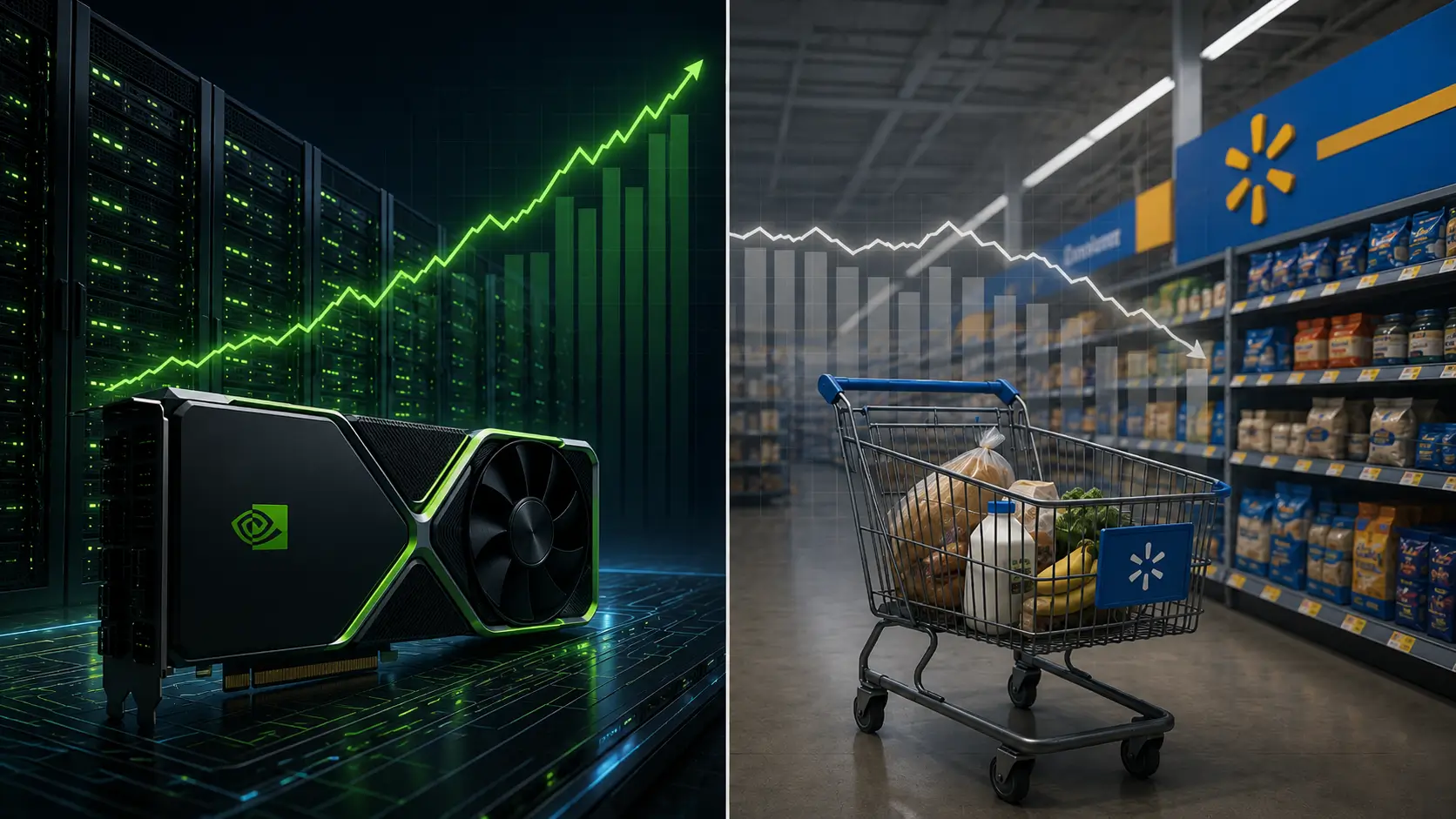
Nvidia just printed the strongest quarter in tech. Walmart's morning numbers show a consumer running out of room. Read together, the two prints describe a U.S. economy splitting into two engines firing at radically different speeds.
Nvidia earnings Q1 2027 landed Wednesday after the close at $81.6 billion in revenue, up 85.2% from a year ago and roughly $2.6 billion above the consensus of $79 billion. Non-GAAP gross margin printed at 75.0% — up from 60.8% in the year-ago quarter — and data center revenue hit a record $75.2 billion, +92% year over year. Management guided Q2 FY27 to $91 billion at the same 75.0% margin, without a dollar from China.
A few hours later, Walmart opened the other side of the economy. Heading into the print, the retailer guided Q1 FY27 sales growth of 3.5%–4.5% in constant currency on top of last year's $164 billion Q1 base. Consensus called for $174.8 billion in revenue, $0.66 EPS, and 3.9% U.S. comparable sales — with Wall Street focused on the traffic-versus-ticket split as the cleanest read on household budgets in the country.
Reading Nvidia's Q1 2027 print against the consumer
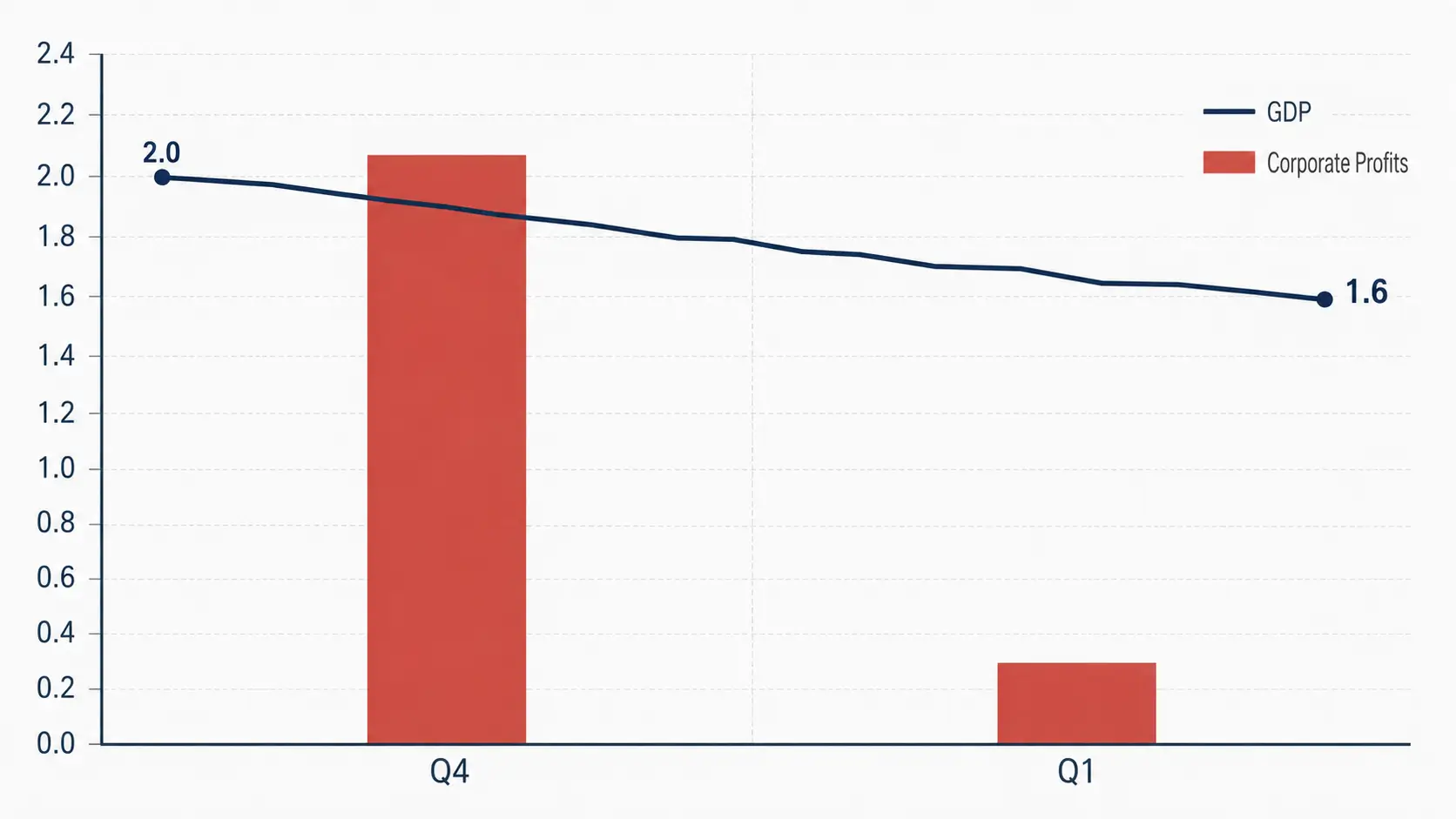
The Nvidia print is now the second straight quarter where non-GAAP gross margin has held at or above 75% while revenue grew 80%+ year over year. The most-cited U.S. consumer confidence surveys, by contrast, are running at their weakest readings since 1952.
The gap is structural, not cyclical. Hyperscaler capital spending is tracking toward roughly $700 billion in 2026, anchored by visible Blackwell demand and a Rubin ramp building into the second half. Walmart's last reported average ticket growth ex-fuel of 2.0% — barely above the company's preferred inflation read of 1.1% — is, by contrast, the weakest profile in the post-pandemic cycle. Higher-income trade-down has propped the comp number for several quarters running. Strength in the core base, it isn't.
For investors, the consequence is direct: the AI capex cycle is being financed by margin expansion at suppliers, while the consumer cycle is being financed by trade-down rather than wage growth. Those are not the same kind of strength.
The rotation problem isn't semis versus staples
Markets have already started pricing this. The Consumer Staples Select Sector SPDR (XLP) finished the first quarter up roughly 13% year to date, its best opening stretch in over a decade, while large-cap tech traded mostly sideways through February and March. What looked like a defensive rotation now reads more like a barbell — AI capex winners on one side, defensive shoppers on the other, with discretionary squeezed in the middle.
Framing this purely as semis-versus-staples misses the point. The real question is which side of the income statement is doing the spending. On Nvidia's customer list, the answer is the largest tech treasuries on the planet. On Walmart's, it's a stretched median household increasingly subsidized by trade-down from above. The first line will keep buying GPUs regardless of where the 10-year trades. The second line cannot. Investors revisiting positioning around the AI productivity playbook will need to weigh whether discretionary cyclicals can hold a bid into the back half.
Why the second-half setup gets harder
The cleanest forward-looking risk is concentration. Even with Nvidia's $91 billion Q2 guide, the AI capex thesis remains a story about five buyers. If hyperscaler commentary on July earnings calls tightens — and there are already signals that one or two are pacing 2027 commitments more carefully — the multiple on semis compresses fast. Cathie Wood's Ark funds trimming the SOXX position in May is one tell that institutional discipline is already kicking in at the margin.
On the consumer side, the Q2 setup looks worse than Q1. Tariff pass-through commentary from Walmart's call this morning will set the tone for Target, Costco, Dollar General, and Dollar Tree through June. If Walmart absorbs more, margins suffer. If it passes through, demand bends. Either path narrows the second-half EPS range for the entire discretionary complex.
Warsh inherits the worst possible configuration
The split arrives on Kevin Warsh's desk in the worst possible configuration. Confirmed by the Senate on May 13 in a 54-45 vote and sworn in May 15, the new Fed Chair holds his first FOMC meeting June 16–17, with the fed funds target sitting at 3.50%–3.75%. CPI rose 0.6% in April after 0.9% in March, putting goods inflation back in the picture just as AI infrastructure spending lifts services-side capex prices.
Cutting to support a weakening consumer risks re-igniting the inflation Warsh was nominated to discipline. Holding compounds pressure on a household sector already running on trade-down. The Nvidia–Walmart split is the first real policy test of the new regime. Watch the June dot plot — and the language around capex-led inflation in the press conference. More than any single comp number, that will tell investors which side of the split the Fed has chosen to favor.
FAQ
What were the key numbers from Nvidia earnings Q1 2027? Nvidia reported $81.6 billion in revenue (+85.2% year over year), non-GAAP EPS of $1.87, and a non-GAAP gross margin of 75.0% for the quarter ended April 2026. Data center revenue hit a record $75.2 billion, and Q2 FY27 guidance came in at $91 billion at the same margin.
Why does Walmart's print matter for the broader market? Walmart captures grocery spending from roughly 90% of U.S. households and is the cleanest single read on consumer health. Its comp sales, traffic-versus-ticket split, and tariff pass-through commentary set the tone for Costco, Target, Dollar General, and Dollar Tree heading into June reporting.
How does the AI capex vs. consumer split affect sector rotation? Strong AI capex supports semiconductors and large-cap tech, while consumer weakness lifts defensive staples. The squeeze sits in discretionary cyclicals — apparel, restaurants, and home — where neither tailwind applies. Many investors are now treating semis and staples as a barbell rather than a single rotation trade.
What does Kevin Warsh's first Fed meeting face? Warsh chairs the FOMC for the first time on June 16–17, 2026, with the fed funds target at 3.50%–3.75%. He inherits sticky inflation — April CPI rose 0.6% month over month — alongside a softening consumer, forcing a trade-off between disciplining capex-led inflation and supporting household spending.
Sources and Further Reading
- NVIDIA Announces Financial Results for First Quarter Fiscal 2027 — StockTitan — 05/20/2026 — https://www.stocktitan.net/news/NVDA/nvidia-announces-financial-results-for-first-quarter-fiscal-fq78amc9h84m.html
- Kevin Warsh wins Senate confirmation as the next Federal Reserve chair — CNBC — 05/13/2026 — https://www.cnbc.com/2026/05/13/kevin-warsh-wins-senate-confirmation-as-the-next-federal-reserve-chair.html
- Walmart (WMT) earnings Q1 2027 — CNBC — 05/21/2026 — https://www.cnbc.com/2026/05/21/walmart-wmt-earnings-q1-2027.html