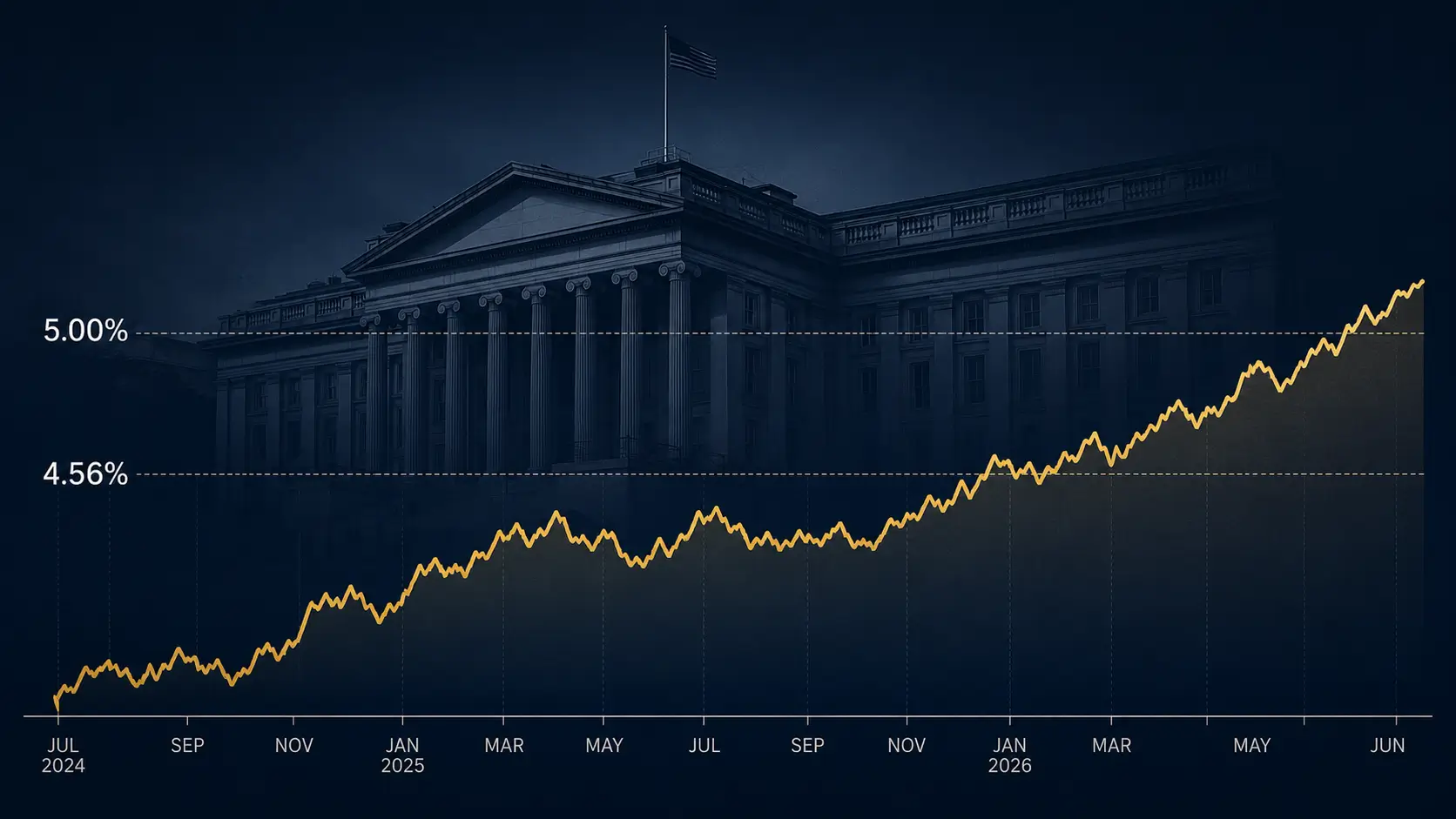
Treasury debt borrowing costs in 2026 are at a cycle high — three drivers say yields aren't done. The 10-year note closed at 4.56% on May 22, near the May peak. The 30-year sits near 4.95%, just below the 5% line that has historically marked the threshold for equity stress. The 2-year ended the session at 4.13%.
The risk for readers is not whether yields drift another five basis points. It is whether the next leg up extinguishes what remains of the rate-cut narrative for the full second half of 2026, with prediction markets already pricing the June 17 FOMC at 89%-97% probability of a hold.
Treasury Debt Borrowing Costs Climbed at the May Refunding
The May 12 auction of $42 billion in new 10-year notes priced at 4.468% — up from 4.282% in April and 4.217% in March. The bid-to-cover ratio fell to 2.13 from 2.45 in March, and the auction "tailed" by 5.5 basis points, meaning bidders demanded a yield well above the pre-auction level to clear the supply. In March, the same auction tailed only 0.7 basis points.
Indirect bidders — the category that captures foreign central banks and sovereign accounts — took 64.0% of the May auction, down from 74.5% in March. That ten-point drop in two months matters. It means primary dealers absorbed a larger share at a higher yield, which leaves less balance-sheet room for the August cycle. For readers tracking how supply pressure translates into rate moves, our primer on bond yields, duration, and convexity covers the mechanics in detail.
Inflation Expectations Are Locking In
The second driver is the inflation backdrop heading into Friday's April PCE release. The University of Michigan's final May reading showed one-year inflation expectations at 4.7% and the 5-to-10-year measure at 3.9% — the highest in seven months. Long-run expectations matter because they are the input the Fed watches most closely for signs of de-anchoring.
The April CPI print of 3.8% year-over-year — the highest reading since May 2023 — sets the floor for what PCE can plausibly show. Core PCE has been running near 3.2%, well above the Fed's 2% target. Consensus for the April release on Friday, May 29, expects core PCE between 3.1% and 3.3%. Anything at the high end or above will be read as confirmation that the inflation glide path has stalled, and the Treasury curve will reprice the front end accordingly.
Dealer Capacity Is the Quiet Constraint
The third driver is structural. Treasury securities held by the public have grown to roughly $24 trillion from $10 trillion over the decade through 2024 — a 139% increase — while primary dealer balance sheets grew only 29% over the same period, according to the Congressional Research Service. The Supplementary Leverage Ratio caps how much Treasury inventory bank-affiliated dealers can hold without burning regulatory capital.
That gap explains why softer indirect bidding shows up as a wider auction tail rather than supply absorbed quietly. Dealers do not have the room to warehouse paper at marginal yields. When foreign demand fades and dealers fill the gap, the clearing yield jumps. This is the mechanical reason Treasury borrowing costs are climbing even as the policy rate sits unchanged at 3.50%-3.75%. The August refunding carries a real risk of a tailed auction at higher absolute levels.
The Yield Level That Breaks the Cut Story
The April 29 FOMC vote was 8-4 to hold — the widest dissent on a single FOMC vote since October 1992 — with Governor Stephen Miran voting for a 25-basis-point cut. Polymarket now puts the probability of zero cuts across all of 2026 at 57%.
The yield level to watch is 4.75% on the 10-year. A close above that line, sustained for more than a week, would historically pull the 2-year above 4.30% and price the first cut into late Q4 or 2027. A break of 5% on the 30-year would tighten financial conditions enough to pressure mortgage rates above 7%, which the housing market — currently absorbing a 6.51% 30-year fixed per the latest Freddie Mac survey — cannot easily clear. The downstream effect on housing is why the 10-year yield and mortgage rate linkage deserves close attention this week.
The forward-looking risk: if Friday's PCE prints at or above 3.3% core, the 10-year takes out 4.60% on the open Monday, and the rate-cut narrative for the full second half of 2026 begins to evaporate. The market is not yet positioned for that outcome.
FAQ
Why are Treasury borrowing costs rising in 2026 if the Fed is on hold? The federal funds rate at 3.50%-3.75% anchors the short end, but the 10-year and 30-year reflect supply, inflation expectations, and dealer balance-sheet capacity. All three are working against bond prices in May 2026, pushing yields higher even with no change in the policy rate.
What 10-year Treasury yield level would delay Fed rate cuts further? A sustained close above 4.75% on the 10-year would typically pull the 2-year above 4.30% and shift the first-cut expectation from Q3 into late Q4 or 2027. Prediction markets already price 57% probability of zero cuts in 2026.
Why does an auction "tail" matter for non-bond investors? A wide tail — like the 5.5 basis points seen on May 12 — means bidders demanded a higher yield than the pre-auction market suggested. That gap flows directly into mortgage rates, corporate bond pricing, and equity discount rates within hours.
When is the next critical inflation data release? The Bureau of Economic Analysis releases the April Personal Consumption Expenditures price index on Friday, May 29, 2026. Core PCE consensus sits between 3.1% and 3.3%; a print at or above 3.3% would likely push 10-year yields toward 4.60%.
Sources and Further Reading
- Quarterly Refunding Statement of Deputy Assistant Secretary Brian Smith — U.S. Department of the Treasury — 05/06/2026 — https://home.treasury.gov/news/press-releases/sb0489
- U.S. 10-Year Treasury Auction Results (May 12, 2026) — Dukascopy Bank — 05/12/2026 — https://www.dukascopy.com/swiss/english/marketwatch/market-news/Market-News-and-Research/154993
- Treasury Market Disruptions and Policy Options (R48734) — Congressional Research Service — 11/21/2025 — https://www.congress.gov/crs-product/R48734